The Crypto Lenders Collapse: 16 Steps From Freeze to Sentencing
In one summer of 2022, the platforms that promised double-digit yields on your crypto locked the doors: Celsius first, then Voyager, then BlockFi. This guide walks the whole contagion line — Terra, the withdrawal freezes, the Chapter 11 filings, the recoveries, and the 2025 courtroom finale — using the archived announcements and court records themselves.
12 minutes • 16 documented steps • Reconstructed from archived announcements, court filings and contemporaneous reporting
Editorial Research & Chronological Archive
Independently synthesized and cross-verified by The Blockchain History Editorial Board using primary whitepapers, historical archives, and on-chain records.
What was the crypto lenders collapse of 2022?
The 2022 crypto lenders collapse was a chain of solvency failures at retail yield platforms. Terra's UST stablecoin broke its dollar peg in May 2022 and destroyed the yield engine behind it; Celsius froze all withdrawals on June 12, 2022 stranding roughly $4.7 billion of customer assets; Voyager defaulted on a $670 million loan to Three Arrows Capital and filed Chapter 11 on July 5; and BlockFi — rescued by FTX in June — collapsed in November when FTX itself failed. Celsius and Voyager paid customers only part of their balances, while Alex Mashinsky was sentenced to 12 years in prison on May 8, 2025.
Key Takeaways
- The 2022 crypto lenders collapse was one contagion chain, not three separate accidents: Terra's UST broke in May, Celsius froze withdrawals on June 12, Voyager defaulted on Three Arrows Capital on June 27, and BlockFi — already weakened — fell with FTX in November.
- The yield was the warning sign. Celsius advertised up to 17% on deposits and Anchor Protocol paid about 19.5% on UST; returns that far above market rates were the fee paid for taking unsecured, opaque counterparty risk.
- Withdrawal optionality was an illusion. Celsius's own memo invoked a clause in its Terms of Use to pause withdrawals, and by then hundreds of thousands of customers had roughly $4.7 billion locked inside.
- Counterparty concentration did the killing: Voyager's balance sheet broke on a single $670 million default by Three Arrows Capital, and BlockFi's on more than $1 billion owed by FTX and Alameda Research.
- Recovery was partial, slow, and uneven. Voyager's first distribution covered about 35.7% of claims in mid-2023; Celsius creditors received 67–85% of holdings plus equity from January 31, 2024; BlockFi's estate announced a 100% recovery for allowed client claims in September 2024.
- The story has a legal ending: Celsius founder Alex Mashinsky was sentenced to 12 years on May 8, 2025 for commodities and securities fraud, and in July 2025 a bankruptcy court approved destroying BlockFi's remaining user data — the administrative close of the lending era.
Failed Exchange Comparison
Celsius Network
Chapter 11 → wound downFrozen Jun 12, 2022 · Filed Jul 13, 2022 · $4.7B in customer assets frozen
The 1.7-million-user lender that advertised up to 17% yield. Earn account balances became estate property in bankruptcy; creditors received 67–85% of holdings plus equity in a successor, with distributions from January 31, 2024.
Voyager Digital
Chapter 11 → self-liquidationFrozen Jul 1, 2022 · Filed Jul 5, 2022 · $670M+ Three Arrows default
The brokerage lent $350 million in USDC and 15,250 BTC to Three Arrows Capital. A planned $1.3 billion sale to Binance.US collapsed, so Voyager liquidated itself; the first distribution covered about 35.7% of claims.
BlockFi
Chapter 11 → clients repaidFrozen Nov 11, 2022 · Filed Nov 28, 2022 · >$1B owed by FTX and Alameda
Rescued by an FTX credit line in June 2022, BlockFi fell when its rescuer did. Over 100,000 creditors were listed; counsel announced a 100% recovery for allowed client claims in September 2024, and a court approved destroying remaining user data in July 2025.
Babel Finance
Frozen → restructuringFrozen Jun 17, 2022
The Hong Kong lender suspended withdrawals just five days after Celsius, citing unusual liquidity pressures in the post-Terra market.
Vauld
Frozen → Singapore moratoriumFrozen Jul 4, 2022
The Singapore-based platform halted withdrawals, deposits and trading and later sought court protection; Nexo's attempted acquisition was terminated in January 2023.
Hodlnaut
Frozen → judicial managementFrozen Aug 8, 2022
The Singapore yield platform paused withdrawals, deposits and swaps citing recent market conditions, the last major freeze of the 2022 lending summer.
Nexo (survivor)
SurvivedUS settlement Jan 19, 2023
The lender that kept operating while rivals died — settling US regulatory charges for $45 million, exiting its Earn Interest Product for American retail clients, and abandoning its attempt to buy Vauld.
The 2021 Yield Machine
Before anything collapsed, retail crypto lending promised something banks could not: double-digit yield on deposits, with no visible risk and no fine print that anyone read.
- 1
The pitch: up to 17% yield, borrowing at 1%
In late 2021, Celsius Network's homepage invited users to earn up to 17% yield on their crypto, get paid new coins every week, and borrow cash at 1% — with no fees. The model was simple on the surface: take customer deposits, lend or stake them into markets that paid more, and share part of the spread. What the homepage did not explain was what happened to the coins once deposited, or who owed whom if markets turned. That gap between the marketing and the mechanics is where the eventual collapse lived.
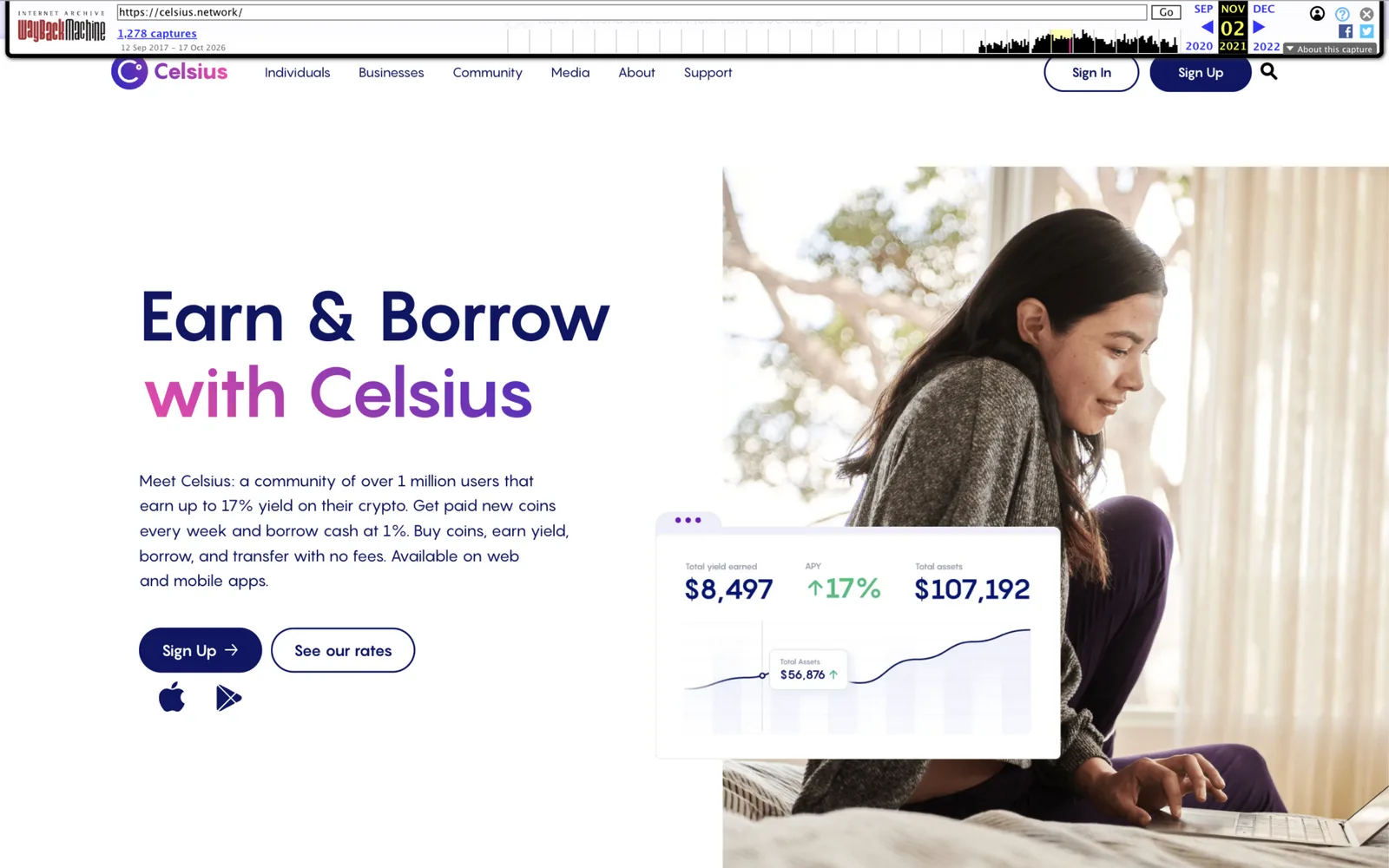
The pitch that built a $26.9 billion balance sheet — read it again with 2022 eyes. - 2
The numbers at the peak
By October 2021 the same site displayed the scoreboard: $26.9 billion in assets, more than 1 million users, over $923 million of yield paid since launch, and 109,000 bitcoin held in the community treasury. The page also carried the trust signals of the era — registration with FinCEN and ISO 27001 security certification. None of these numbers said anything about asset segregation, hedging, or what percentage of deposits were loaned to counterparties. Scale and credentials made the platform look institutional while the underlying risk remained retail.
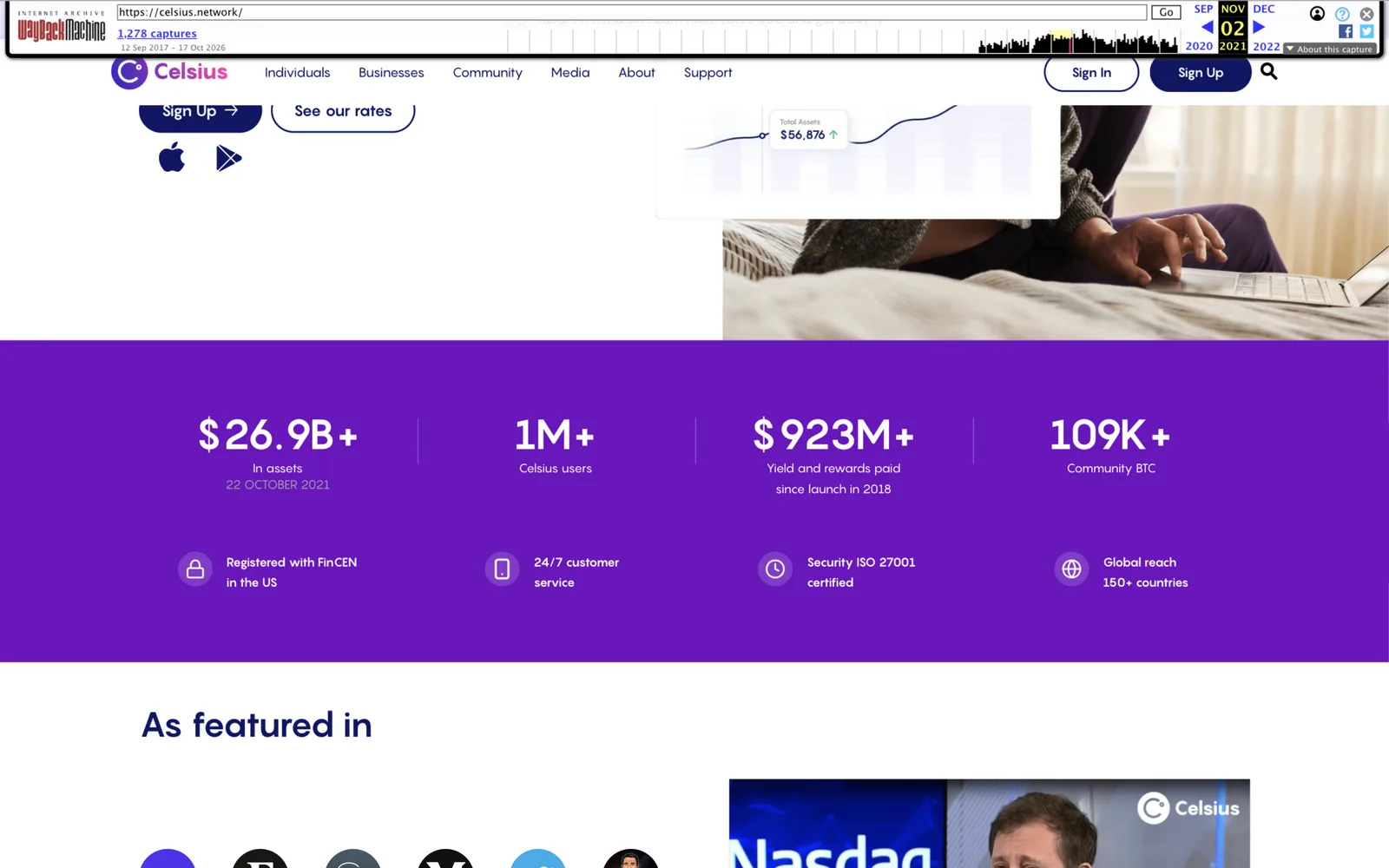
The scoreboard on celsius.network in November 2021. Nothing on it measured asset segregation. - 3
Anchor: the 20% engine under Terra's UST
The single biggest yield tap of the era was Anchor Protocol, which paid roughly 19.5% interest on Terra's UST stablecoin. Its dashboard in April 2022 showed about $12.4 billion of stablecoin deposits inside a 19.5 billion UST total value locked — a large share of all UST in existence. Economists later described this subsidy as the main driver of UST demand, and Terraform's own attempts to cut the rate in early May 2022 helped trigger the withdrawals that broke the peg. When the engine paid 20% while lending markets paid single digits, the reserve was always going to run out.
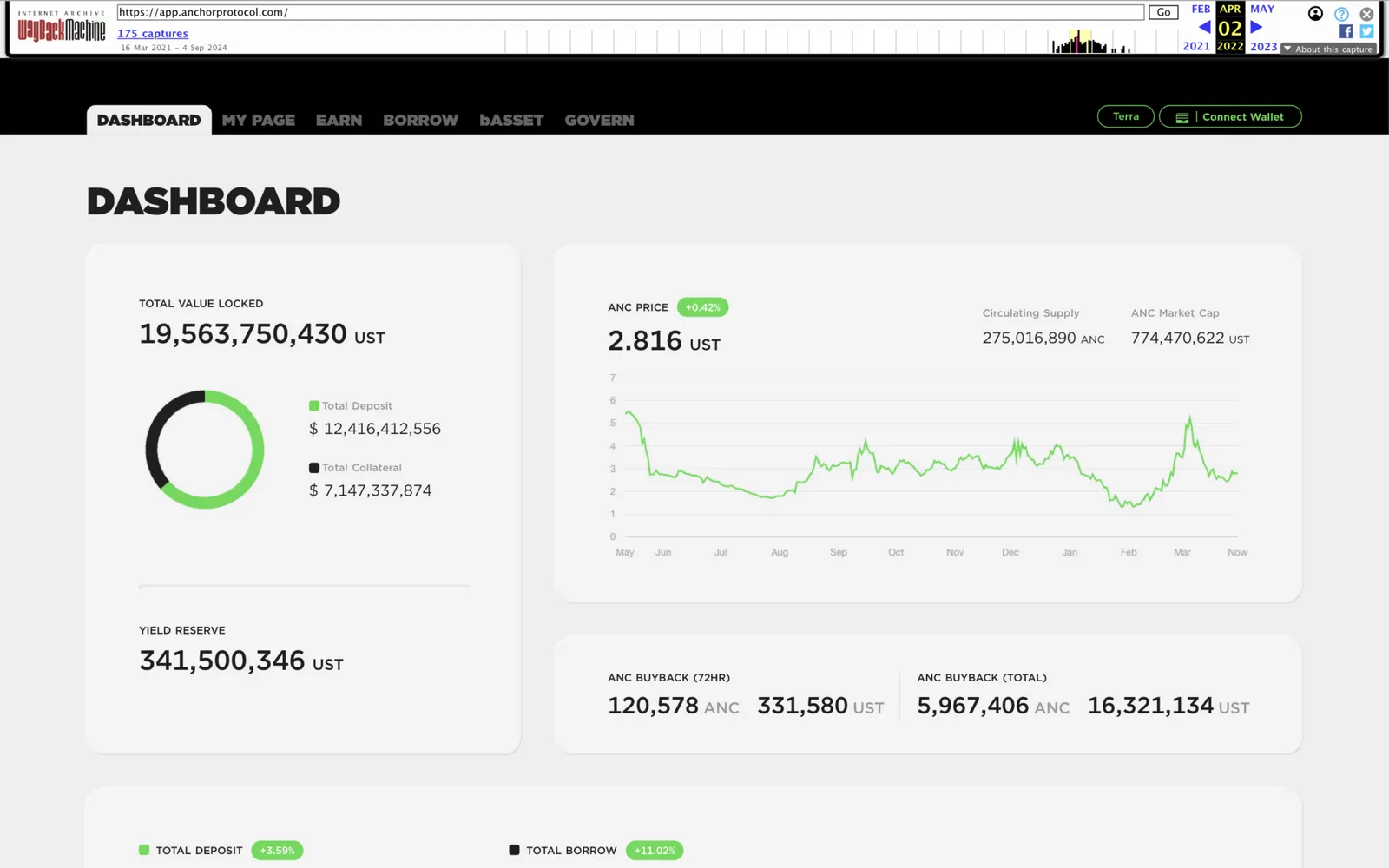
Anchor's earn dashboard, April 2022: $12.4 billion of deposits chasing roughly 19.5%.
May–June 2022: The Ignition
One stablecoin depeg in May turned into a summer of frozen withdrawals. This is how the contagion entered the lending platforms.
- 4
Terra's UST breaks the buck (May 7–13, 2022)
Large trades on Curve de-pegged UST from its dollar peg on May 7, 2022, and the run that followed destroyed both the stablecoin and its sister token LUNA within a week, erasing roughly $40 billion. Withdrawals from Anchor accelerated as its yield was cut, and the mint-and-burn mechanism printed LUNA into worthlessness trying to defend the peg. The chart of bitcoin's monthly closes marks this as the cliff edge of the entire market. Every retail lender with UST exposure, LUNA on its books, or customers nursing sudden losses now faced the same question: would depositors line up at the door?
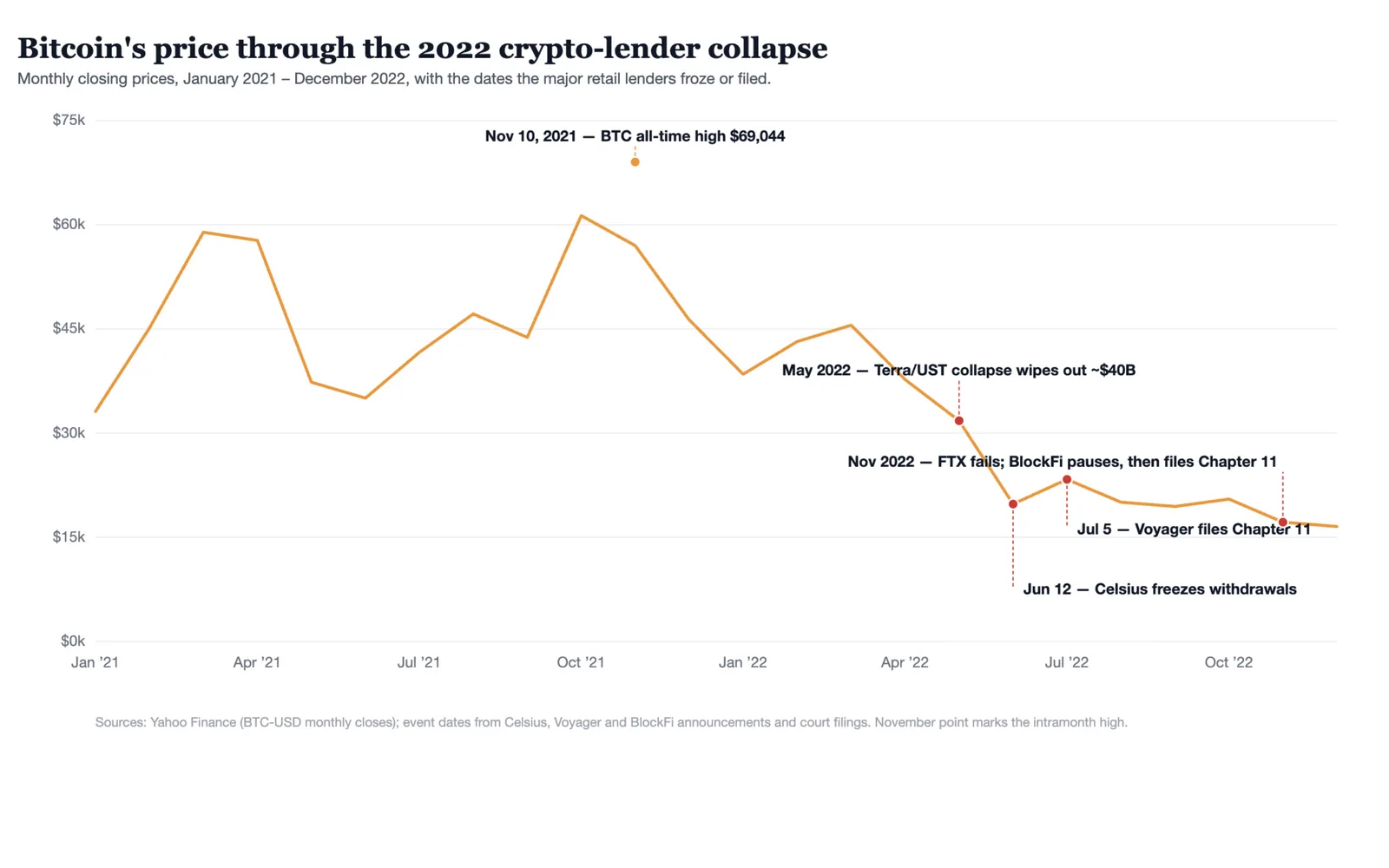
Bitcoin's route from $69,044 to $16,547 — with the lender collapse dates pinned to it. - 5
June 12, 2022: Celsius pauses everything
On the night of June 12, 2022, Celsius posted 'A Memo to the Celsius Community' announcing it was 'pausing all withdrawals, Swap, and transfers between accounts' due to extreme market conditions, invoking a clause in its own Terms of Use. Hundreds of thousands of customers had about $4.7 billion in assets locked when the pause hit. Prosecutors later said Mashinsky withdrew roughly $8 million of his own assets in the days before the freeze. A month later, on July 13, Celsius filed Chapter 11 in the Southern District of New York, disclosing a $1.19 billion balance-sheet hole.
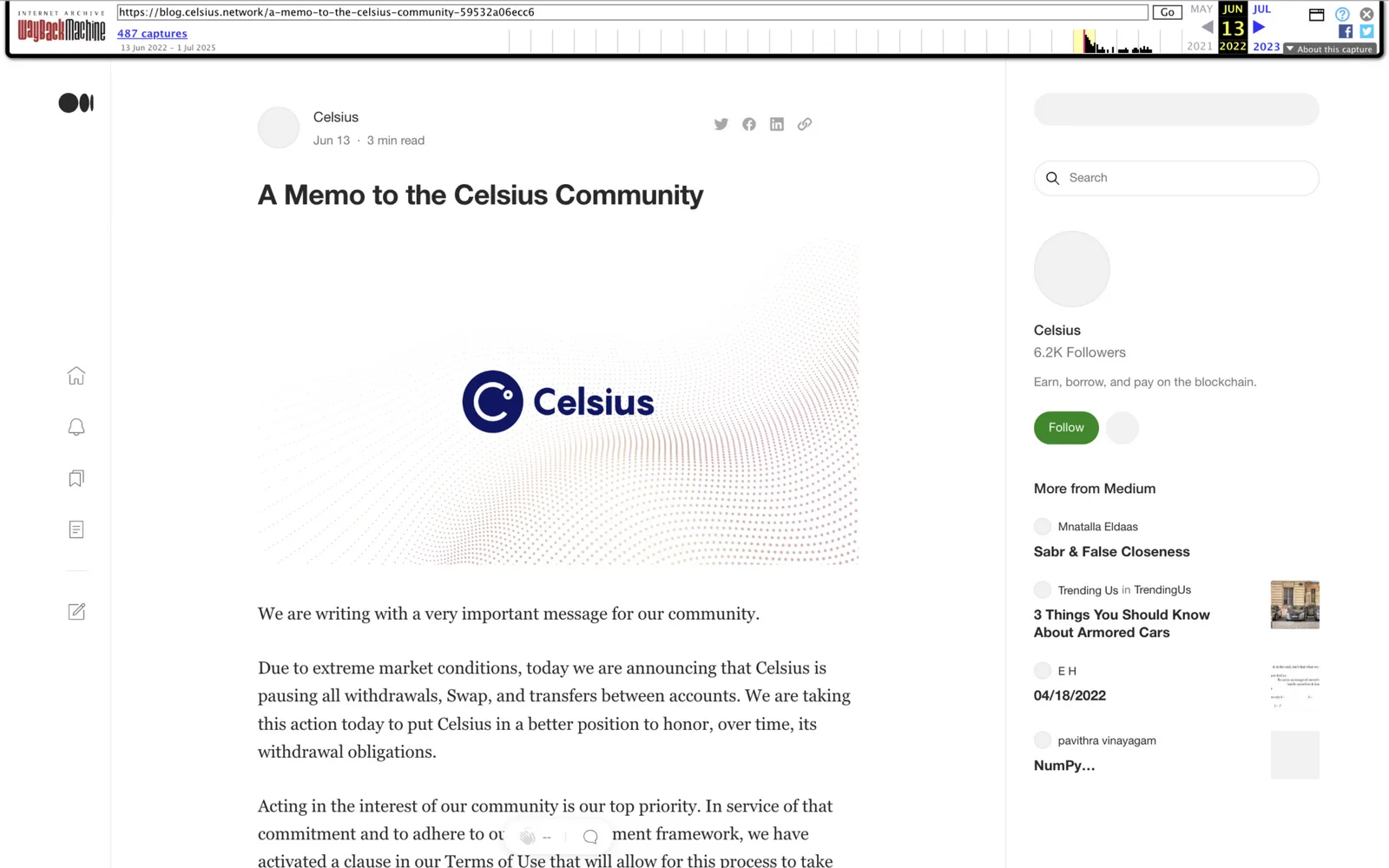
The memo itself, archived hours after posting: 'pausing all withdrawals, Swap, and transfers between accounts.' - 6
The storefront stayed open while the vault was sealed
The day after the freeze, Celsius's public homepage still read '1.7 million people call Celsius their home for crypto' and still offered new users $50 in crypto for signing up, alongside promises of military-grade security and next-level transparency. A few days later a yellow banner appeared above it: withdrawals, swaps and transfers were paused, with a link to the memo. That contrast — a growing user count on the front page, a frozen balance sheet behind it — is worth remembering whenever a platform's marketing and its mechanics disagree.
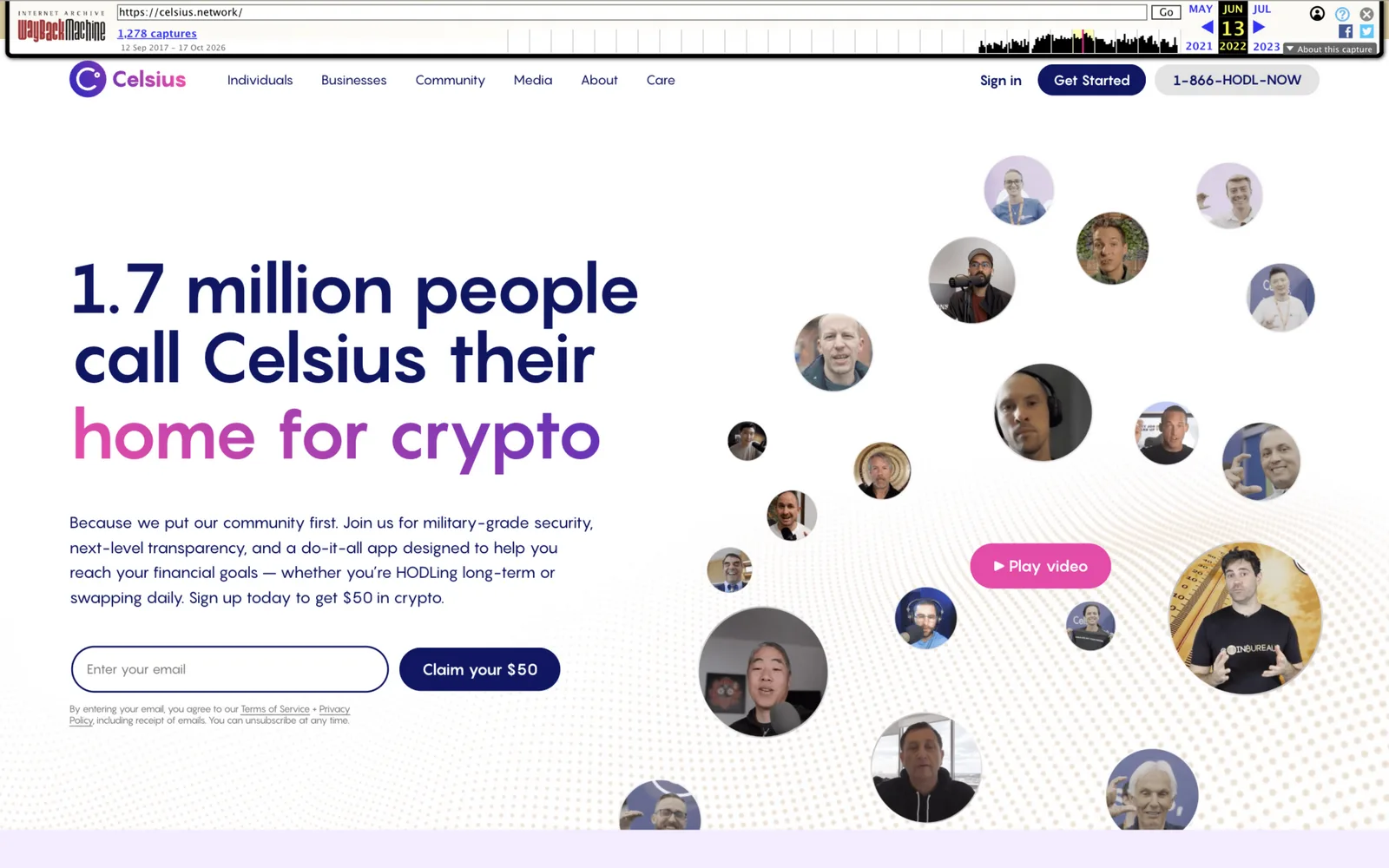
June 2022, the day after the freeze: the storefront still selling $50 sign-up bonuses. - 7
The freeze went global in eight weeks
Celsius was first, not alone. Babel Finance in Hong Kong suspended withdrawals on June 17, five days after Celsius, citing unusual liquidity pressures. Vauld in Singapore halted withdrawals, deposits and trading on July 4 and later sought court protection. Hodlnaut, also in Singapore, paused everything on August 8, the last major freeze of the summer. Each platform had its own balance sheet, but they shared one design flaw: customer money was out earning yield, so there was nothing liquid left to hand back when everyone asked at once.
Voyager: The Hedge-Fund Domino
Voyager's collapse shows the other failure mode: not a run by customers, but a single counterparty default that broke the balance sheet.
- 8
June 27, 2022: Three Arrows defaults on $670 million
Voyager Digital had lent $350 million in USDC and 15,250 bitcoin — together about $670 million — to Three Arrows Capital, the Singapore hedge fund that had levered itself into the Terra collapse. On June 27, Voyager issued a notice of default and acceleration after 3AC failed to repay. The CNBC headline called it 'one of the most prominent crypto hedge funds' defaulting on a $670 million loan. A broker holding customer crypto had, in effect, rehypothecated it into one directional bet, and that bet had just gone to zero.
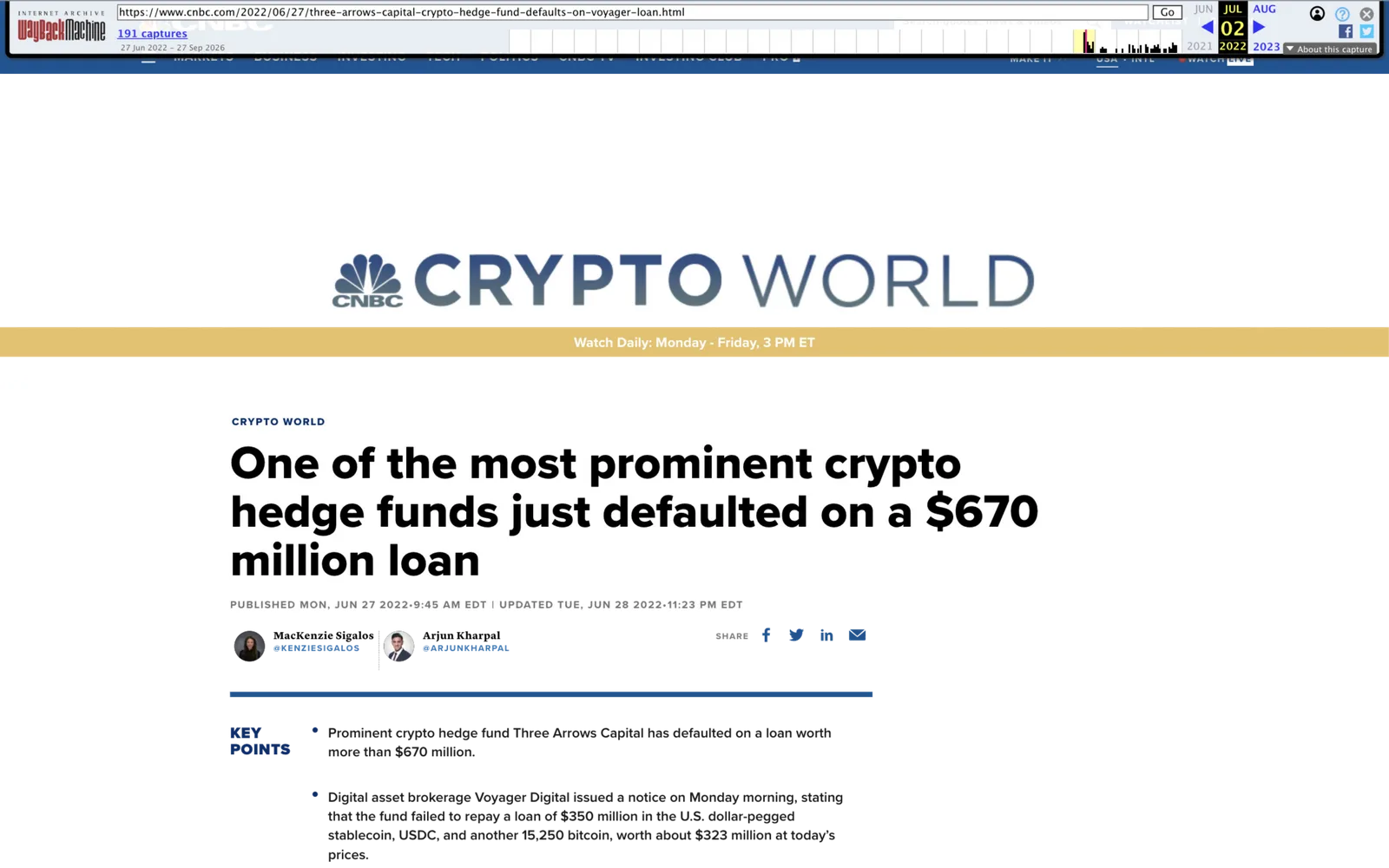
CNBC, June 27, 2022: the single default that broke Voyager's balance sheet. - 9
July 1–5, 2022: suspension, then Chapter 11
Unable to meet customer requests after the default, Voyager suspended all trading, deposits, withdrawals and loyalty rewards on July 1. Four days later it filed for Chapter 11 in the U.S. Bankruptcy Court for the Southern District of New York. The creditor list contained the era's best irony: Sam Bankman-Fried's Alameda Research was listed as Voyager's largest unsecured creditor, with a $75 million claim — the same firm that was simultaneously 'rescuing' BlockFi. Voyager's own money had flowed out through 3AC, and the entity it was owed by most, besides 3AC, was the one that would fail five months later.
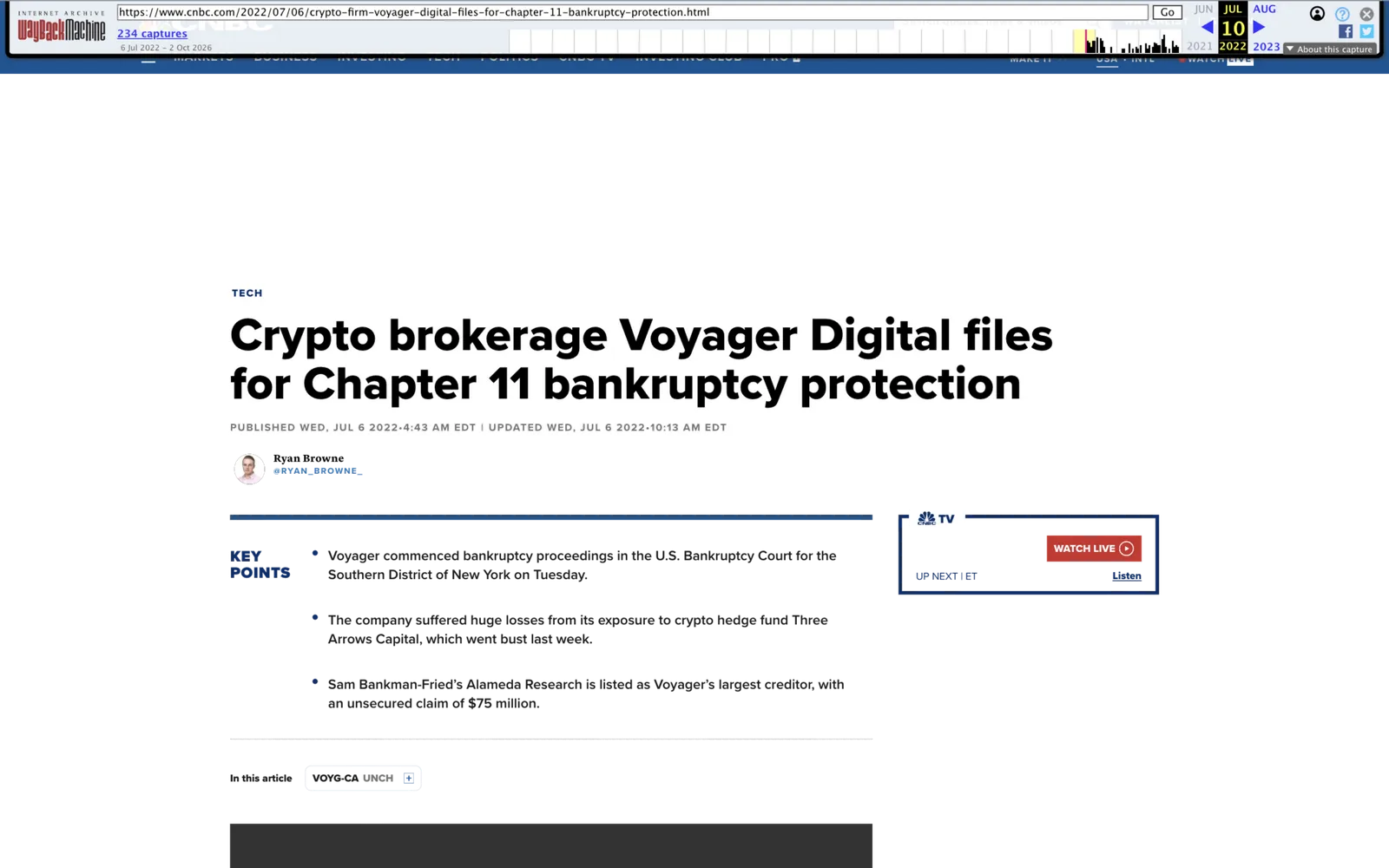
July 2022: Voyager in Chapter 11 — with SBF's Alameda at the top of the creditor list. - 10
The bailout that wasn't, and the 35.7% payout
In September 2022 Binance.US agreed to buy Voyager's assets for about $1.3 billion, but the deal collapsed in April 2023 amid US regulatory resistance. Voyager pivoted to direct self-liquidation, and in June 2023 customers began receiving in-kind distributions covering roughly 35.7% of their claims — with further recoveries projected up to about 63.7% if litigation over FTX assets succeeded. The lesson in the numbers: even the 'good' outcome of a retail lender bankruptcy left most of the account value gone for more than a year.
BlockFi: From Rescue to Casualty
BlockFi nearly died first and was saved by FTX. Then its rescuer failed, and the rescue became the cause of death.
- 11
The lender that already wobbled in June
BlockFi entered the crisis as one of the largest retail lenders — its June 2022 homepage advertised buying, selling and earning crypto, over one million clients, and more than $10 billion in assets. But it had lent heavily to counterparties collateralized by collapsing tokens, and when Terra fell, its balance sheet wobbled before the public ever saw it. At the eventual first-day hearing, BlockFi's own lead attorney said 'the Luna collapse really was the start of everything.' The homepage looked calm in June; behind it, the company was negotiating for its life.
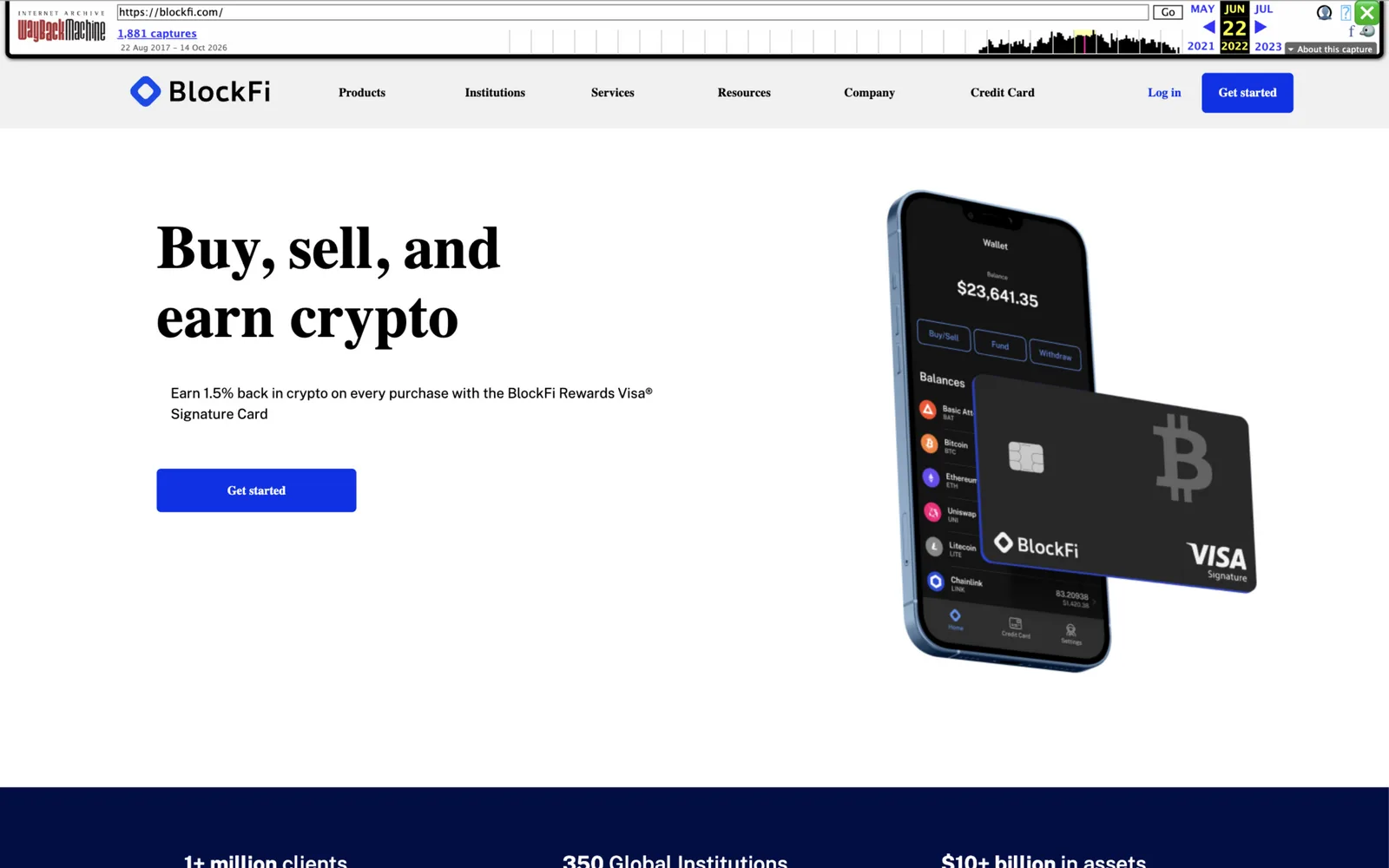
BlockFi's homepage in June 2022 — calm surface, negotiations underneath. - 12
June 21, 2022: the FTX rescue term sheet
On June 21, 2022, BlockFi announced 'a landmark term sheet with FTX to provide a $250 million credit facility,' with proceeds explicitly subordinated to client balances. CEO Zac Prince called it proof of BlockFi's commitment to safeguarding funds; Sam Bankman-Fried praised BlockFi's 'strong bias towards prudent risk management.' The rescue worked as a story: deposits stayed, and the deal later grew into a larger agreement with a buyout option. It failed as a fact: within five months both companies were gone, and the rescuer's own token was part of BlockFi's collateral problem.
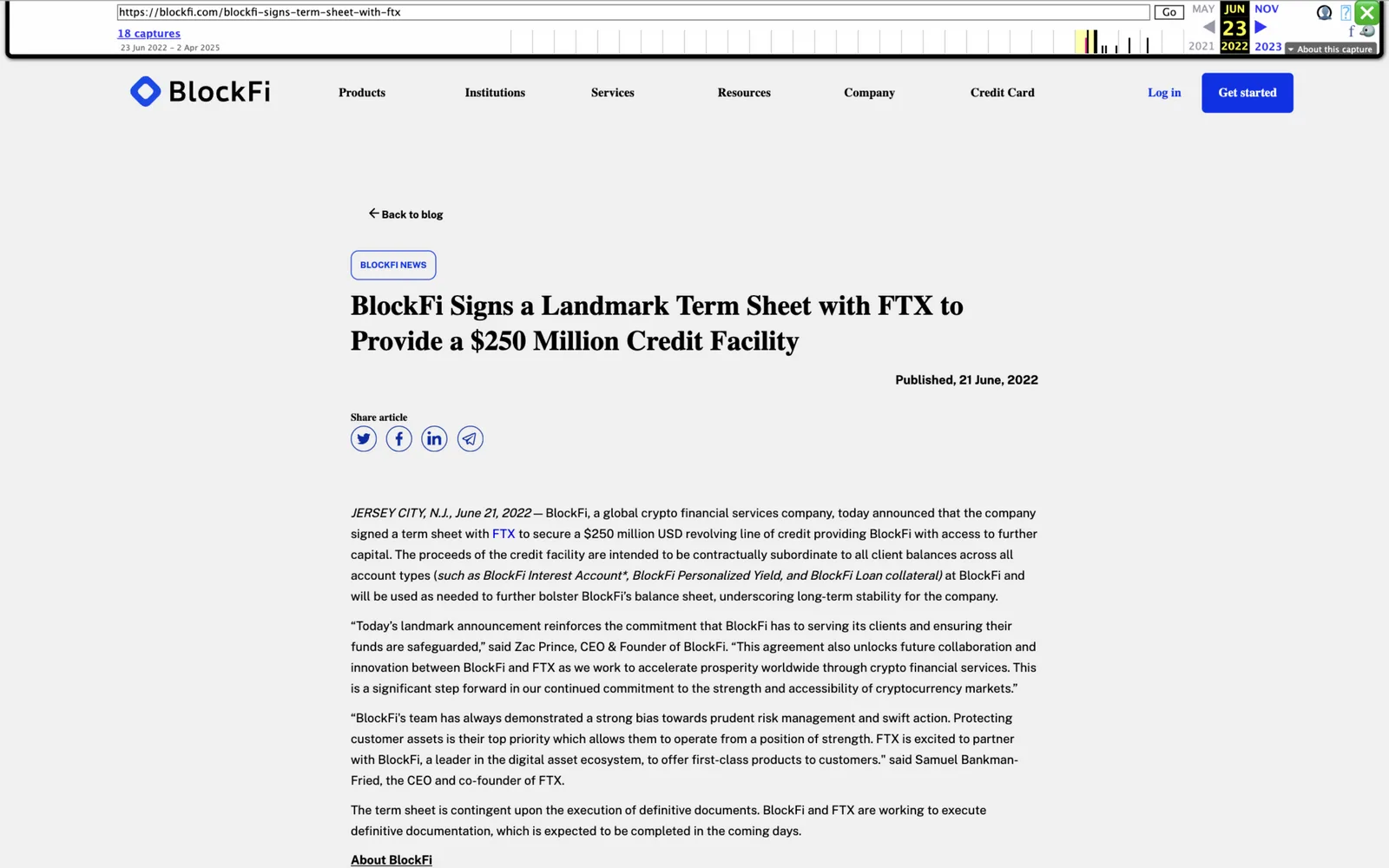
The rescue, in its own words — with SBF praising BlockFi's 'prudent risk management.' - 13
November 2022: the rescuer failed first
When FTX filed Chapter 11 on November 11, 2022, BlockFi disclosed 'significant exposure' and paused client withdrawals the same day. In court, the numbers came out: FTX and Alameda owed BlockFi more than $1 billion, including a $671 million unsecured loan to Alameda, while BlockFi listed FTX as its second-largest creditor at $275 million. On November 28, BlockFi filed Chapter 11 with eight affiliates in the District of New Jersey, listing over 100,000 creditors. The platform that survived June by leaning on FTX learned that a rescue is only as solvent as the rescuer.
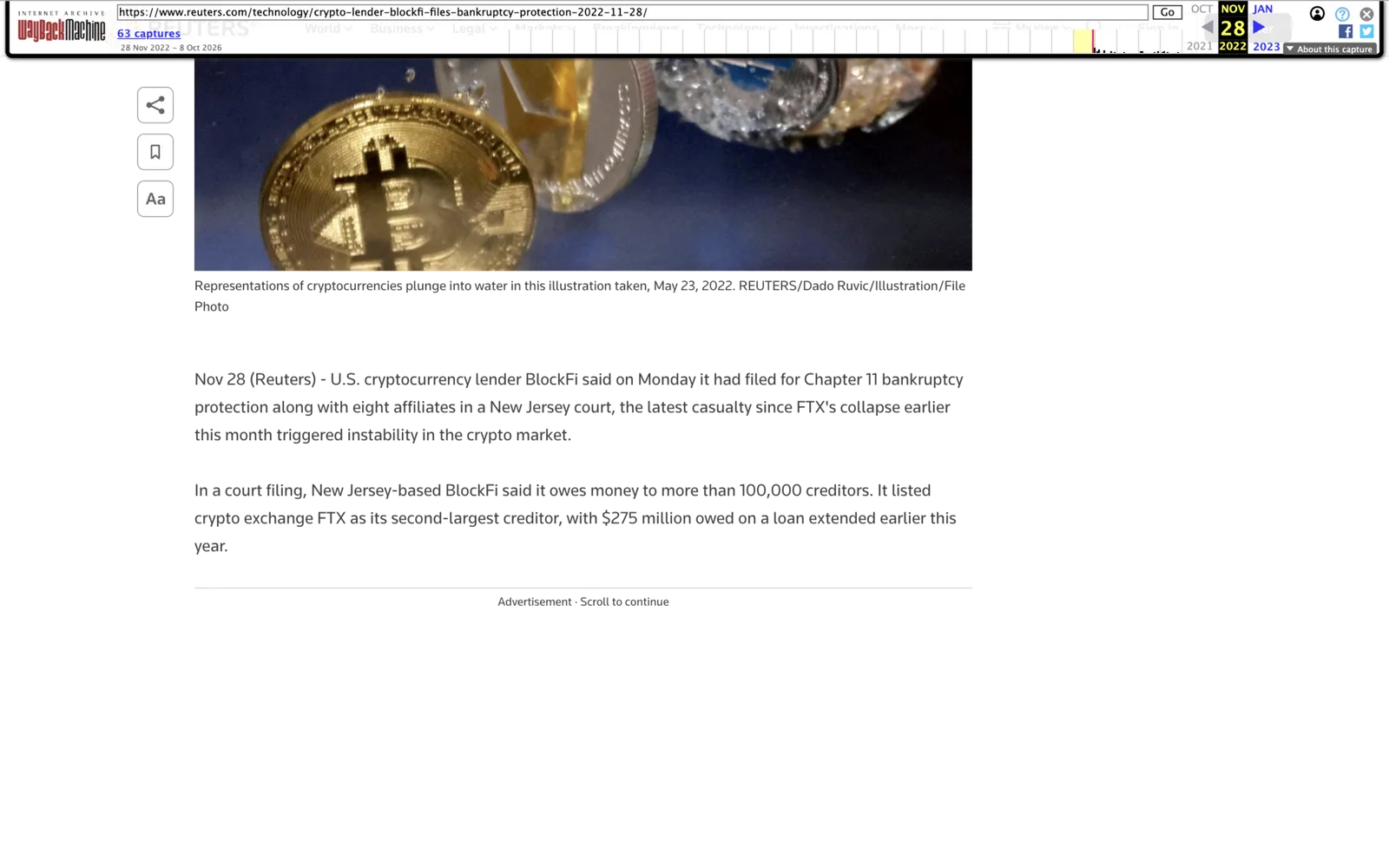
Reuters, November 28, 2022: the rescued becomes the casualty.
Bankruptcy, Recovery, and the 2025 Endgame
Freezes were the opening act. The years that followed decided how much of customers' money survived — and who answered criminally.
- 14
Celsius's reckoning: Chapter 11, then billions back
Reuters reported Celsius's July 13, 2022 filing as the moment the lender 'files for bankruptcy,' with assets and liabilities each listed between $1 billion and $10 billion. The bankruptcy rewrote who owned what: a judge ruled that most Earn account crypto belonged to the estate, turning depositors into unsecured creditors. The plan approved in late 2023 paid Earn creditors 67–85% of their holdings plus equity in a new company, and on January 31, 2024, Celsius began distributing over $3 billion in crypto and cash to more than 600,000 account holders. Partial, delayed — but far better than the zero customers feared on freeze day.
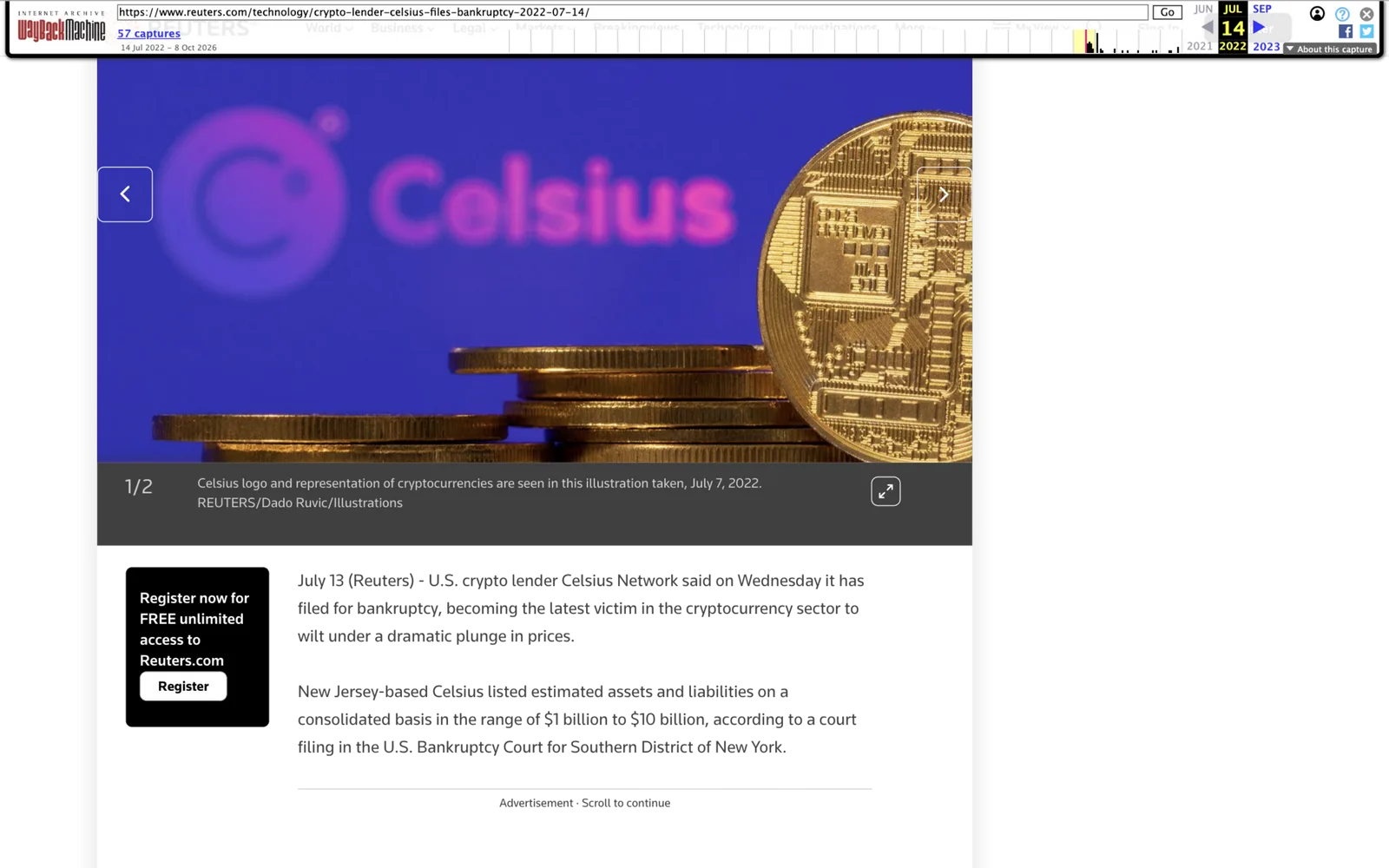
Chapter 11, as Reuters readers saw it on July 14, 2022. - 15
May 8, 2025: the sentence closes the story
Alex Mashinsky, who founded Celsius in 2017 and built his brand on calling crypto banks unsafe, pleaded guilty on December 3, 2024 to commodities fraud and securities fraud. On May 8, 2025, the U.S. Attorney's Office for the Southern District of New York announced his sentence: 12 years in prison. Prosecutors proved he directed the purchase of Celsius's own CEL token to prop up its price — profiting about $48 million — while marketing Celsius as 'the safest place for your crypto' and withdrawing $8 million shortly before the freeze. The DOJ statement put the peak figure at roughly $25 billion of customer assets entrusted to Celsius.
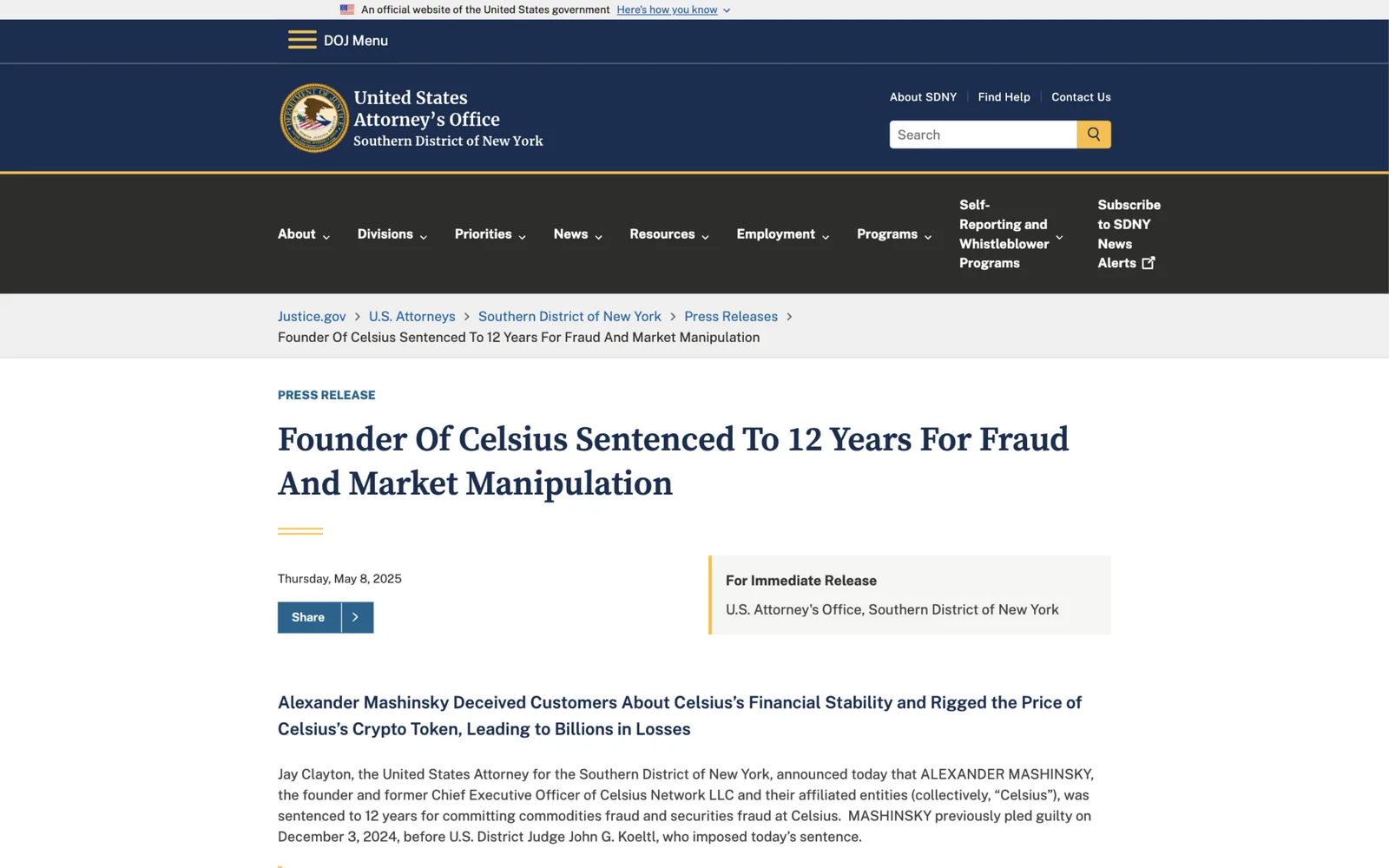
The endgame on justice.gov: 12 years, three years after the freeze. - 16
Survivors, lessons, and a final court order
Not every lender died. Nexo kept operating through the contagion, settled US regulatory charges for $45 million in January 2023, and let its attempted acquisition of Vauld lapse — the survivor's path of shrinking promises instead of freezing doors. BlockFi's estate, against expectations, announced in September 2024 that allowed client claims would be paid in full. Then on July 2, 2025 it won court approval to destroy its remaining user data, permanently closing the books for anyone who never filed a claim. The timeline below is the whole arc: freezes in weeks, bankruptcies in months, recoveries in years, and the last court orders in 2025. The durable lessons: yield above the market is risk deferred, not risk absent; withdrawal access is the only audit that matters in real time; and a counterparty that owes you money is your real balance sheet.
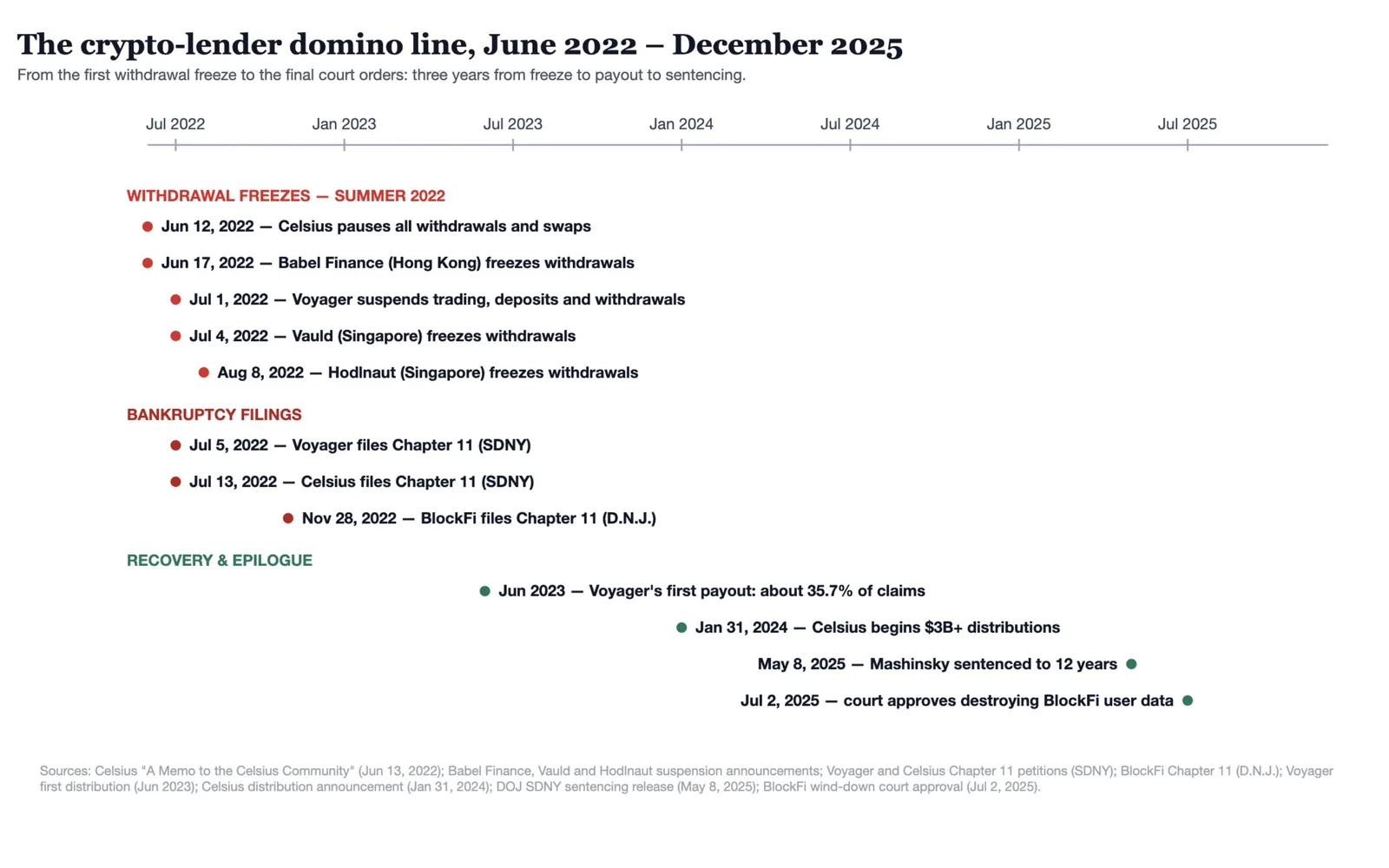
Freezes in weeks, bankruptcies in months, recoveries in years, court orders last.
Frequently Asked Questions
What was the 2022 crypto lenders collapse?
Why did Celsius freeze withdrawals on June 12, 2022?
What did Three Arrows Capital have to do with Voyager's bankruptcy?
Did BlockFi customers get their money back?
How much did Celsius and Voyager customers recover?
What happened to Alex Mashinsky?
Which crypto lenders survived the 2022 collapse?
Continue the Collapse History
Failed Crypto Exchanges: 12 Steps Through Six Collapses
The companion hub on failed exchanges — Mt. Gox, BTC-e, QuadrigaCX, Cryptopia, Cryptsy and FTX — and how their failure modes differ.
The Biggest Crypto Scams in History, Explained in 16 Steps
Where the Celsius fraud sits in the wider history of crypto frauds, from OneCoin to FTX.
USDC Depeg 2023: The Weekend the Dollar Coin Broke
The next spring's stablecoin scare: how a bank failure, not a lender, broke USDC — and why it recovered.
Crypto Winter 2018: The Year Bitcoin Fell 84%
The previous market washout, for comparing how each bear market finds the weakest balance sheets.
References
This illustrated guide is maintained strictly for educational, research, and historical documentation purposes. None of the materials constitute investment, financial, legal, or trading advice. Historical crisis and market events are documented from public archives. Digital assets involve significant risks.