USDC Depeg 2023: The Weekend the Dollar Coin Broke
On Friday, March 10, 2023, regulators seized Silicon Valley Bank — one of the banks holding the cash behind USDC, the world's second-largest stablecoin. By the small hours of March 11 a token named "USD Coin" traded at 87 cents. This is the minute-by-minute story of those sixty hours: Circle's $3.3 billion problem, the exchanges that shut the exit doors, the Sunday-night backstop, and the TradFi counterparty-risk lesson crypto learned the hard way.
9 minutes • 15 illustrated steps • Hour-by-hour timeline of March 10–13, 2023
Editorial Research & Chronological Archive
Independently synthesized and cross-verified by The Blockchain History Editorial Board using primary whitepapers, historical archives, and on-chain records.
What was the USDC depeg of 2023?
The USDC depeg was the roughly sixty-hour period, March 10–13, 2023, when USD Coin — a stablecoin designed to always equal one US dollar — fell to about $0.87–$0.88. The trigger: on March 10, California regulators closed Silicon Valley Bank after a $42 billion deposit run, and Circle, the issuer of USDC, disclosed that $3.3 billion of the stablecoin's cash reserves, about 8% of the total, was stuck inside the failed bank. With banks closed for the weekend and Coinbase and Binance suspending USDC conversions, holders rushed to sell, and the price overshot far below the value of the underlying reserves. On Sunday night, March 12, the Treasury, Federal Reserve and FDIC invoked the systemic risk exception and guaranteed all SVB depositors; by Monday, March 13, USDC was back at $1.00. The peg survived — but the episode exposed how much TradFi counterparty risk was hiding inside crypto's dollar.
Key Takeaways
- USDC broke its dollar peg in the early hours of March 11, 2023, falling to roughly $0.87–$0.88 — the deepest break for a major stablecoin since TerraUSD's collapse ten months earlier.
- The cause was TradFi, not crypto plumbing: Circle disclosed $3.3 billion of USDC's cash reserves — about 8% of roughly $40 billion — was held at Silicon Valley Bank, which California's DFPI closed on March 10 after a record $42 billion single-day deposit run.
- The panic deepened because the exits closed at the same time: Coinbase paused USDC-to-dollar conversions over the weekend, Binance suspended USDC auto-conversion, and the Curve 3pool drained — all while banks were shut, so market price replaced redemption price.
- Contagion hit crypto's banking layer: Silvergate announced voluntary liquidation on March 8, and Signature Bank — with roughly 30% of deposits from crypto clients — was seized by New York regulators on March 12, taking the 24/7 Signet and SEN payment rails down with it.
- On the evening of March 12, the Treasury, Federal Reserve and FDIC invoked the systemic risk exception: all Silicon Valley Bank and Signature depositors, insured or not, would be made whole by Monday morning — with losses covered by the Deposit Insurance Fund, not taxpayers.
- USDC fully repegged to $1.00 on March 13 after Circle CEO Jeremy Allaire confirmed 100% of the SVB deposits were secure; the episode became a catalyst in the US debate over payment stablecoin regulation.
A Stablecoin and Its Bank
USDC promised a dollar you could move at internet speed. That promise quietly rested on a bank most holders had never thought about.
- 1
The dollar coin built by Circle
USD Coin was launched in 2018 by Circle, a Boston-based fintech, together with Coinbase: hand a regulated company a dollar, receive a token worth a dollar, and redeem it 1:1 whenever you choose. By March 2023 it had grown into the world's second-largest stablecoin with roughly $40 billion in circulation — the "transparent, US-based" alternative to Tether, holding reserves in cash and short-dated US Treasuries at partner banks. The pitch was safety through boringness. But every one of those 40 billion tokens was only as good as the bank accounts holding the cash behind them. And one of those banks was Silicon Valley Bank.

A dollar that lives on the internet — as long as the bank behind it stays open.Watch at 0:20 - 2
The bank holding crypto's cash
Silicon Valley Bank was not a crypto company, but crypto banked there. The Santa Clara institution — the 16th-largest US bank with about $209 billion in assets — served nearly half of America's venture-backed startups, and its client list included the biggest names in digital assets. Circle itself described SVB as one of the reserve banking partners for USDC: part of the stablecoin's cash pile sat in SVB accounts, alongside short-term Treasury bills custodied elsewhere. None of this was secret, and in the long bull market nobody priced it. A stablecoin is a promise to pay dollars on demand — and on March 10, 2023, the bank on the other side of that promise went down.
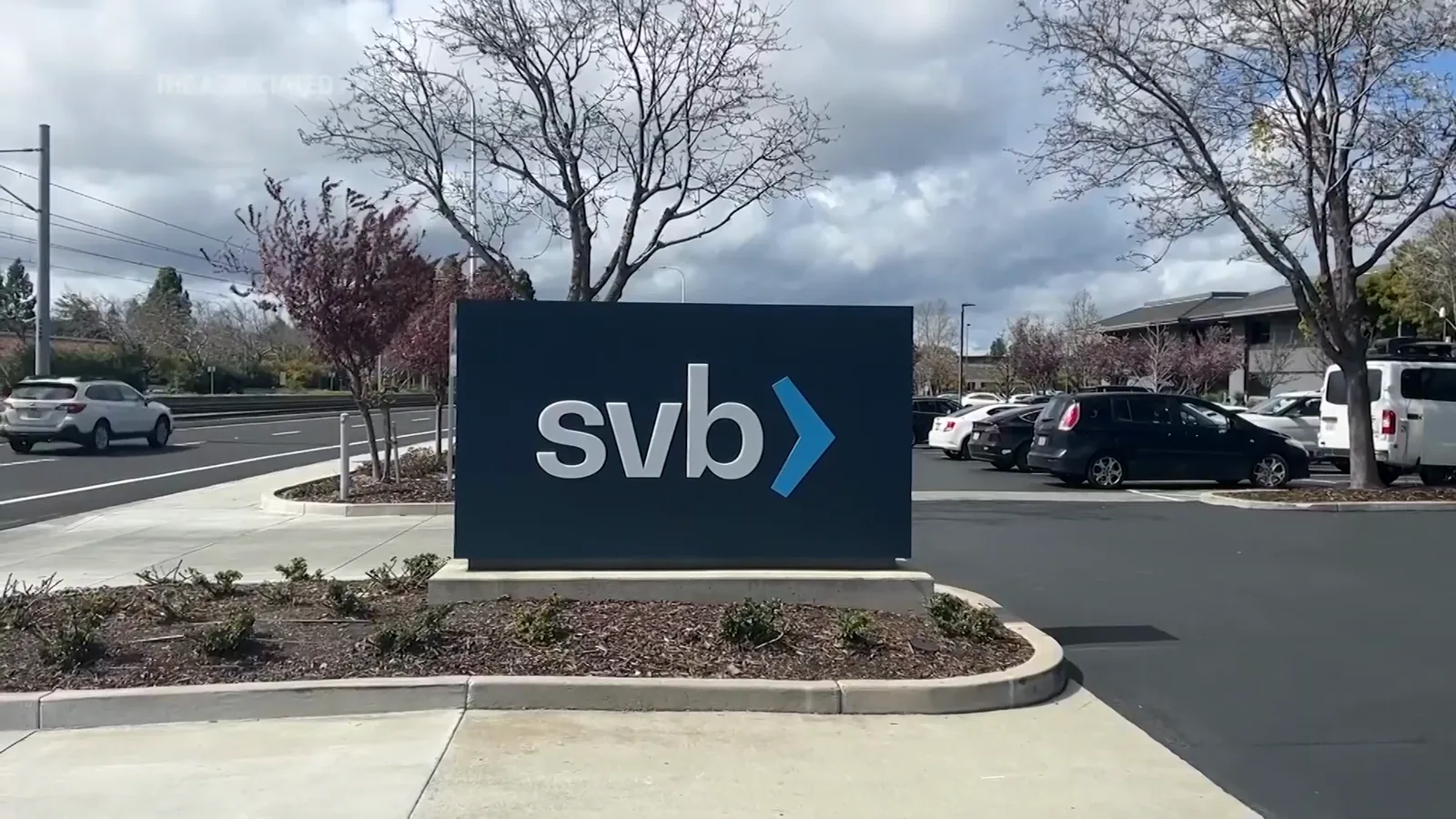
The startup world's bank — and, quietly, one of USDC's reserve banks.Watch at 0:36
Friday, March 10: The Bank Falls
A record $42 billion bank run ended Silicon Valley Bank in a single day — and stranded a slice of every USDC holder's reserves.
- 3
A $42 billion run ends SVB in one day
The dominoes fell in seventy-two hours. On March 8, Silvergate Bank — the crypto industry's other favorite lender — announced it would voluntarily liquidate. On March 9, Silicon Valley Bank announced a botched $2.25 billion capital raise after selling $21 billion of Treasuries at a $1.8 billion loss, and its clients pulled $42 billion in a single day — the fastest bank run in history, coordinated entirely over Twitter and venture-capital group chats. On the morning of March 10, the California Department of Financial Protection and Innovation took possession of SVB and appointed the FDIC as receiver. At roughly $209 billion in assets, it was the second-largest bank failure in US history since Washington Mutual in 2008.
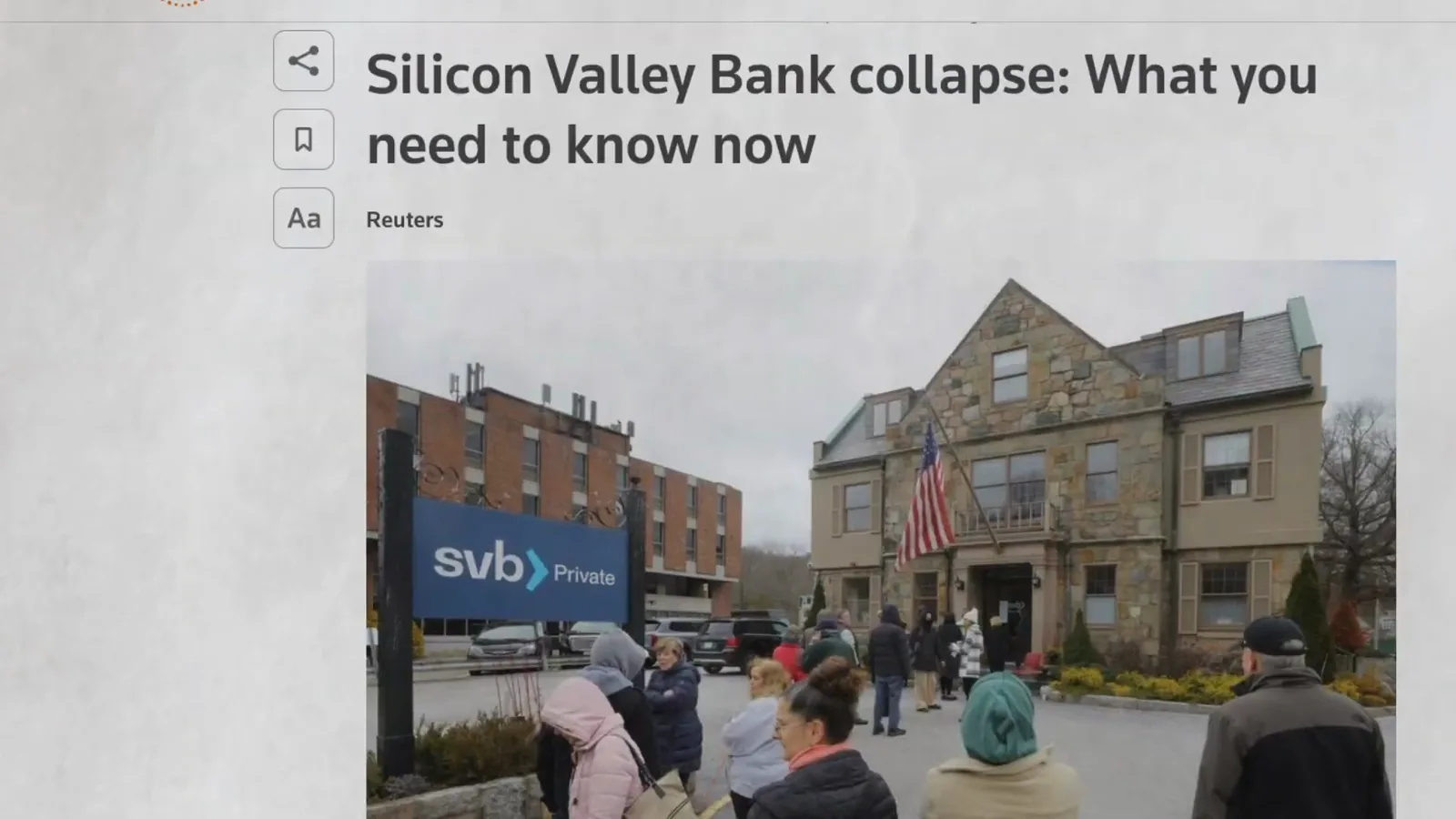
From botched capital raise to receivership in under 36 hours.Watch at 0:42 - 4
Closed by California, held by the FDIC
The takeover order came under California Financial Code section 592, citing inadequate liquidity and insolvency. The FDIC moved immediately to protect the small depositor: insured balances — up to $250,000 per account — would be accessible Monday morning through a newly created successor bank. The problem was everything above that line. More than 90% of SVB's deposits exceeded the insurance cap, and for the fate of those uninsured billions the FDIC offered only a promise to pay an advance dividend next week. From Friday night until Monday morning, an unknown quantity of money — including Circle's $3.3 billion — simply had no price.
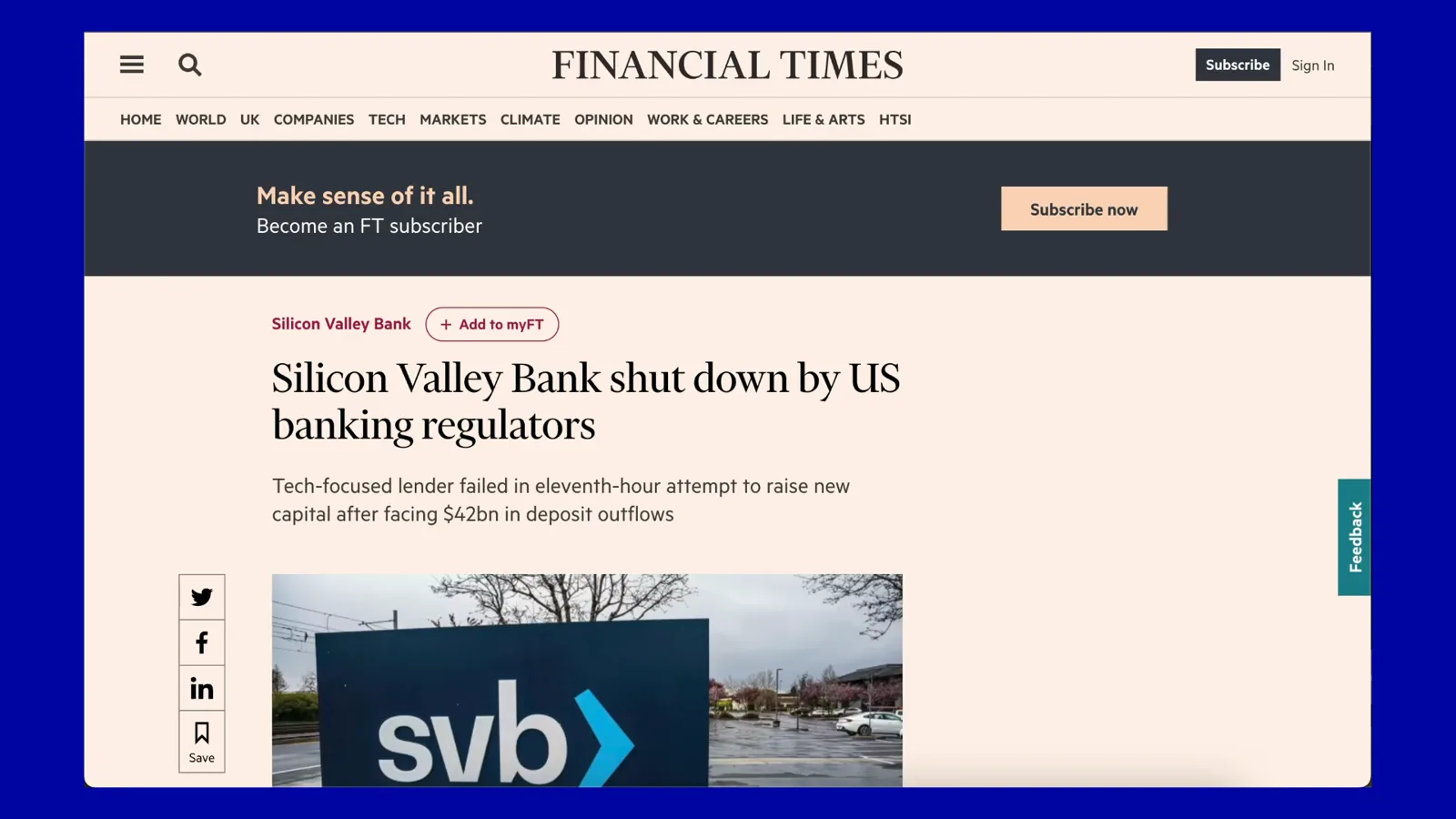
The regulator held the bank. Nobody could price the uninsured billions inside it.Watch at 1:00 - 5
Depositors at the door
The run itself had been digital — $42 billion left in hours, no queue required. But the failure landed physically. SVB's branches and headquarters closed with regulators inside; payroll stalled for thousands of startups; founders flew in to stand outside the Santa Clara offices hoping for answers. For the crypto industry the anxiety had a sharper edge: if a top-20 American bank could vanish in a day, what did that mean for the reserves backing the industry's own dollar? That question was about to be answered with a number.
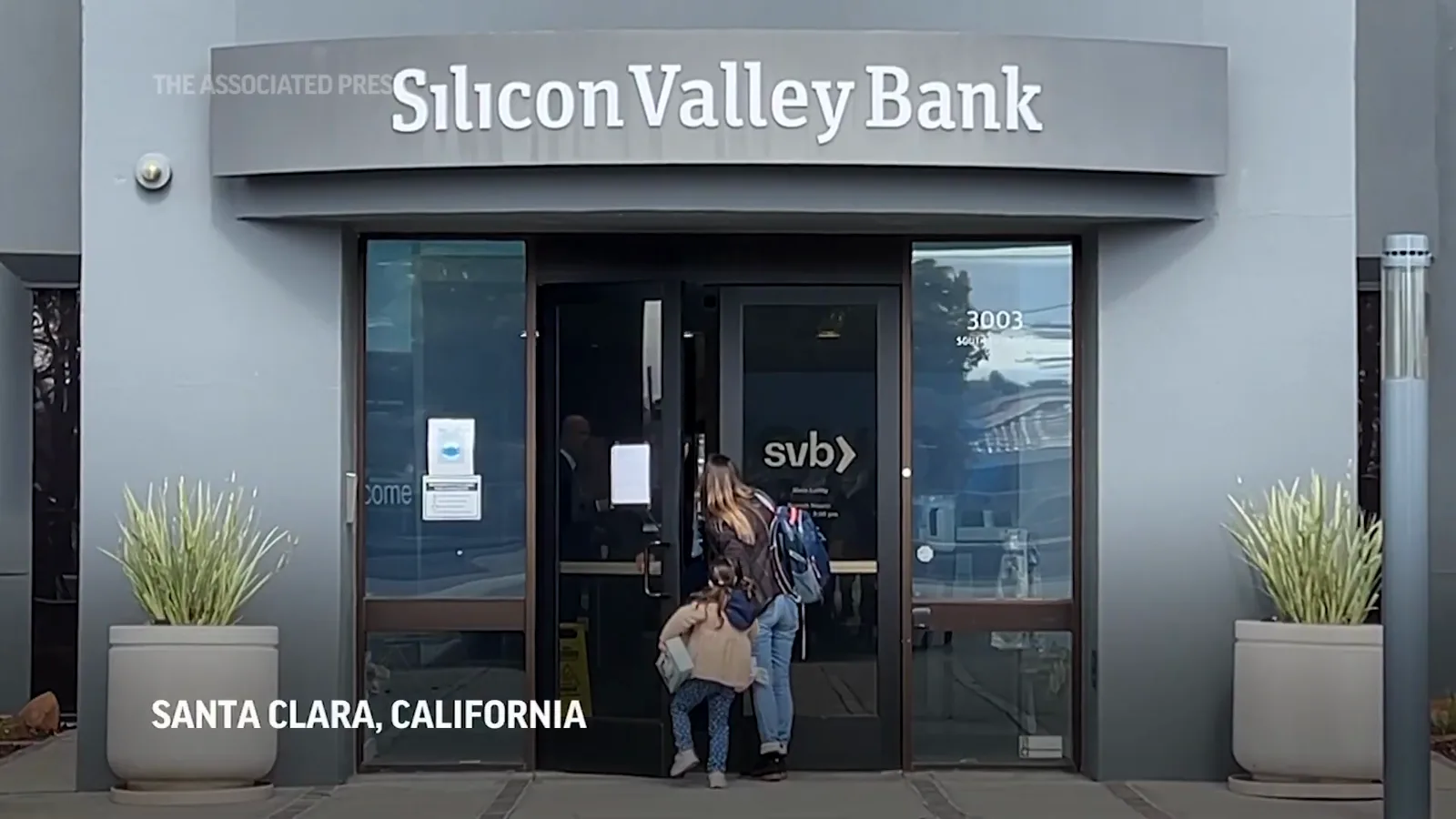
When a bank fails, the queue moves from the app to the sidewalk.Watch at 1:10
The Weekend: USDC Breaks the Buck
Circle's disclosure turned a bank failure into a stablecoin crisis. For about sixty hours, one USDC cost 87 cents.
- 6
Circle discloses $3.3 billion stuck at SVB
On the night of Friday, March 10 — with the disclosures landing in the early hours of March 11 — Circle revealed that $3.3 billion of USDC's cash reserves remained at Silicon Valley Bank. The company had initiated withdrawals on the Thursday, but the transfers had not settled before the bank was seized. Against roughly $40 billion of circulating USDC, the stranded amount was about 8%; the other 92% was short-dated Treasury bills and cash at other banking partners. Logically, that is a manageable hit for a profitable issuer. Markets did not trade logic on a weekend — they traded the phrase "8% of the reserves is unavailable" against the memory of TerraUSD's death, and USDC began to slide.
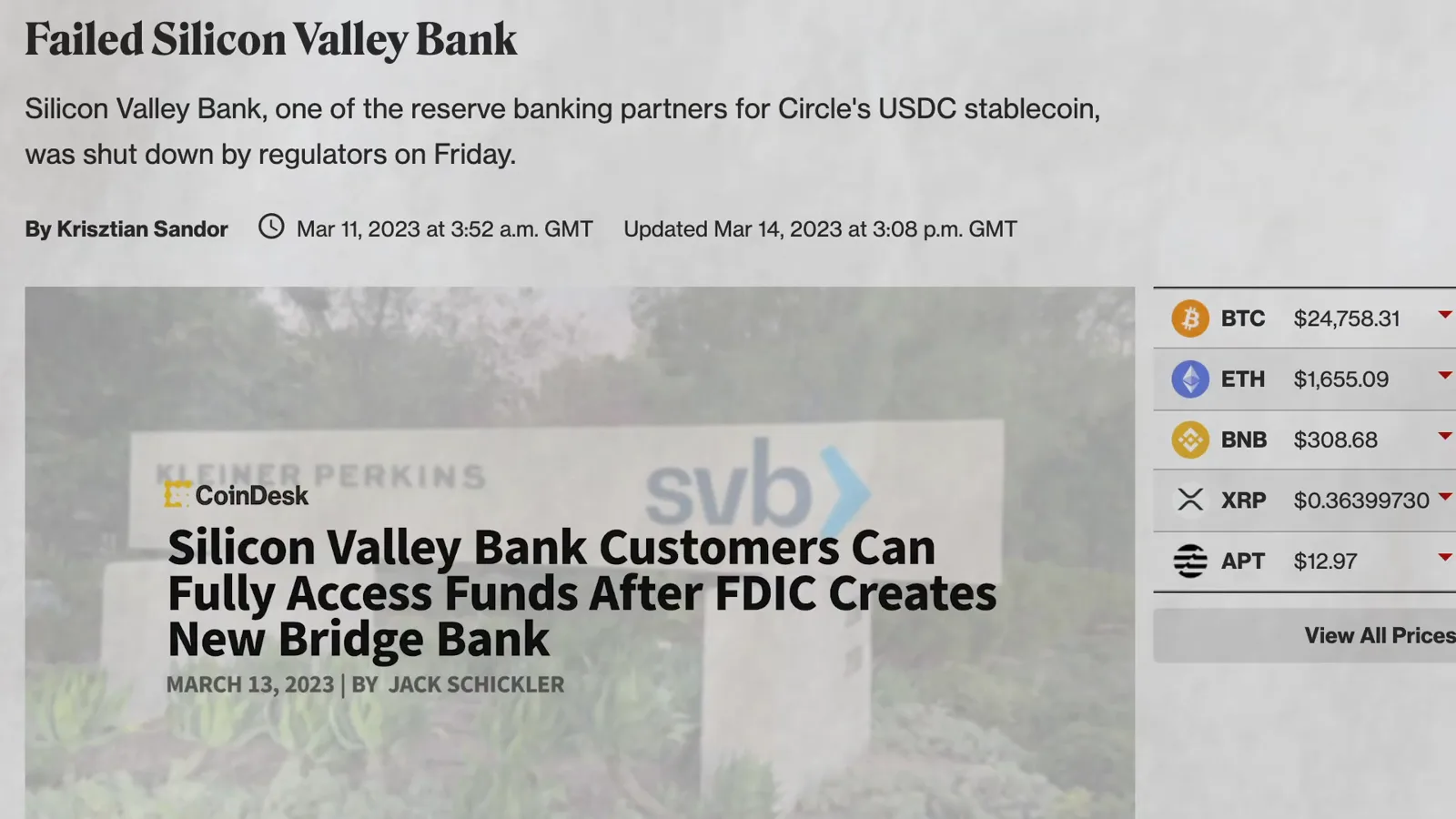
8% of the reserves. 100% of the panic.Watch at 0:28 - 7
A dollar now costs 87 cents
Through Saturday the peg eroded, and in the small hours of March 11 USDC bottomed near $0.87–$0.88 on major exchanges — the second-largest stablecoin trading at a 12% discount to the dollar it promised to be. The mechanics mattered: redemption at $1.00 was a promise you could only keep through bank rails, and the banks were closed until Monday. So the market price became pure fear, amplified by the Curve 3pool draining and by investors who had watched TerraUSD's algorithmic dollar go to zero ten months earlier. The chart tells the whole story in one candle: a cliff to 0.88, then a three-day climb back as the facts arrived.
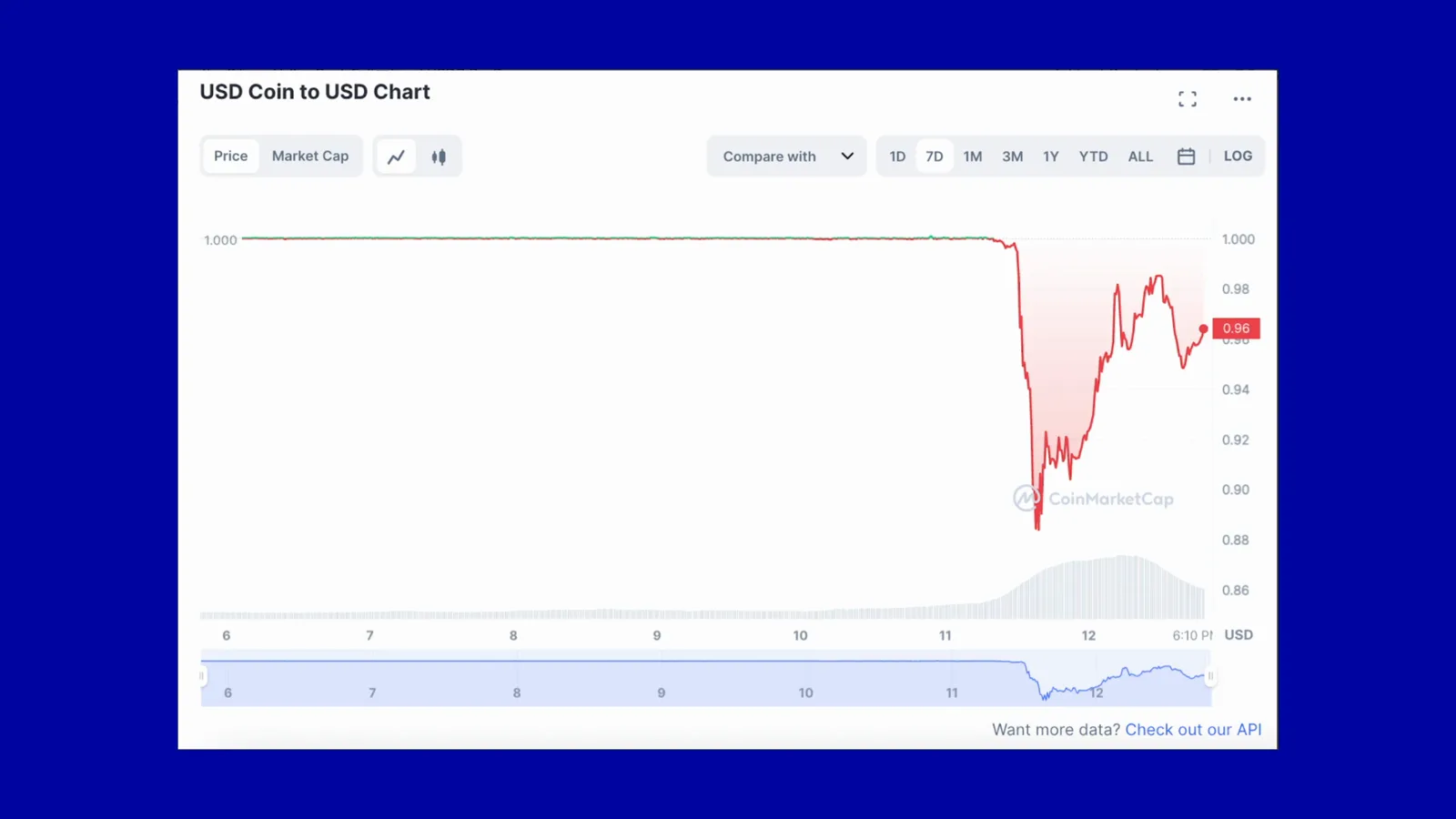
Sixty hours in which the dollar itself traded at a discount.Watch at 1:16 - 8
Backed by real assets — unlike Terra
Why did USDC survive when UST died? The answer is on the balance sheet. Circle's reserves were actual assets: roughly three-quarters in short-dated US Treasury bills and the rest in cash at banking partners — $32.4 billion of Treasuries alone at the January 2023 attestation. The $3.3 billion at SVB was a stranded fraction, recoverable through the resolution process, not an evaporated one. Analysts argued through the weekend that USDC could not go to zero; the worst case was a discount until the money came back. But solvency is not liquidity: every redemption still depended on a bank wire, and it was the weekend. The reserves were sound. The doors were locked.
Real paper backed the token — paper you couldn't reach on a Saturday.Watch at 4:43 - 9
The exit doors close
What turned a wobble into a rout was that the exits shut at the same time. Coinbase announced it was pausing USDC-to-dollar conversions for the weekend — "while banks are closed," the exchange explained, since conversions depend on wires that settle during banking hours. Binance suspended its auto-conversion of USDC into its own BUSD stablecoin, citing market conditions and heavy inflows. Circle's own redemption desk could not promise weekend settlement either. With the official exits closed, sellers had only thin decentralized pools and exchange order books — which is exactly how a fundamentally solvent asset trades eleven cents low. Forbes counted Coinbase, Circle and Paxos among the major firms with funds tied up in the failed banks.
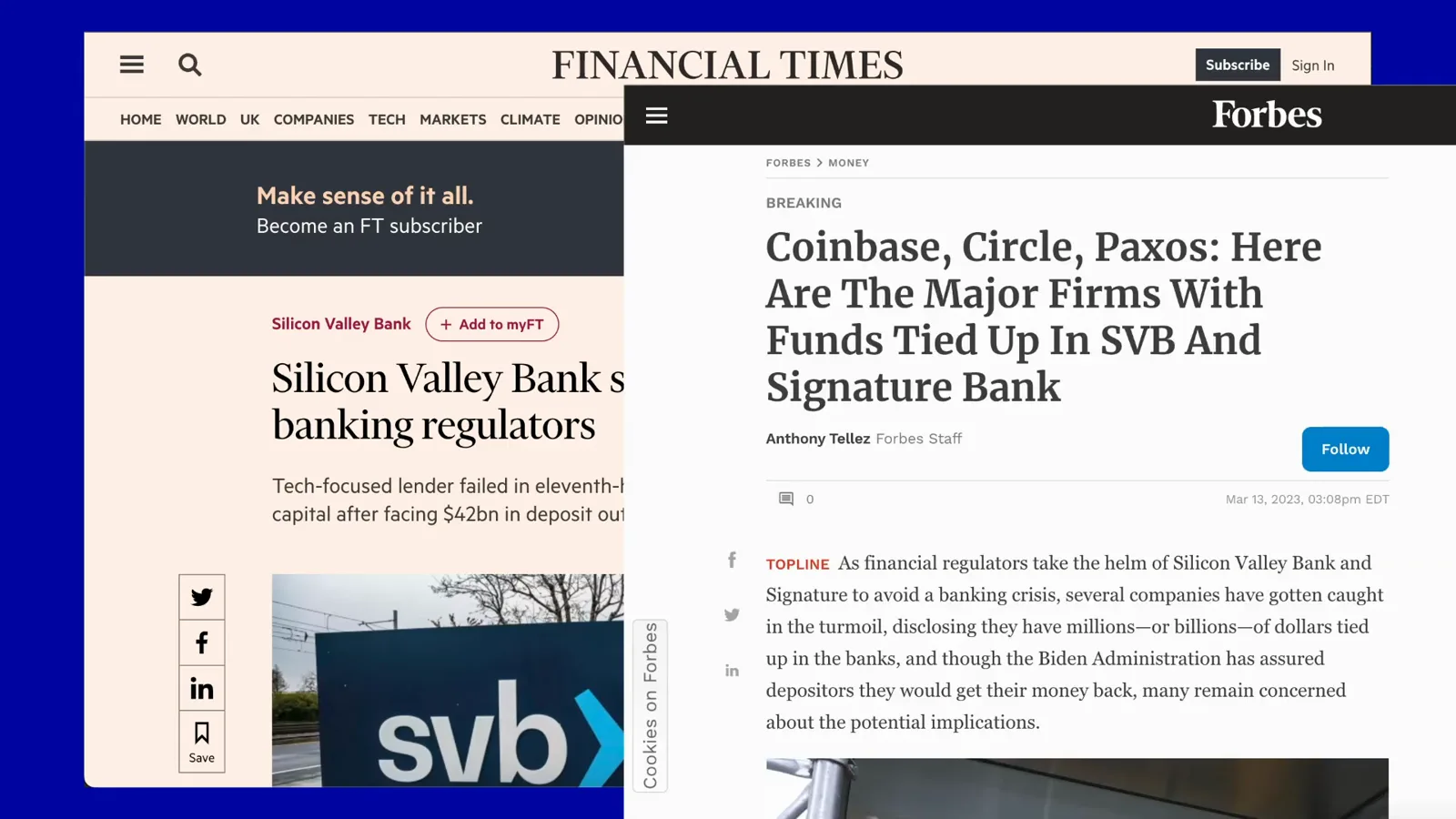
When conversions stop, the peg is only worth the last trade.Watch at 4:59
Sunday: Contagion Hits Crypto's Banks
While USDC bled, regulators moved on the industry's remaining bank — and the 24/7 pipes that moved crypto's dollars went down with it.
- 10
Signature Bank becomes the second shoe
On Sunday, March 12, the New York State Department of Financial Services closed Signature Bank — at $110.4 billion in assets, the third-largest bank failure in US history at that point, two days after SVB. Signature was a full-service New York commercial bank with deep real-estate and legal clients, but it had bet early on crypto: digital-asset deposits reached roughly a fifth to a third of its book, and after SVB fell, customers — most holding far more than the $250,000 insurance cap — pulled more than $10 billion in deposits. Regulators said they acted to protect the financial system; much of crypto read a different message: banks serving this industry get closed. Silvergate, SVB, Signature — all three of crypto's favorite banks were gone in five days.

Five days took down all three of crypto's favorite banks.Watch at 1:40 - 11
The rails go dark: Signet and SEN
The part that hurt for years was plumbing nobody outside the industry had heard of. Signature's Signet and Silvergate's SEN were private 24/7/365 payment networks — the only US banking rails that settled dollars between crypto platforms around the clock, on weekends and holidays, when the rest of the banking system slept. Coinbase and Circle both used them to move institutional money. With their parent banks seized or liquidated, US crypto lost its round-the-clock dollar pipes overnight: settlement slowed to banking hours, US liquidity thinned, and analysts called it a huge step backward for the industry's infrastructure. A stablecoin that trades 24/7 had just learned its dollars only move when banks allow it.

The banks died on a weekend. The pipes died with them.Watch at 4:06
Monday: The Backstop
Washington invoked a rule built for systemic crises, every depositor was made whole — and USDC went home to $1.
- 12
Treasury, Fed and FDIC act together
On the evening of Sunday, March 12, Treasury Secretary Janet Yellen, Fed Chair Jerome Powell and FDIC Chairman Martin Gruenberg issued a joint statement: invoking the systemic risk exception, all depositors of Silicon Valley Bank would have access to all of their money starting Monday, March 13 — the same protection applied to Signature Bank. The losses would be covered by the Deposit Insurance Fund through a special assessment on banks, and the statement was explicit: no losses associated with the resolution would be borne by the taxpayer. The Fed added a new Bank Term Funding Program behind it, so other banks would not have to sell underwater Treasuries to meet withdrawals. The panic had found its counterparty: the US government.
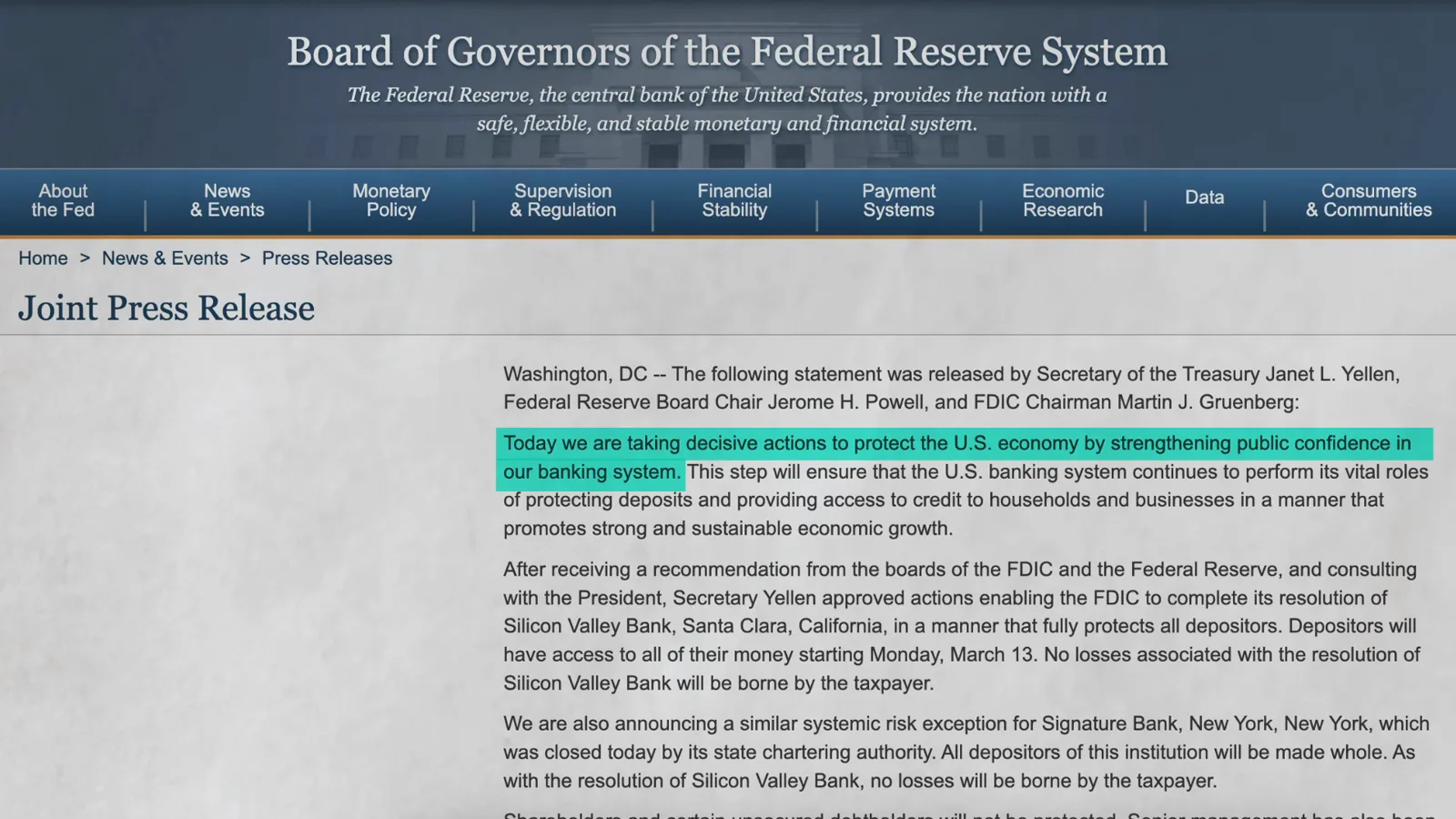
The systemic-risk exception — reserved for moments when letting a bank fail is the bigger risk.Watch at 3:36 - 13
Every depositor made whole
Monday morning went exactly as promised. The FDIC transferred all deposits — insured and uninsured — and substantially all assets of Silicon Valley Bank into a newly created bridge bank, Silicon Valley Bridge Bank, N.A. Depositors had full access to their money at the opening of business: online banking, ATMs, debit cards, checks, all working as before. Borrowers kept their loans on the same terms. The uninsured 90%-plus of SVB's deposit base — the money the whole weekend had been priced against — never lost a cent, and Circle confirmed its $3.3 billion was accessible. The overhang that had crushed USDC to 87 cents simply evaporated.
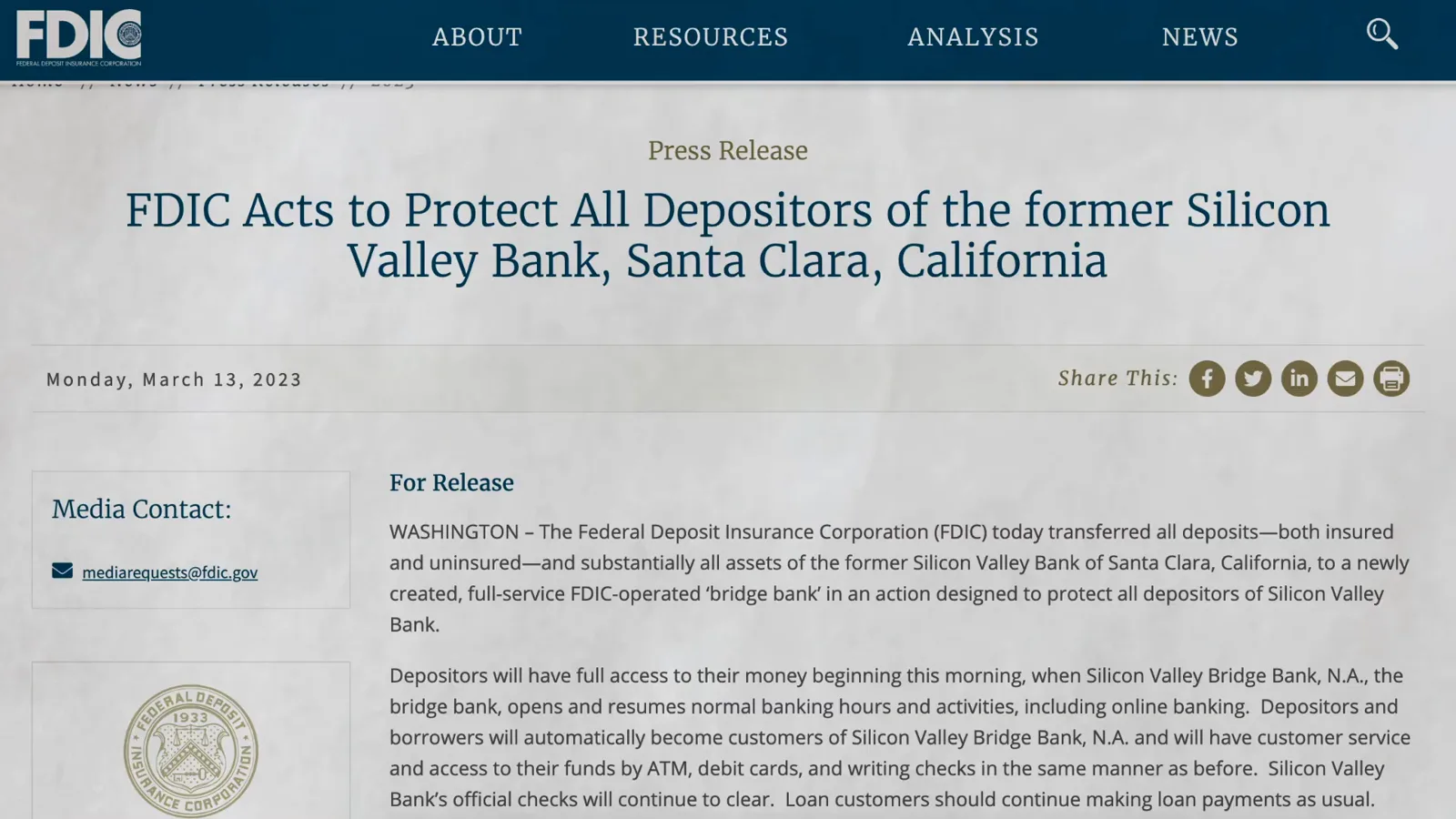
Insured or not, every dollar came back.Watch at 5:09 - 14
USDC goes home to $1
The all-clear came from the top. Circle's CEO Jeremy Allaire posted that 100% of the deposits held at Silicon Valley Bank were secure and would be available at banking open — the line CoinMarketCap splashed across its quote card as the market reopened. USDC climbed back through Monday morning and was trading at or above $1.00 on major venues by March 13, with the Curve pool refilling as arbitrageurs bought the discount against redemption. The episode's scoreboard: no USDC holder who waited lost a dollar; holders who sold at 0.88 booked a 12% loss on a dollar. Circle survived, scarred. Silvergate and Signature did not. And the phrase "TradFi counterparty risk" entered crypto's permanent vocabulary.
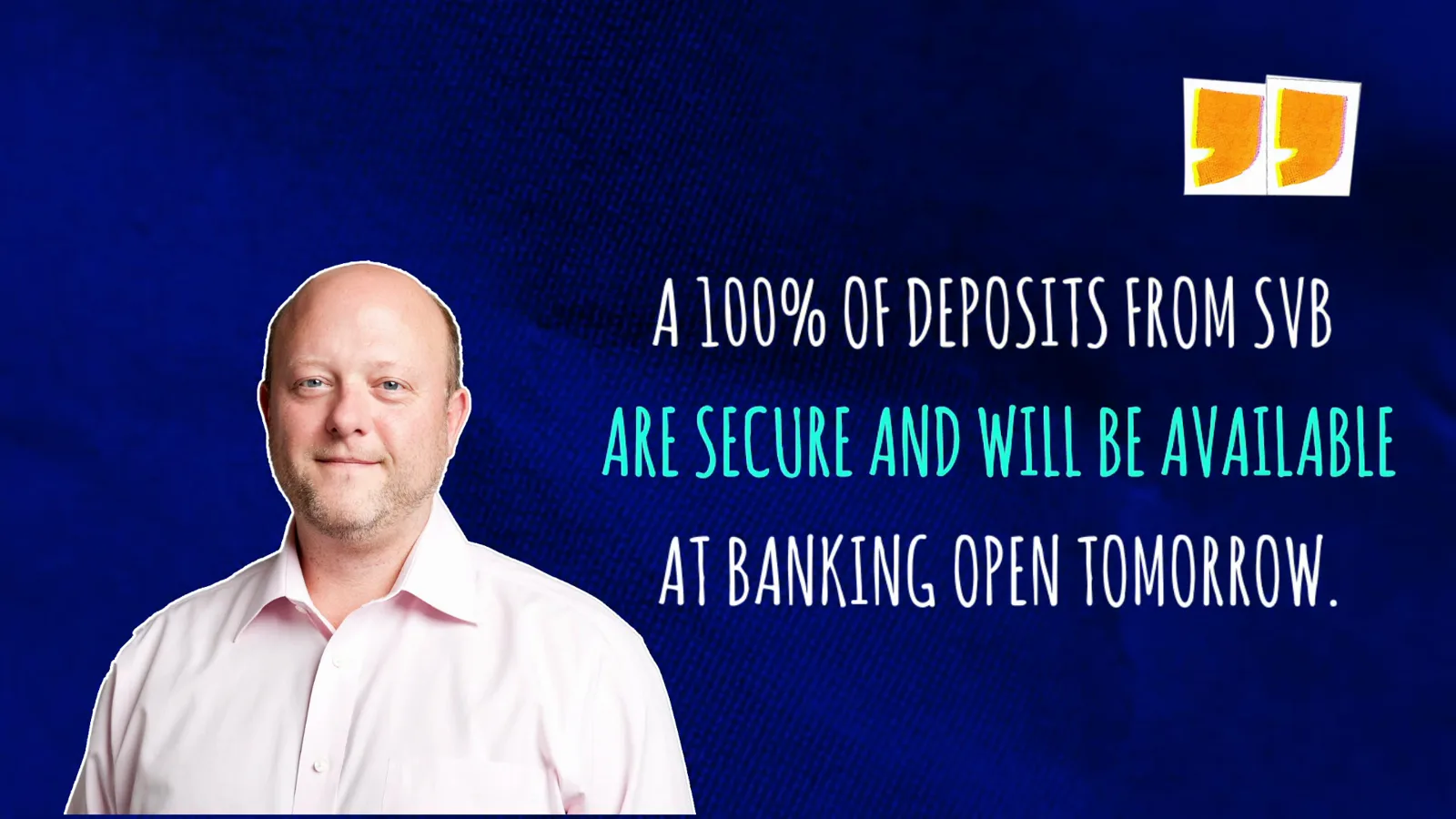
The sentence that ended the panic.Watch at 5:32 - 15
The queue outside, the lesson inside
On Monday afternoon, depositors lined up outside the Santa Clara headquarters as the bridge bank opened its doors — the physical tail end of a run that had been almost entirely digital. The lesson travelled faster than the line. Stablecoins had not removed banking risk; they had imported it, wire-by-wire, into crypto's foundations. Within months the episode was cited in Washington debates over payment stablecoin legislation and in Federal Reserve research on stablecoin runs, alongside a simple fact: USDC's deepest crisis came not from code, or a hack, or a rug pull, but from an ordinary 40-year-old risk — a bank failure. Crypto had built a dollar for the internet and parked its reserves in a bank for startups.
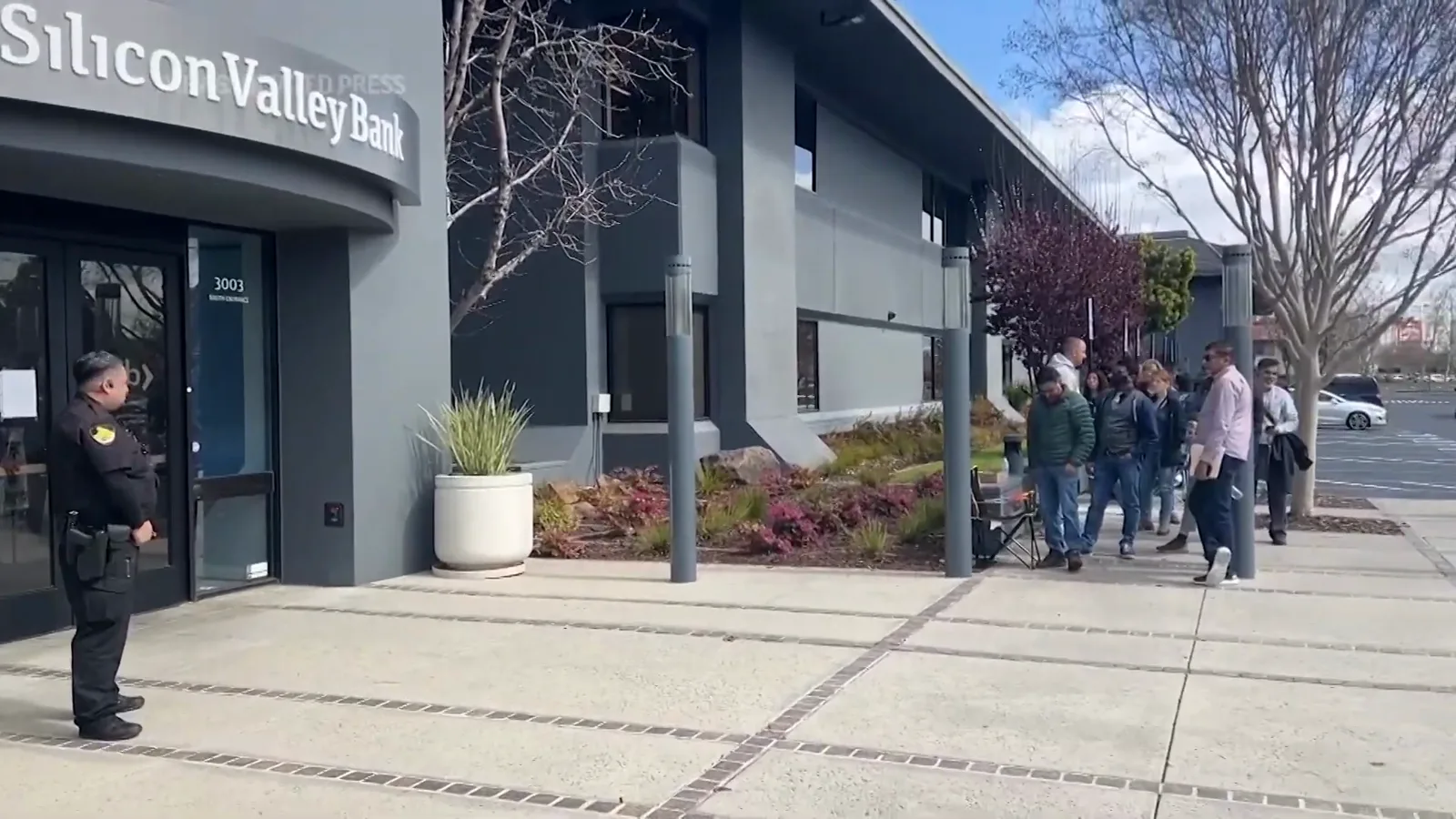
TradFi risk had been hiding inside crypto's dollar all along.Watch at 5:40
Frequently Asked Questions
What caused the USDC depeg in March 2023?
Did USDC lose its peg permanently? How low did it go?
Is USDC safe now after the 2023 depeg?
What is Circle, the company behind USDC?
USDC vs USDT: how are the two biggest stablecoins different?
Did the USDC depeg change stablecoin regulation?
Continue the Story
The History of Crypto Regulation
The USDC depeg became Exhibit A in the push for payment stablecoin rules — trace the whole regulatory timeline from FinCEN's 2013 notice to the GENIUS Act era.
E-Gold: The Internet's First Digital Dollar
Decades before USDC, e-gold let anyone hold money backed by real assets — until regulators showed what happens to private money at scale.
Crypto Winter 2018: How Bitcoin Fell 84%
Five years before the depeg, crypto's first great winter taught the same lesson: markets test whether promises are real — and they rarely are.
Dead Crypto Exchanges: Six Major Collapses
Mt. Gox, FTX and friends failed from hacks, fraud and insolvency — the counterparty-risk hall of fame the SVB weekend briefly joined.
References
Extended Multimedia Reference
Visual sequences and chronologies in this guide cross-reference video documentation “The USDC De-Peg Explained” by CoinMarketCap.
This illustrated guide is maintained strictly for educational, research, and historical documentation purposes. None of the materials constitute investment, financial, legal, or trading advice. Historical crisis and market events are documented from public archives. Digital assets involve significant risks.