The History of Bitcoin Mining, Machine by Machine
From a Nokia phone that mined 0.42 BTC to 200 TH/s flagships: a walk through the machines that turned a laptop hobby into a global industry in barely fifteen years.
13 minutes • 16 illustrated steps • sourced from Red Fox Crypto's museum walkthrough
Source video
“The Amazing History of Bitcoin Mining”
Channel: Red Fox Crypto
How has bitcoin mining changed over time?
Bitcoin mining started as an experiment on whatever hardware was nearby — even a 2010 Nokia N900 could mine at 150 KH/s and send 0.42 BTC to another phone. Graphics cards briefly ruled in 2013, until the Avalon 1 arrived as the world's first dedicated ASIC miner and made general-purpose chips obsolete overnight. Bitmain's Antminer line then pushed the arms race from shoebox rigs to warehouse scale, and by January 2024 a single Antminer S21 delivering 200 TH/s held more mining power than every computer on the planet combined during bitcoin's early CPU era.
Key Takeaways
- Bitcoin mining compressed a century of hardware evolution into about fifteen years: the museum's oldest everyday device, a Nokia N900, mined at 150 KH/s, while a 2024 Antminer S21 does 200 TH/s — a billion-fold jump.
- The Avalon 1 (January 2013) is labeled the world's first ASIC on its museum placard — the first dedicated bitcoin miner ever released to market, and treated by collectors as the Mona Lisa of mining.
- Pre-order scandals are part of the history: Butterfly Labs took $25 million in pre-orders from 20,000 customers for its Jalapeno, shipped almost none, and was later shut down by the government.
- Bitmain's Antminer line industrialized mining: the S7 jammed 162 chips into a shoebox-sized rig to quadruple hash power per square inch, and the S9 became the most legendary miner of all time by running "like a tank" through mud, rain and freezing temperatures.
- January 2024 flagships made the contrast explicit: the Whatsminer M60S claims hash power one million times greater than all computers used for NASA's Apollo moon landings.
- The frontier is still moving — the Teraflux AT1500 marks the first bitcoin miners manufactured in the USA, donated to the museum by Marathon Digital Holdings.
When Anything Could Mine
In bitcoin's first years there were no mining machines — people mined with whatever hardware they already owned, and the amounts sound tiny today.
- 1
A conference hall that holds the whole time line
Every year at the Mining Disrupt conference, the Bitcoin Mining Museum lines up the machines that defined each era of bitcoin mining. The collection is short in years but dense in change: within a single decade, mining hardware went from home computers to purpose-built terahash monsters. Walking the tables in order is the fastest way to feel how fast the race moved.
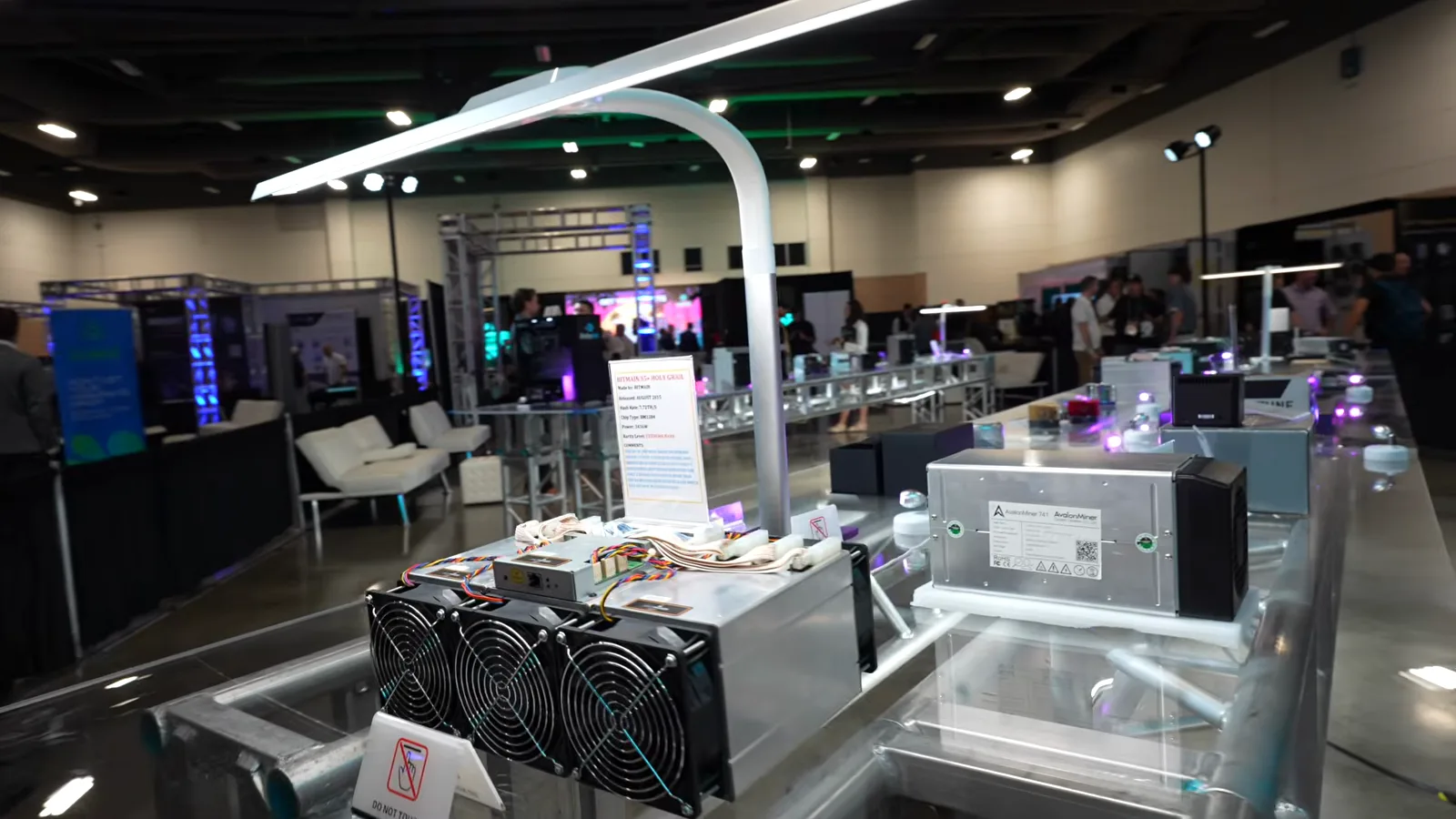
The walkthrough begins: a conference hall laid out as mining's time line.Watch at 1:18 - 2
2010: the phone that mined bitcoin
The Nokia N900 was a smartphone with a real terminal — and a bitcoin client wallet. Its placard credits it with about 150 KH/s of hash power and records that it mined and sent 0.42 BTC to another N900 user over the phone network. In 2010 that was ordinary mining; today it is one of the museum's most charming exhibits.
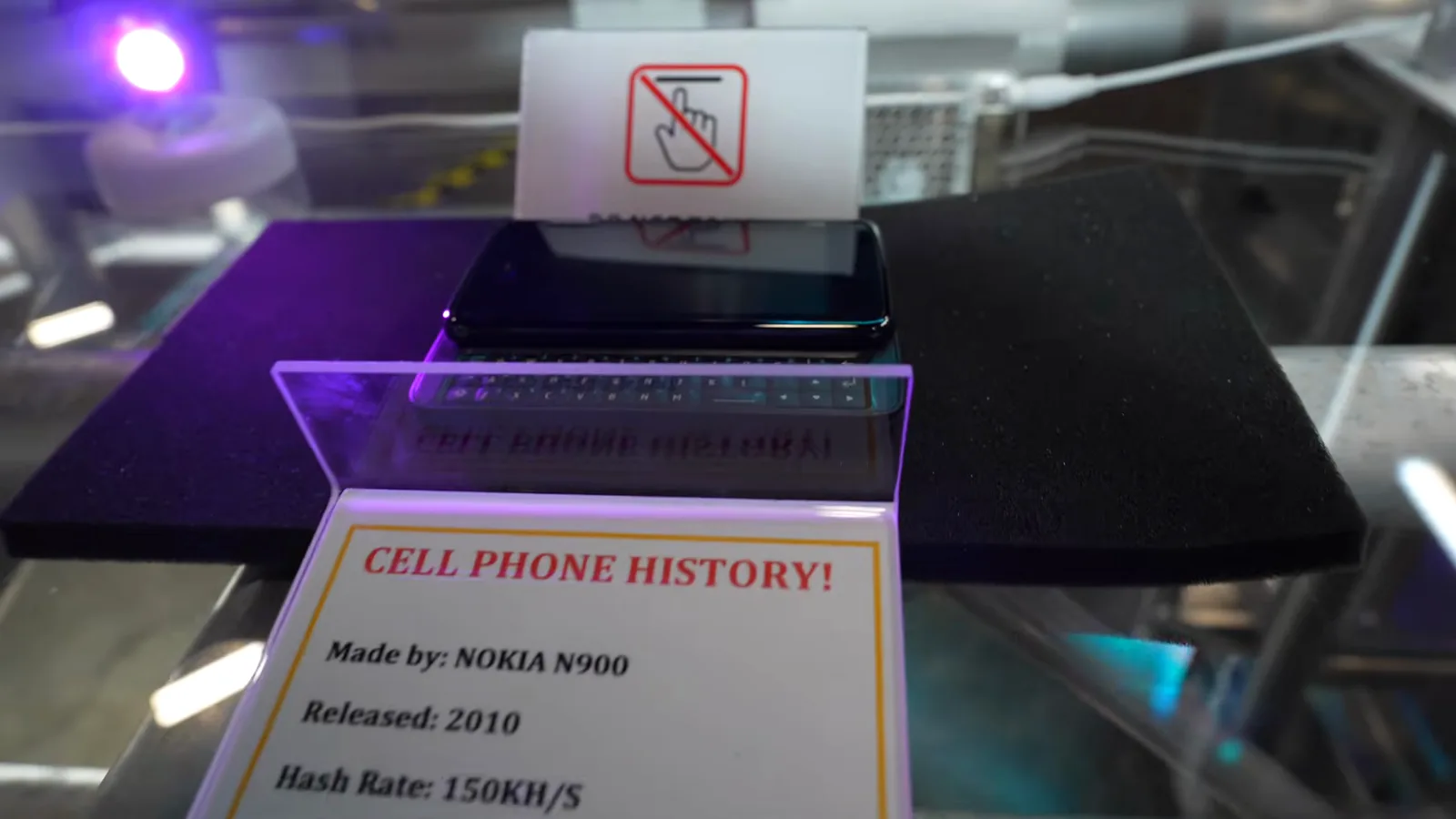
Before dedicated rigs existed, a phone with a terminal could mine and send bitcoin.Watch at 7:00 - 3
2015: a USB stick for developers
The 21.co Bitcoin PC paired a tiny ASIC USB module with a Raspberry Pi and was marketed almost entirely to developers. At 50 GH/s and just 15 watts, it mined bitcoin and could transact peer to peer — less a money-maker than a programmable introduction to mining. It marks the last moment a general-purpose gadget still counted as mining hardware.
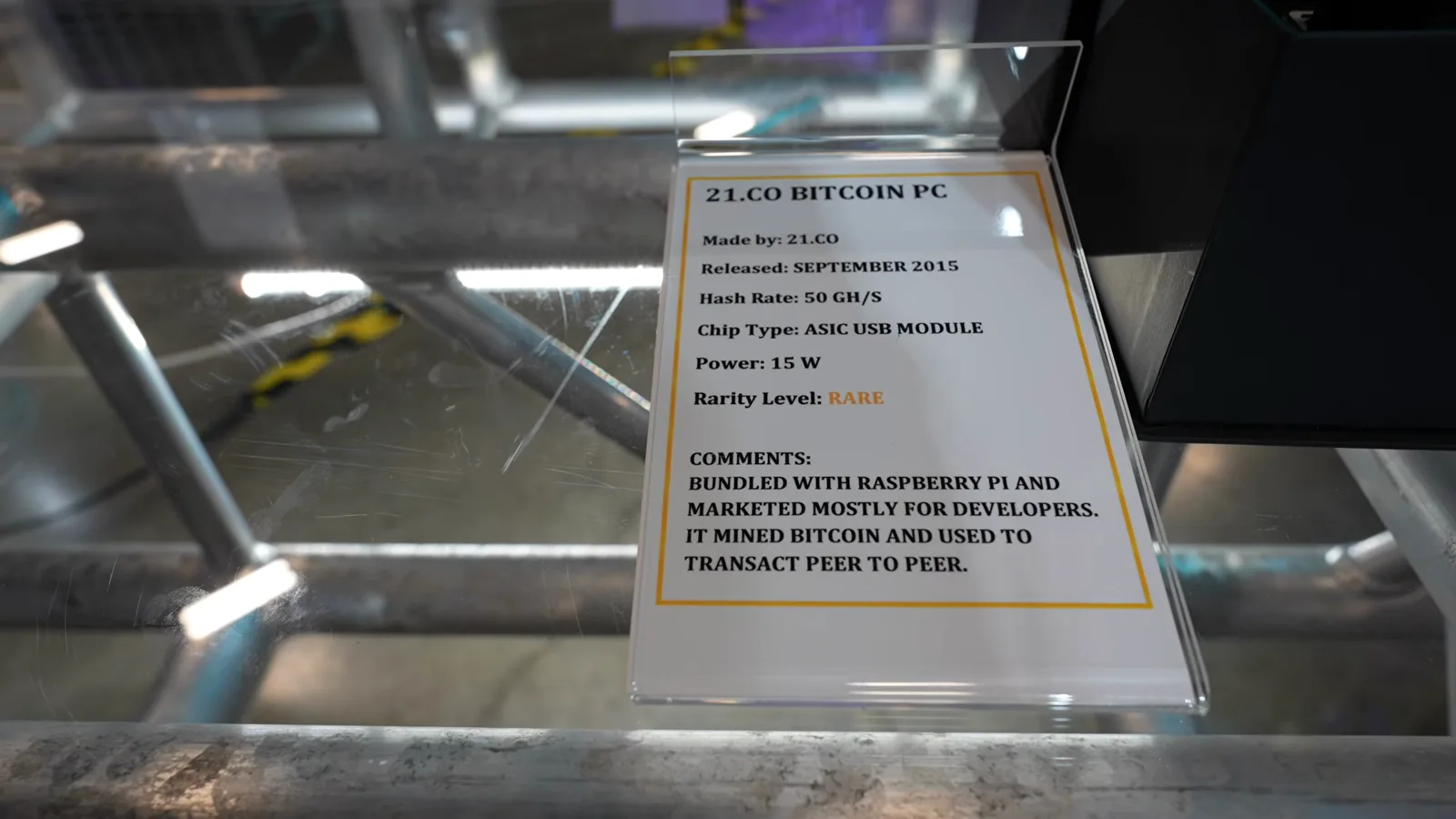
A 15-watt stick that mined bitcoin and passed transactions peer to peer.Watch at 6:40
The GPU Detour
For a brief window, the same graphics cards that rendered video games were the most profitable mining hardware on earth.
- 4
May 2013: the card that started the race
The museum's ASUS GeForce GTX 780 placard reads "common yet historic" — under 1 MH per card, 28 nanometers, 250 watts. This exact card class was used for bitcoin mining by OG BitsBeTrippin, which the placard calls the first-ever YouTube channel for bitcoin mining back in 2013. When gamers and miners started bidding for the same cards, the mining race got its first consumer-market casualty.
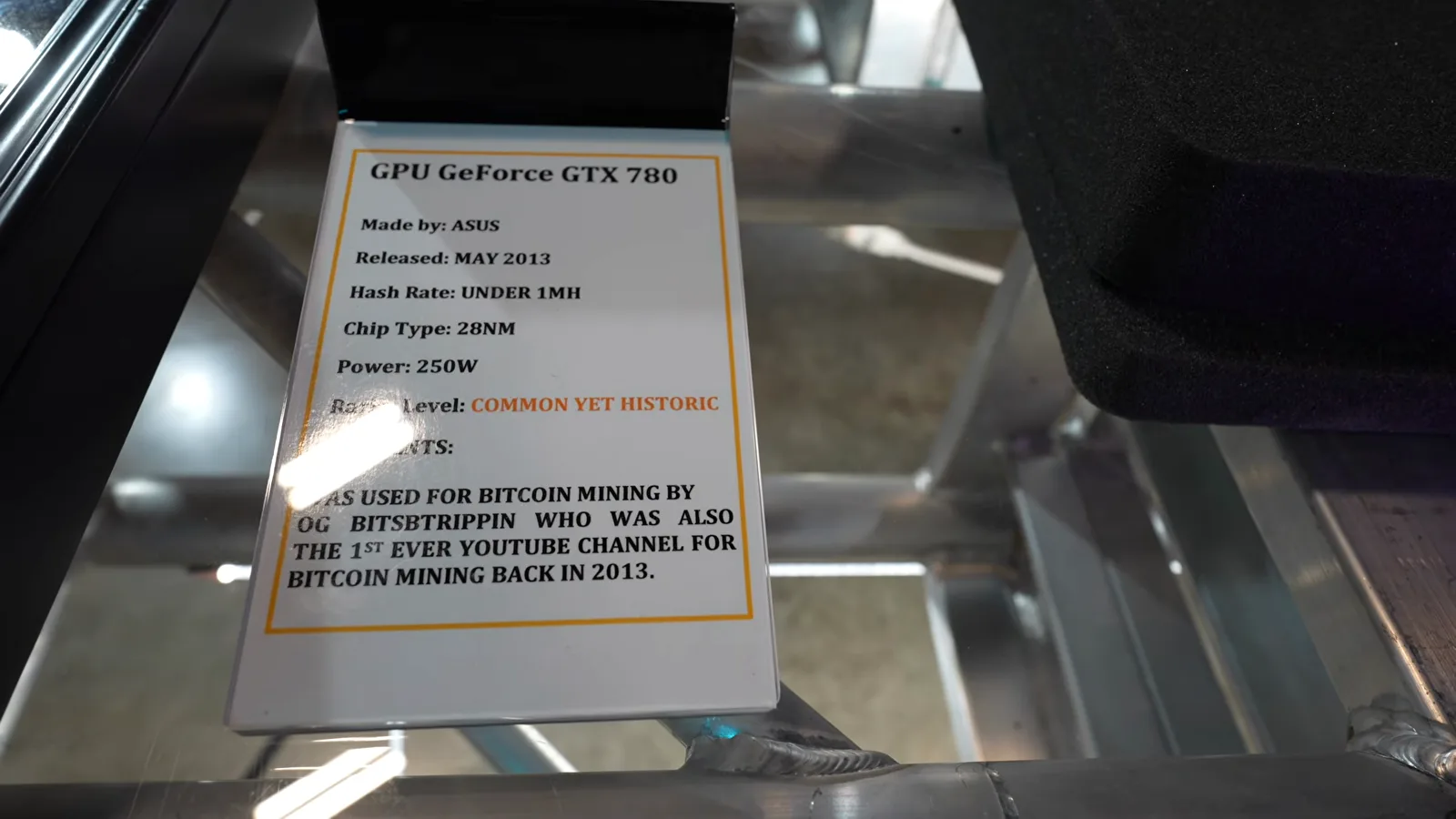
"Common yet historic": the card that turned gaming GPUs into mining tools.Watch at 2:52 - 5
What one graphics card actually looked like
A single dual-fan GPU like this ASUS card is all it took to join the network in the GPU era. Compared with the phone before it, a card delivered orders of magnitude more hash rate — but compared with what came next, it was a candle next to a floodlight. Its short reign ended the day the first ASICs shipped.
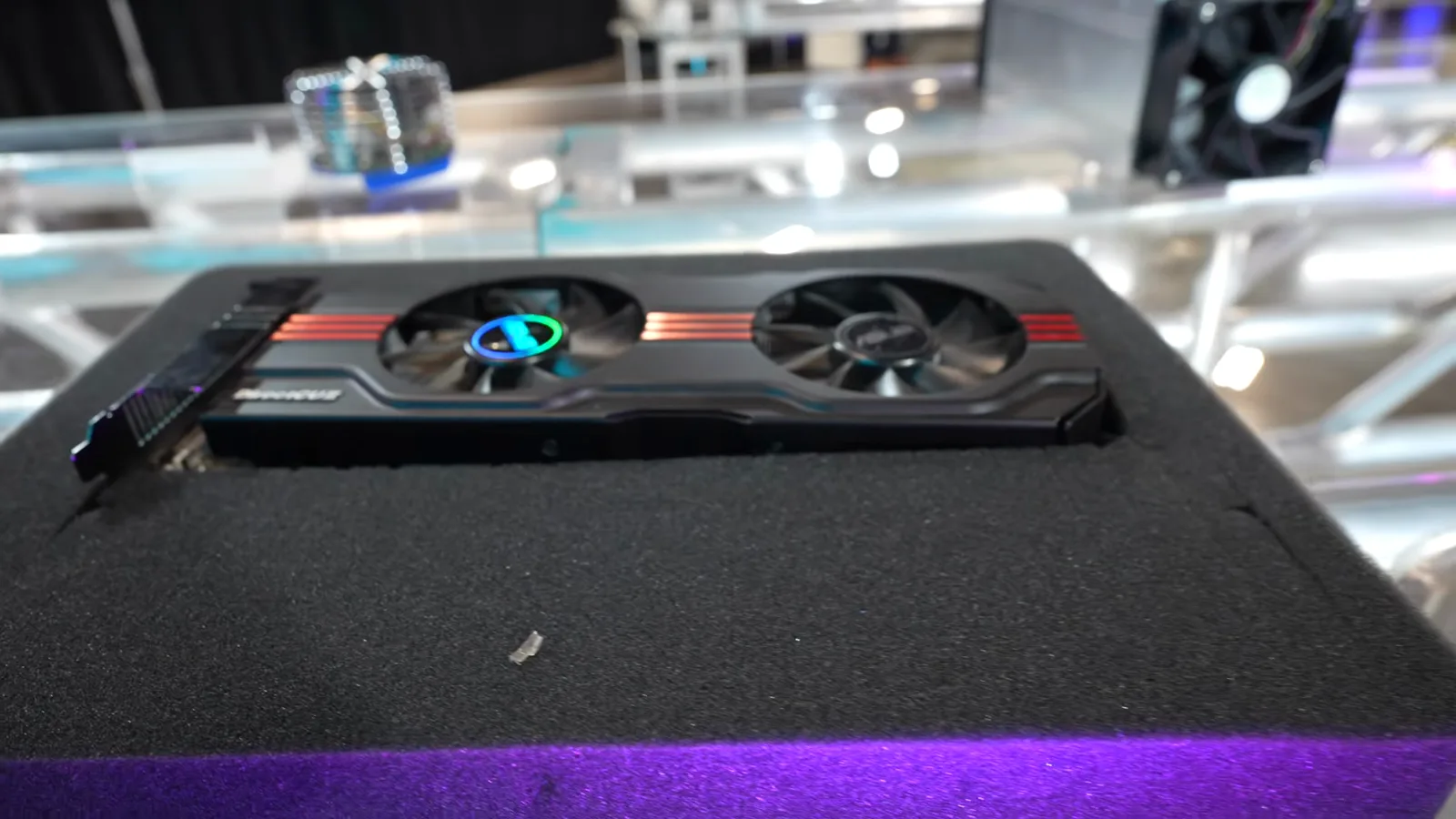
One card, one miner: the GPU era's low barrier to entry.Watch at 2:58
2013: The ASIC Big Bang
Within eighteen months, purpose-built ASIC miners appeared, sold out on pre-orders, and made every GPU rig obsolete.
- 6
The $25 million pre-order
Butterfly Labs' Jalapeno (April 2013, 5 GH/s on a 65nm chip at 30 watts) is the museum's reminder that demand ran far ahead of delivery. Its placard records that BFL took $25 million in pre-orders from 20,000 customers — and that over a year later only a select few ever got one. The ASIC era began with the industry's first great shipping scandal.
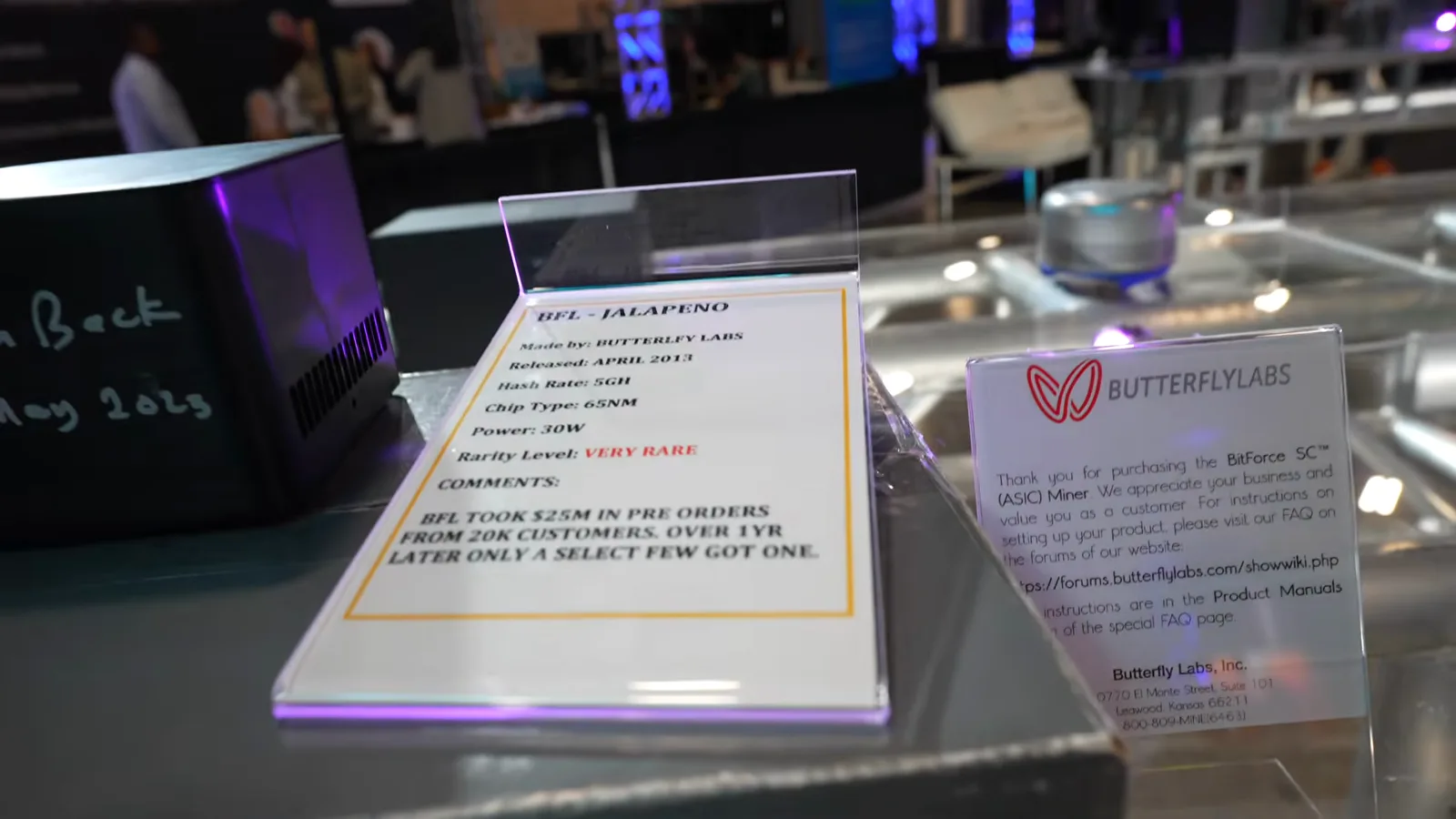
BFL took $25M from 20,000 customers. A year later, only a few had miners.Watch at 2:00 - 7
Avalon 1: the world's first ASIC
Released in January 2013 with an Avalon A3256 chip, 60 GH/s and 620 watts, the Avalon 1 is labeled on its placard as the world's first ASIC — the first dedicated bitcoin miner ever released to market. Collectors consider it the Mona Lisa of mining. From this point on, mining belonged to machines that could do nothing but hash.
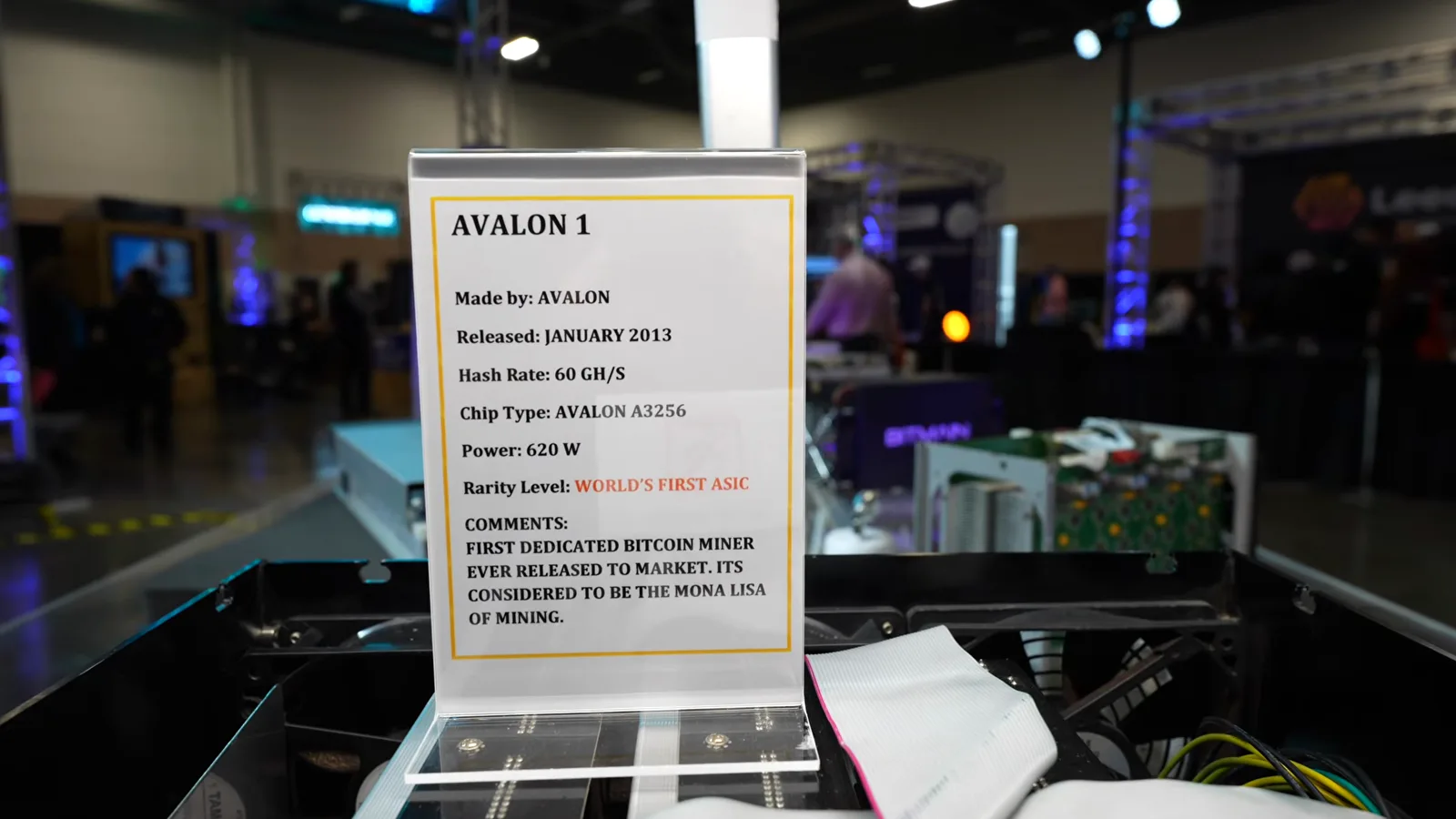
The Mona Lisa of mining: the first machine built for nothing but hashing.Watch at 4:20 - 8
ASICMINER's stackable blades
The Blade V2, made by ASICMINER in May 2013, delivered 10.7 GH/s per blade at 80 watts on a 130nm chip, and could run individually or ten to a back plate. Its ultra-rare placard marks one of the era's strangest experiments: a mining company that sold shares and hardware at the same time. Blades like these turned mining from a desk setup into rack infrastructure.
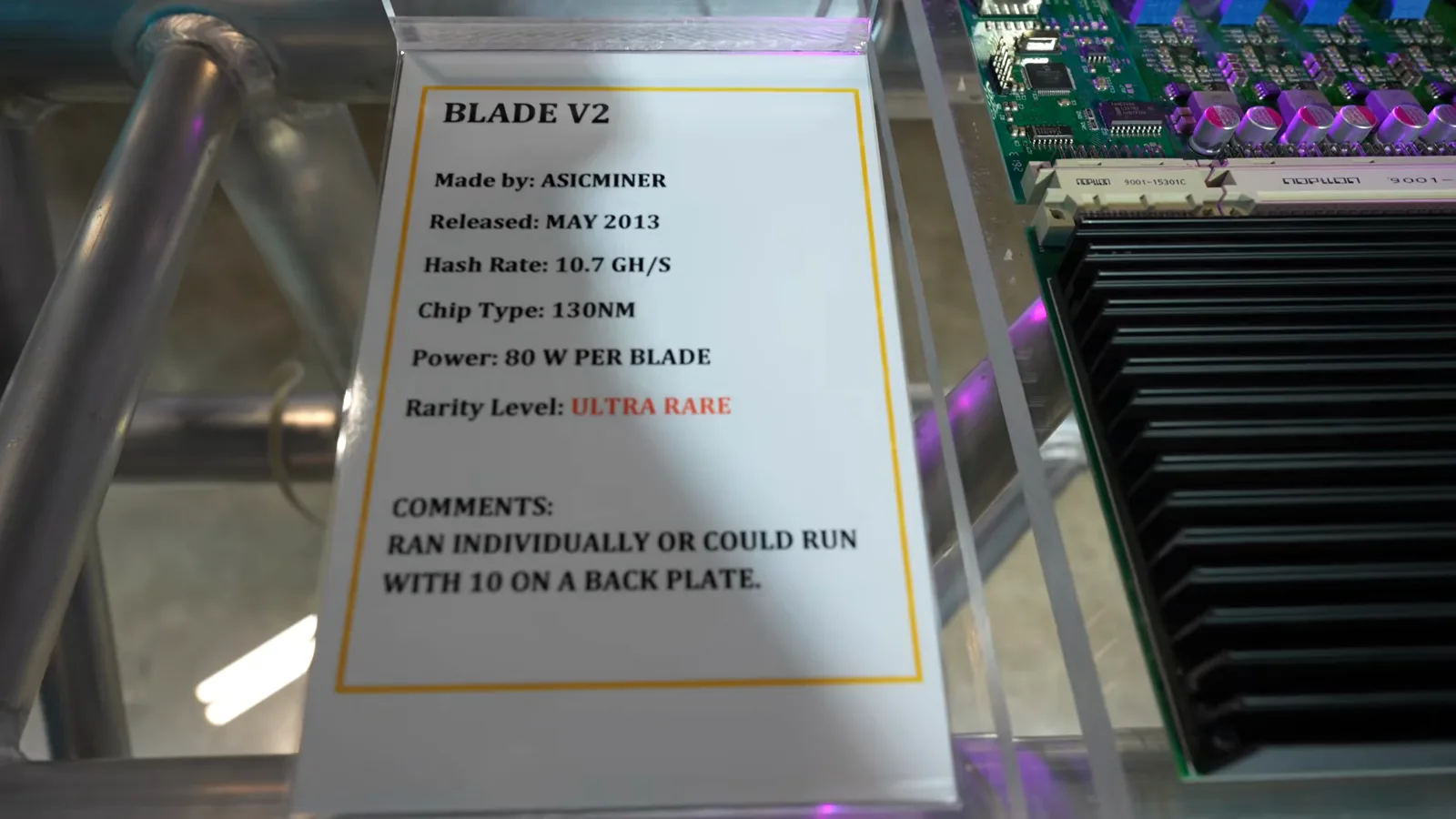
Ten blades on a back plate: mining starts to look like rack hardware.Watch at 3:30 - 9
KnC Neptune: a Swedish rarity
KnC's Neptune arrived in May 2014 at 3 TH/s on a 20nm chip drawing 2,100 watts — and this particular unit is ultra rare. Its placard notes it was autographed in Sweden by KnC founder Sam Cole, one of only five miners he ever signed. Within a year of the first ASIC, a single machine was already hashing like thousands of GPUs.
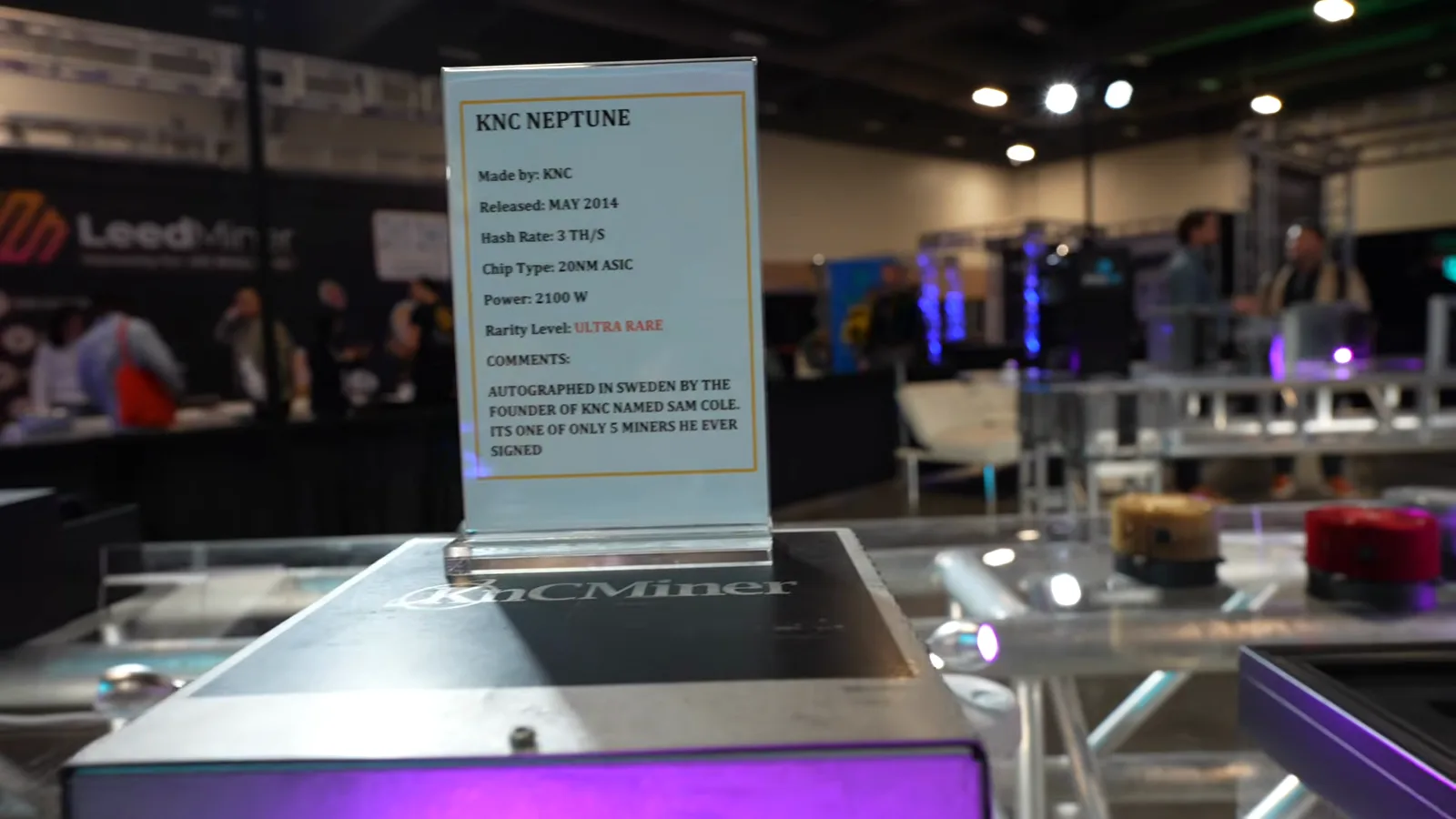
One of only five ever signed by KnC's founder — ASICs had reached terahash scale.Watch at 2:28
Factories, Scandals and the Tank
The second half of the 2010s belonged to Bitmain's Antminer line — and to the industry's first boom-bust cautionary tales.
- 10
Butterfly Labs gets shut down
The Monarch was Butterfly Labs' flagship: 700 GH/s on a 28nm chip, 650 watts, priced at $5,000. Its placard tells the ending plainly — the government shut BFL down after 20,000 pre-orders never shipped. The company that opened the ASIC era with undelivered Jalapenos closed it as mining's first cautionary tale.
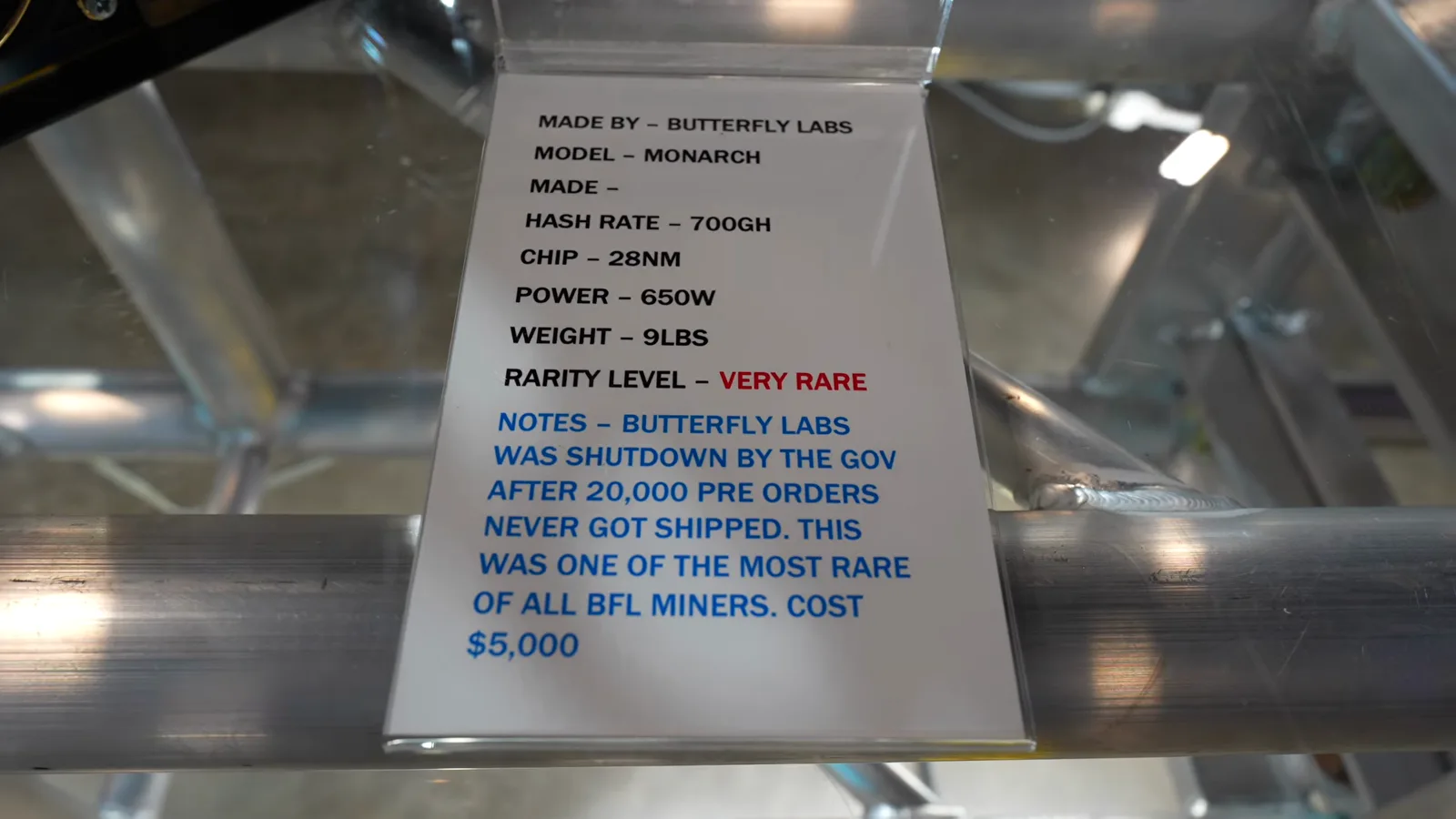
$5,000 a unit — and the story ends with a government shutdown.Watch at 8:14 - 11
2015: the S7 density monster
Bitmain's Antminer S7 (September 2015, 4.7 TH/s on the BM1385 chip at 1,293 watts) earned its placard's nickname by jamming 162 chips into a shoebox-sized rig — versus just 60 in the S3 — quadrupling hash power per square inch. Density became the new battleground: more hashing in the same footprint meant more revenue per warehouse rack.
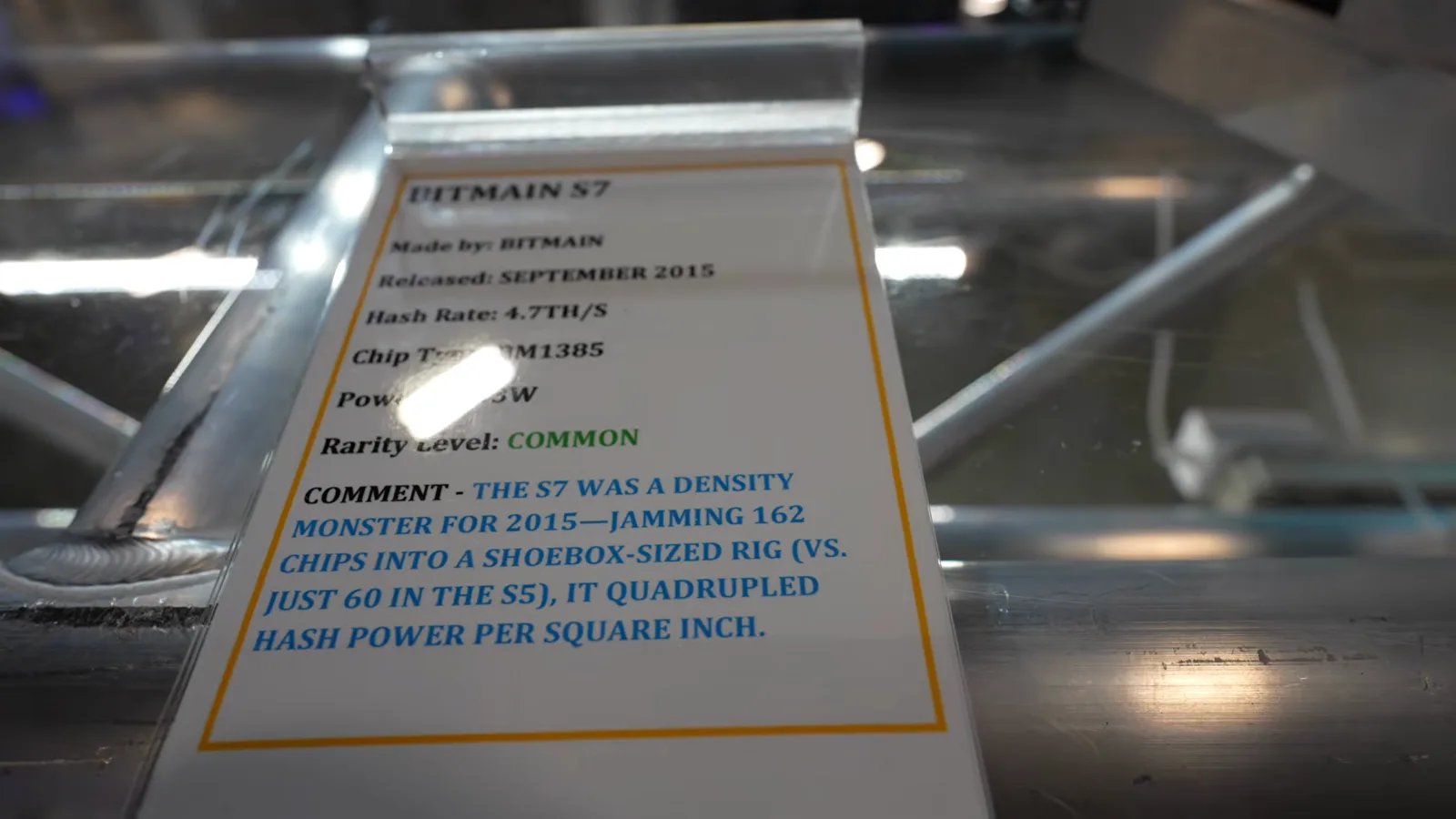
162 chips in a shoebox: the moment mining became an engineering discipline.Watch at 5:10 - 12
The S9: the most legendary miner of all time
Released in May 2017 at 13.5 TH/s on the BM1387 chip, the Antminer S9 is described on its placard as the most legendary miner of all time — it ran like a tank through mud, slides, rain, freezing temperatures and hot weather. Ruggedness, not just raw speed, is what let mining scale into basements, farms and warehouses worldwide. Many S9s kept hashing years after newer machines arrived.
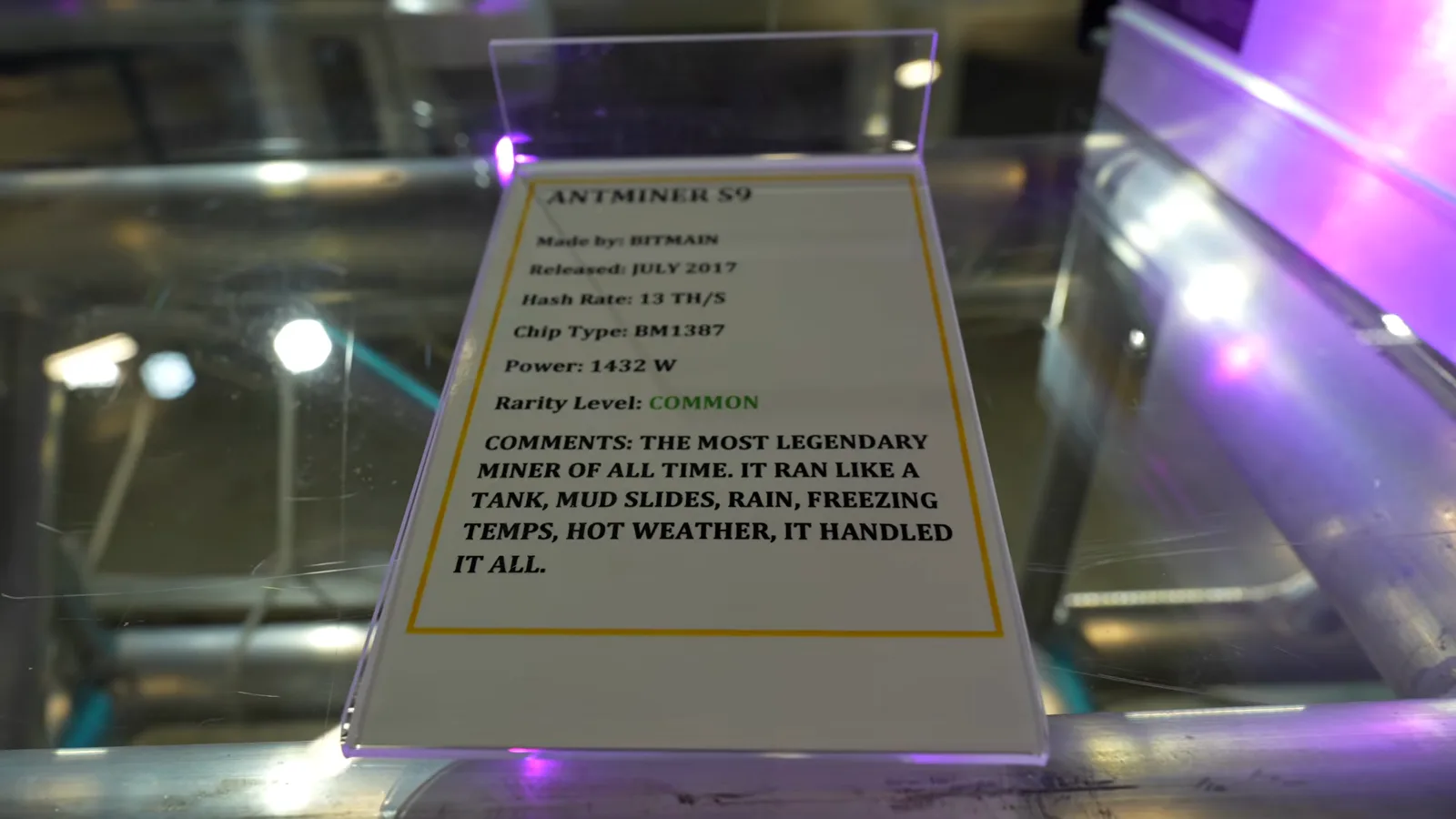
Mud, slides, rain, freezing temps — the S9 handled it all.Watch at 5:32
2024: Terahash Monsters and a New Map
Today's flagships hash hundreds of terahash per unit — and the industry's center of manufacturing has started to shift again.
- 13
M1: the first Whatsminer, signed
The Whatsminer M1 (March 2018, 12 TH/s at 2,000 watts) is placarded as the first Whatsminer model ever made and a historic piece of bitcoin mining history. This unit was signed by founder Zuoxing Yang, who had worked at Bitmain — the company behind the legendary S9 — before founding MicroBT. A Bitmain alum building Bitmain's toughest competitor is the subplot that defined late-era mining.
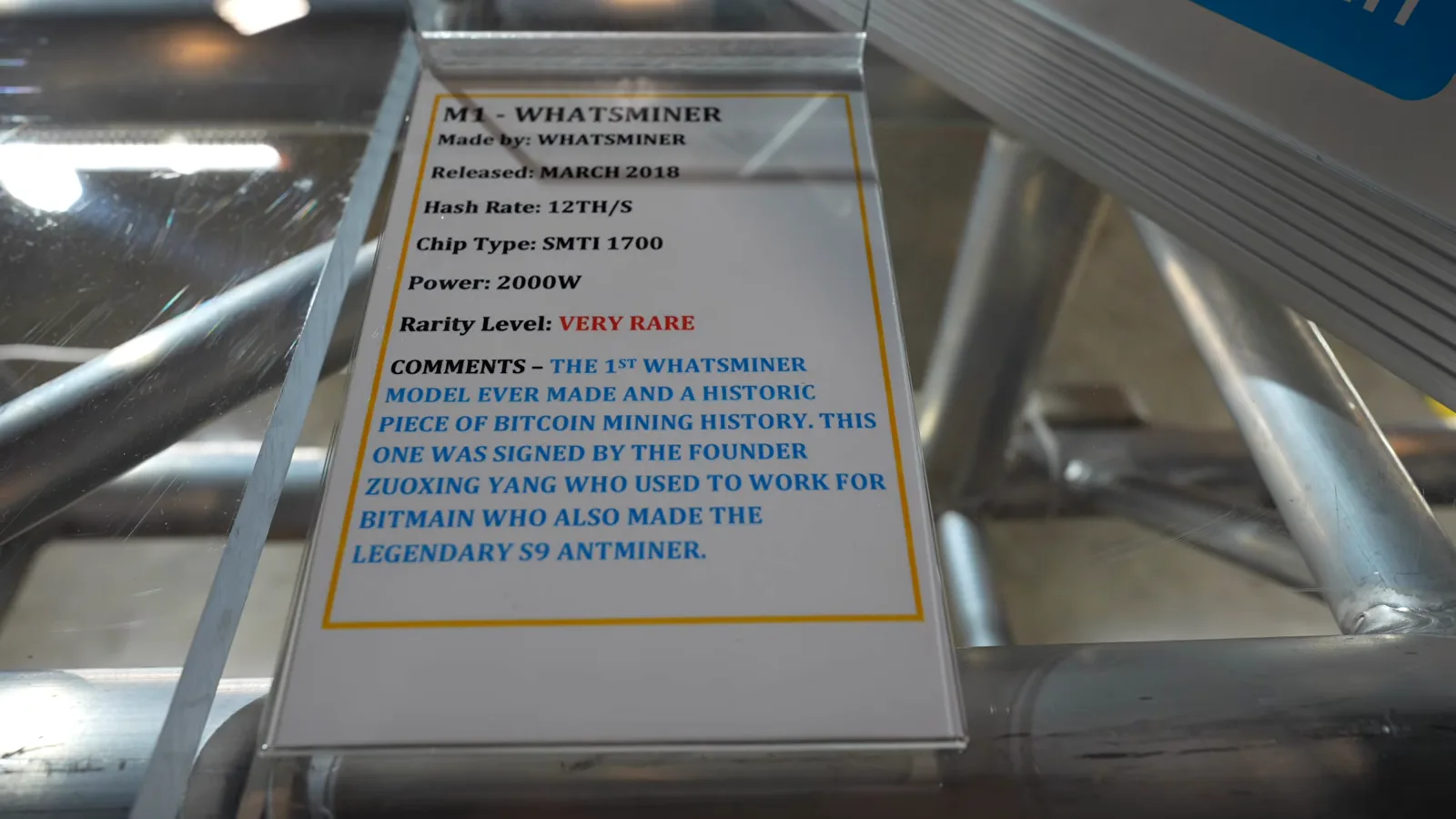
The first Whatsminer, signed by the ex-Bitmain founder who built it.Watch at 10:20 - 14
M60S: a million times Apollo
The Whatsminer M60S, released in January 2024, hashes 186 TH/s on Samsung 5nm silicon at 3,441 watts. Its placard's fun fact makes the scale vivid: that hash power is one million times greater than all the computers used for NASA's Apollo moon landings combined. Machines like this are why individual hobbyist rigs no longer register on the network's radar.
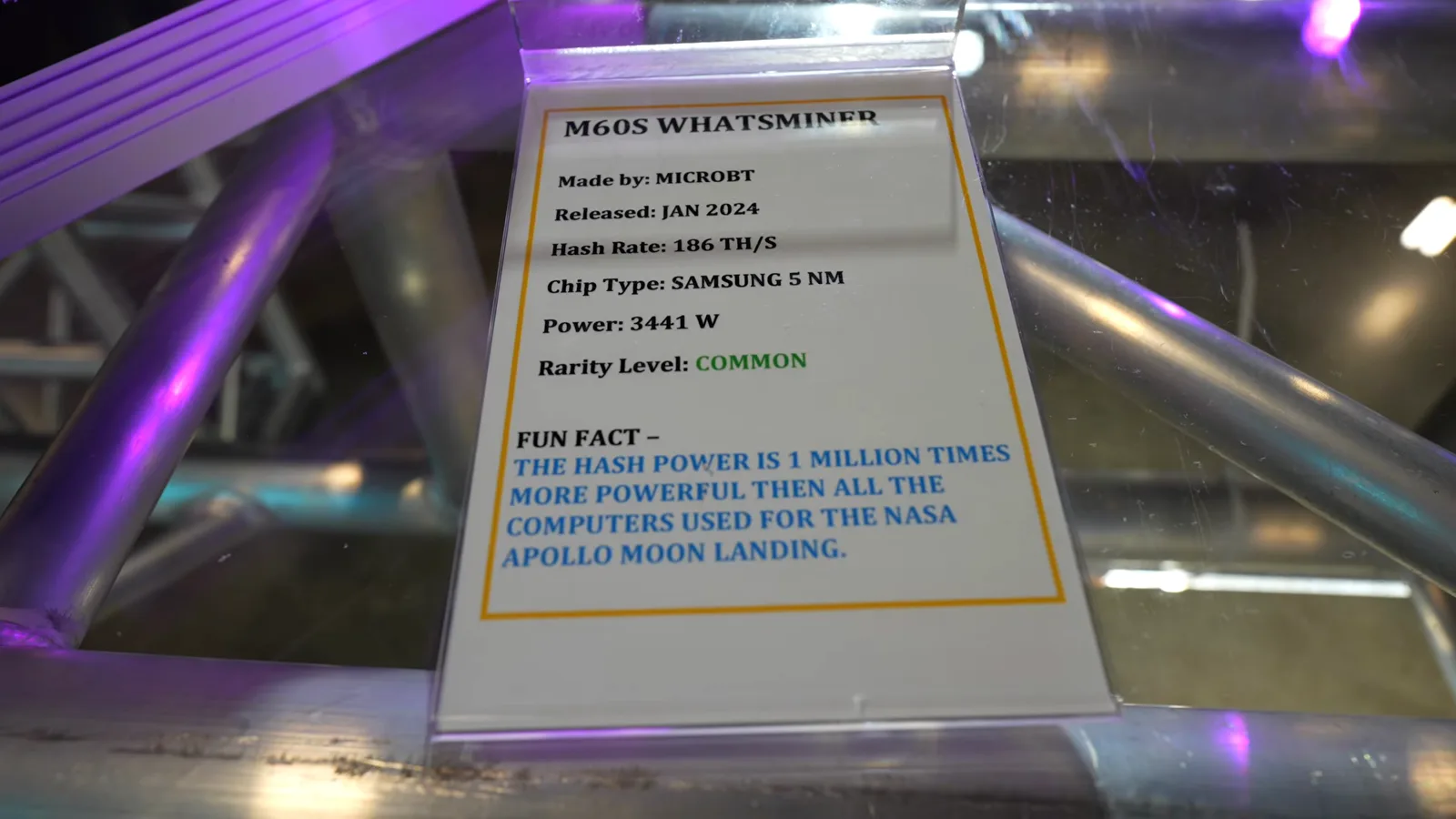
One box, more hash power than the Apollo program's entire computer budget.Watch at 7:40 - 15
Antminer S21: out-mining bitcoin's first decade
Bitmain's answer, the Antminer S21 (January 2024), delivers 200 TH/s on a 5nm chip at 3,500 watts. Its placard puts the number in perspective: a single unit passes more bitcoin-mining power than every computer on the planet combined during bitcoin's early days of 2009-2010, when mining was done with basic CPUs. The whole network's original hash rate now fits in one shoebox.
One 2024 unit > every CPU on Earth in 2009-2010.Watch at 8:52 - 16
Teraflux AT1500: made in the USA
Auradine's Teraflux AT1500, released in January 2024, hashes 150 TH/s on a 4nm chip — and its placard records two firsts: the first bitcoin mining company to manufacture miners in the USA, and a unit donated to the museum by Marathon Digital Holdings. After years of Asia-centered manufacturing, the industry's geography is diversifying again. The museum's newest shelf, like mining itself, keeps moving.
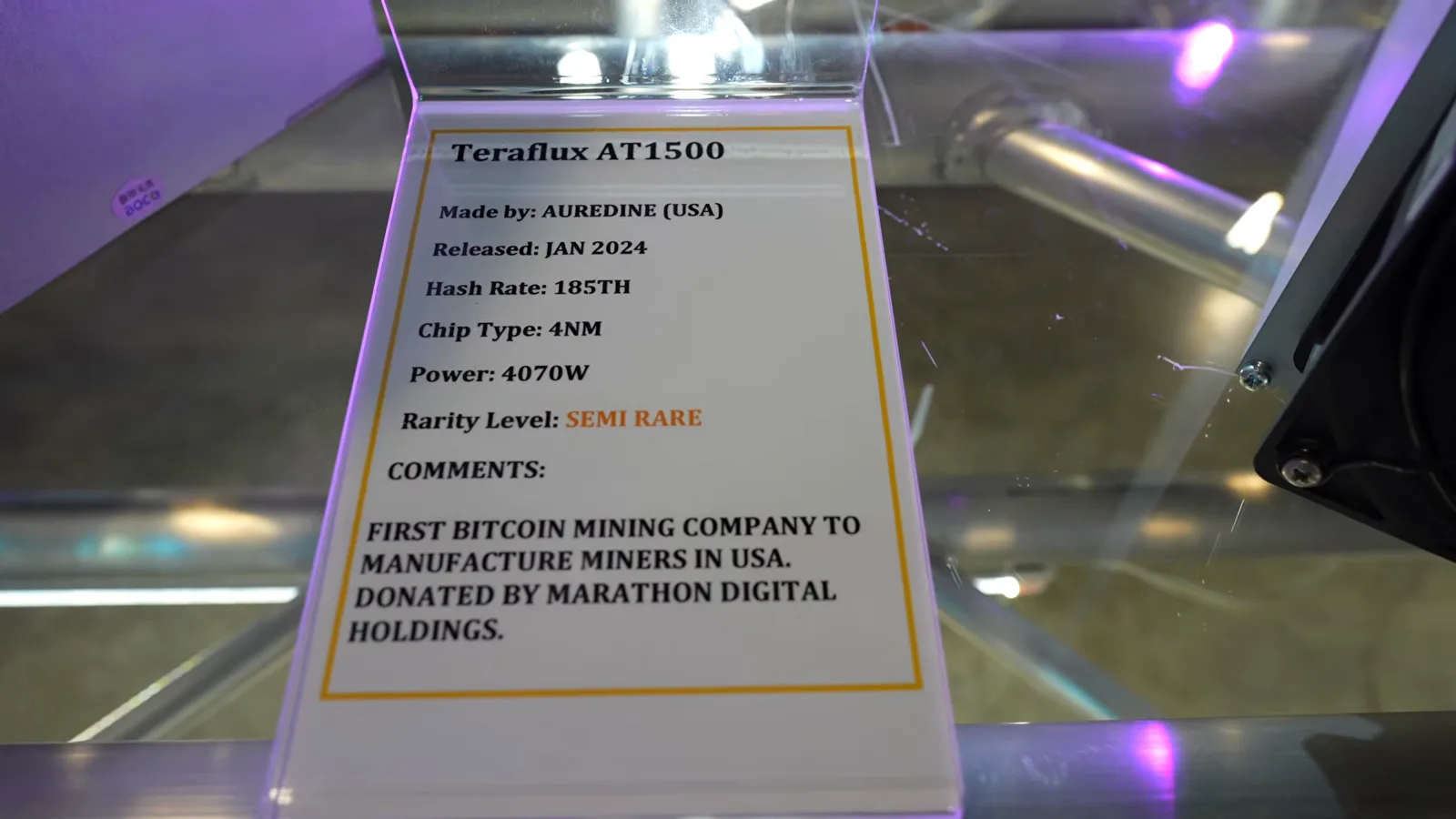
The first US-manufactured miner — mining's map is still being redrawn.Watch at 7:56
Frequently Asked Questions
How has bitcoin mining changed over time?
When did GPU mining start?
What is an ASIC?
Why did miners move to China, and why did they leave?
What is a mining pool?
Is bitcoin mining still profitable?
Continue the Story
Bitcoin Halving History: Every Reduction, Explained
The halvings are mining's economic engine — see how each reward cut reshaped the miners on this page.
What Is the Genesis Block?
Start where the first CPU-mined block was minted: block 0 and the 50 BTC reward that can't be spent.
Bitcoin History: The Complete Guide
Place the hardware race back into the full arc from whitepaper to institutional adoption.
The Mt. Gox Collapse: Complete Timeline
The exchange era that grew up alongside the mining boom — and how it collapsed.
Bitcoin Whitepaper, Explained Section by Section
The document that defined the proof-of-work system all these machines serve.