184 Billion Fake Bitcoin: The 2010 Value Overflow Incident
On August 15, 2010, someone used an integer overflow to conjure 184,467,440,737.09551616 bitcoin in a single transaction — nearly 8,800 times everything Bitcoin can ever mine. What followed is the closest thing Bitcoin has to a rescue story: a one-line forum post, a patch written by Satoshi in about five hours, and the only chain rollback in Bitcoin's history. This illustrated guide walks the whole incident through the original posts, screenshots and numbers.
9 minutes • 16 illustrated steps • The only rollback in Bitcoin's history
Editorial Research & Chronological Archive
Independently synthesized and cross-verified by The Blockchain History Editorial Board using primary whitepapers, historical archives, and on-chain records.
What was the 2010 Bitcoin value overflow incident?
The value overflow incident was a bug exploited on August 15, 2010, in which a transaction in block 74638 created 184,467,440,737.09551616 BTC — about 184.5 billion fake bitcoin — through an integer overflow now catalogued as CVE-2010-5139. Two outputs of roughly 92.23 billion BTC each summed to a value so large it wrapped around in 64-bit math, so unpatched clients accepted the transaction as valid. Developer Jeff Garzik flagged it on the Bitcointalk forum within about an hour; Satoshi Nakamoto and Gavin Andresen posted patches the same evening, a fixed client (version 0.3.10) was out within about five hours, and miners abandoned the bad chain — the good chain overtook it at block 74691 on August 16, erasing the fake coins in a 53-block reorganization. No fake bitcoin ever circulated, and nobody lost money.
Key Takeaways
- On August 15, 2010, block 74638 carried a transaction that created 184,467,440,737.09551616 BTC — roughly 184.5 billion fake bitcoin, about 8,800 times Bitcoin's entire 21 million cap — split across three different addresses.
- The bug, CVE-2010-5139, was an integer overflow: two outputs of 92,233,720,368.54277039 BTC each summed to a figure that wrapped around in 64-bit arithmetic, so pre-fix clients read the transaction as valid and the block solver pocketed an extra 0.01 BTC that had never existed.
- Jeff Garzik spotted the anomaly on the Bitcointalk forum and asked the question that named the bug class — '92233720368.54277039 BTC? Is that UINT64_MAX, I wonder?' — and within minutes other users had diagnosed the overflow.
- Satoshi Nakamoto posted his own CheckTransaction patch in the thread and urged miners to stop generating on the bad chain; a fixed client was published within about five hours of discovery, and the official 0.3.10 release followed the next day.
- The resolution was a soft fork, not an administrator's undo button: miners built only on the good chain, which overtook the bad one at block 74691 on August 16 — a 53-block reorganization after which the 184-billion transaction simply does not exist on the chain Bitcoin kept.
- The comparison to Ethereum's 2016 DAO rollback fails on every number: in 2010 bitcoin's all-time high was about $0.40 and the whole network was worth under ~$1.54 million, while Ethereum reversed its chain at a ~$1 billion market cap — and Bitcoin caught a second inflation bug (CVE-2018-17144) in 2018 before anyone could exploit it.
The Day the Money Supply Broke
August 15, 2010. Block 74638. A transaction nobody was supposed to be able to write.
- 1
A hacker mints 184 billion bitcoin
On August 15, 2010, block 74638 carried a transaction that created 184,467,440,737.09551616 BTC — call it 184.5 billion — sent to three different addresses. Two outputs held roughly 92.23 billion BTC each, and the block's solver also collected an extra 0.01 BTC that had not existed before the transaction. Against Bitcoin's hard cap of 21 million, the single transaction claimed about 8,800 times everything that can ever be mined. It remains the largest amount of fake money ever created on a major blockchain — and, remarkably, the entire episode was over within hours, with no fake coin ever reaching an exchange.

184.5 billion BTC, conjured in one transaction.Watch at 0:18 - 2
'Zero security audits'? Open source is the audit
The incident lives on as a favorite talking point for altcoin promoters: articles retelling it highlight that Bitcoin's source code "still has zero security audits." The critique collapses the moment you look at what Bitcoin actually is. The client and the blockchain are both fully open source, and thousands of developers, miners, exchanges and researchers read that code every day — Bitcoin has, as the video puts it, more eyes on it than probably any project in computer science history. It is one giant bug bounty program: anyone who finds a hole can try to steal hundreds of billions of dollars. No paid audit can match that incentive — and it is exactly how this bug, and a second one in 2018, got found and fixed so fast.

'Zero security audits' — the line that sells altcoins.Watch at 2:48 - 3
The reference books agree on the basics
The Bitcoin Wiki's "Value overflow incident" entry preserves the canonical facts: block 74638, mined August 15, 2010, carried 184,467,440,737.09551616 newly created BTC across three addresses, and the flaw is catalogued as CVE-2010-5139. The root cause was subtle — transaction validation checked each output against the rules but never checked whether the outputs, summed together, would overflow the 64-bit integer space. The entry also records the strange footnote of the case: the 0.5 BTC the attacker spent to trigger the bug still exists on the chain today, untouched since. The fake billions, by contrast, were wiped from history entirely.
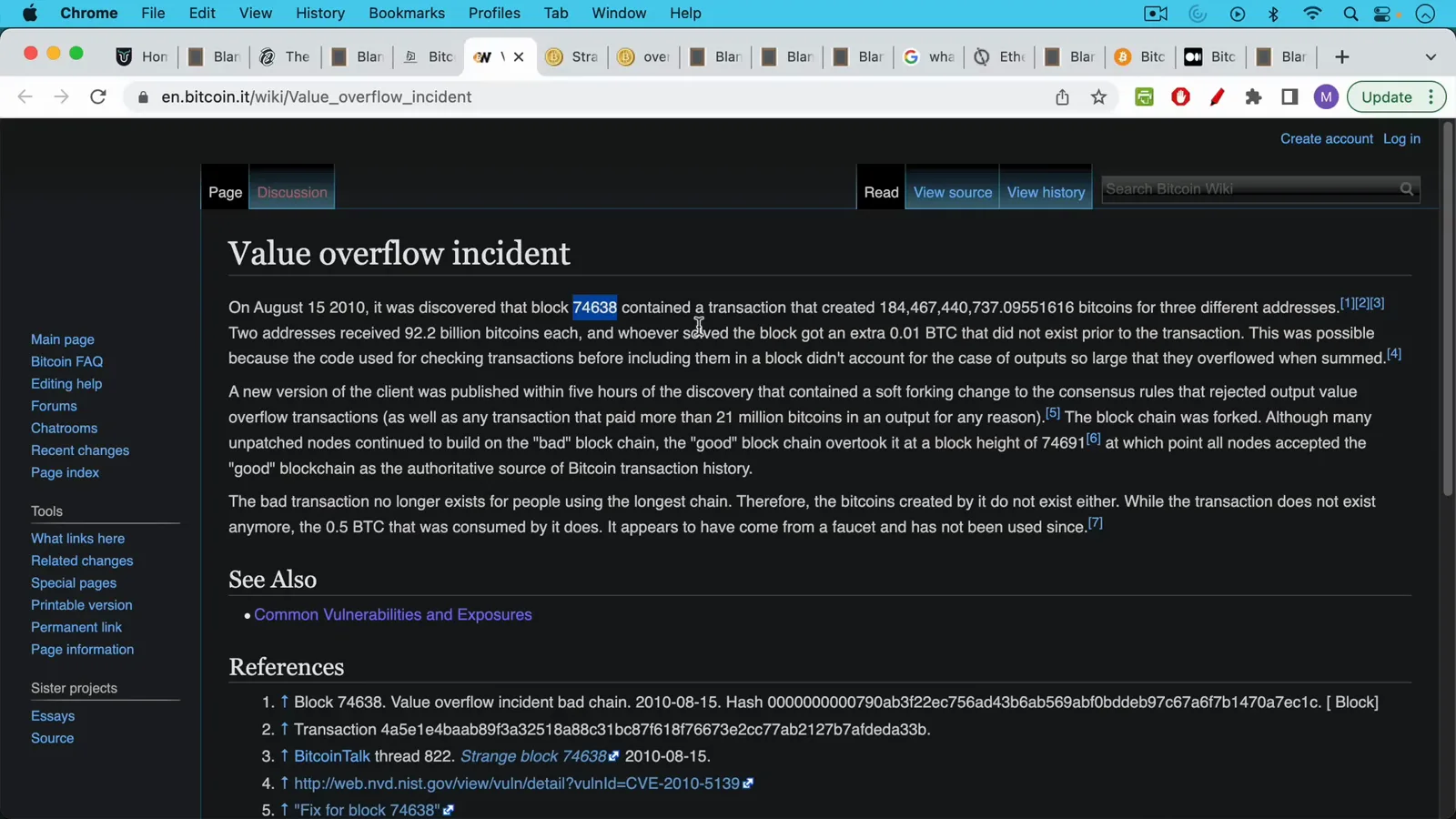
Block 74638 — the number that broke the rules.Watch at 3:46
Spotted Live: The Forum Response
The poison block survived for under an hour before a developer's eyebrows went up. What happened next is Bitcoin governance working in real time.
- 4
The raw transaction: 92 billion BTC per output
Jeff Garzik didn't just report the oddity — he pasted the block's raw JSON so anyone could verify it. The dump shows two "value" fields of 92,233,720,368.54277039 BTC inside block 74638, next to an ordinary coinbase output worth about 50 BTC. To a trained eye the numbers jump off the screen: 92 billion bitcoin is more than the network would ever mine. Forum regulars did the math within minutes — the pair of outputs summed to a value that wraps around the 64-bit integer space, which is exactly why pre-patch clients had accepted them as valid. Total transparency is the whole story here: no trusted third party had to break the news.
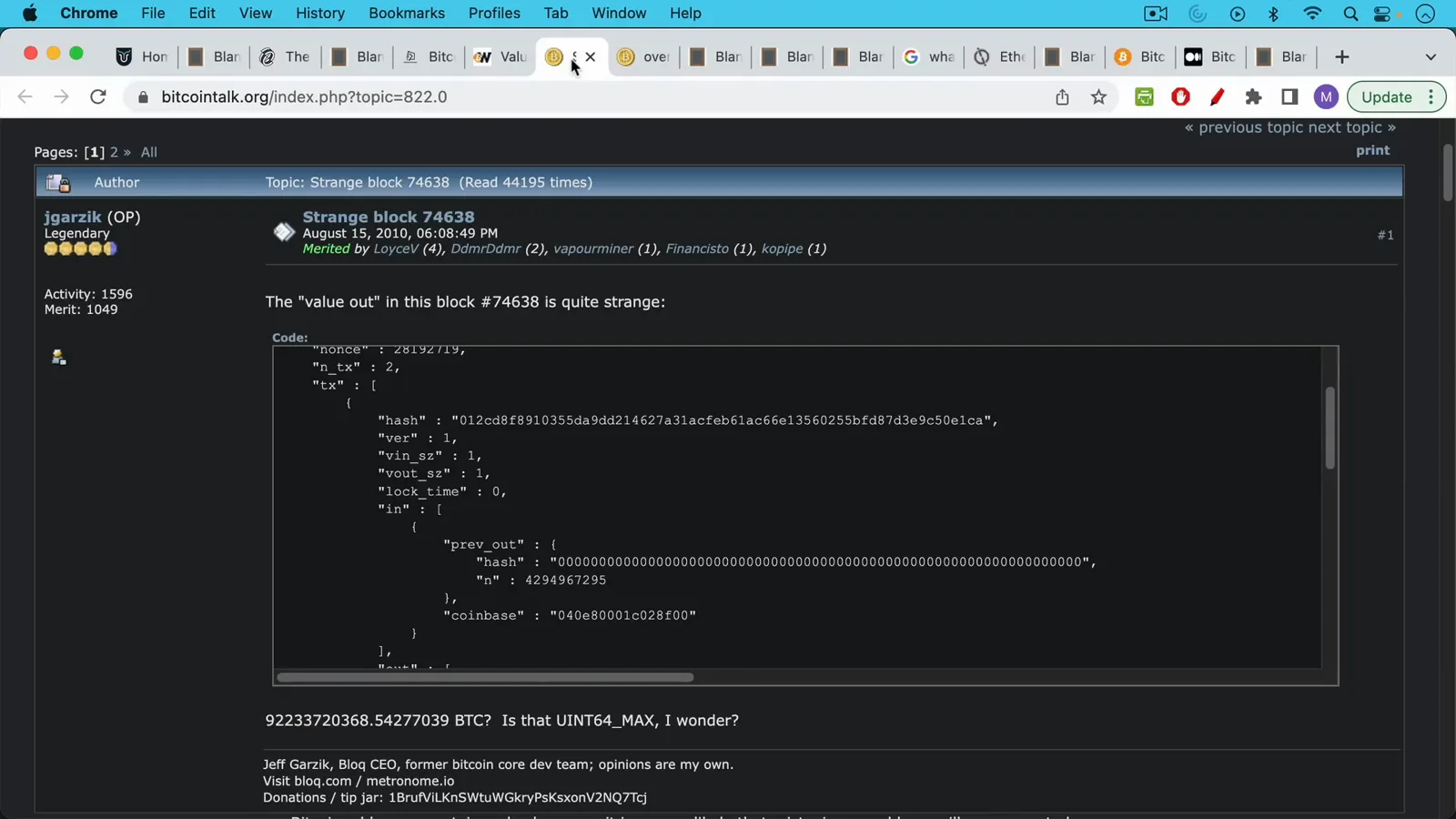
92 billion per output — right there in the JSON.Watch at 3:54 - 5
Jeff Garzik: 'Is that UINT64_MAX, I wonder?'
The alert went out at 6:08 PM on August 15, 2010, when developer Jeff Garzik started the Bitcointalk thread "Strange block 74638" with a one-line observation: "The 'value out' in this block #74638 is quite strange." Beneath the raw transaction he asked the question that named the bug class: "92233720368.54277039 BTC? Is that UINT64_MAX, I wonder?" — correctly sensing the amounts had slammed into the ceiling of 64-bit integer math. Replies came fast: one user pinned the value at INT64_MAX, another called it "a serious problem," and miners began discarding the bad chain. Discovery to diagnosis took well under an hour.
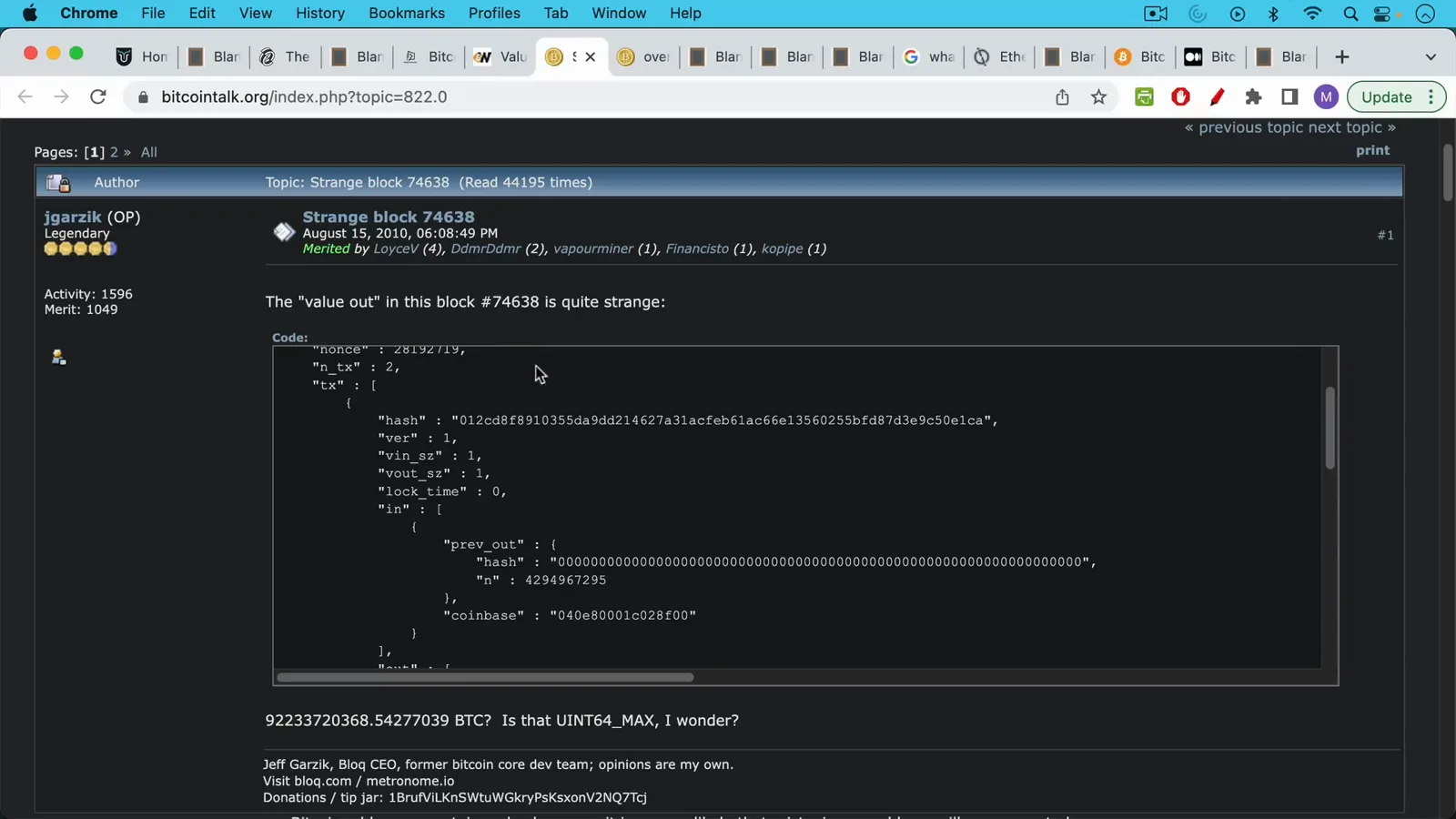
The post that stopped the network in its tracks.Watch at 4:06 - 6
'We need a fix asap': the patch thread
A second thread, bluntly titled "overflow bug SERIOUS," became the war room. Gavin Andresen proposed rejecting any output above 21 million BTC; Satoshi posted his own patch to Bitcoin's CheckTransaction function and urged miners to "stop generating" until the fix spread; the first patched build hit SVN the same night. Before the evening was out, Satoshi had edited download links for version 0.3.10 — the emergency release carrying the fix — into the original post, and the official 0.3.10 release followed the next day. From first forum post to working, downloadable fix: about five hours, assembled entirely in public.
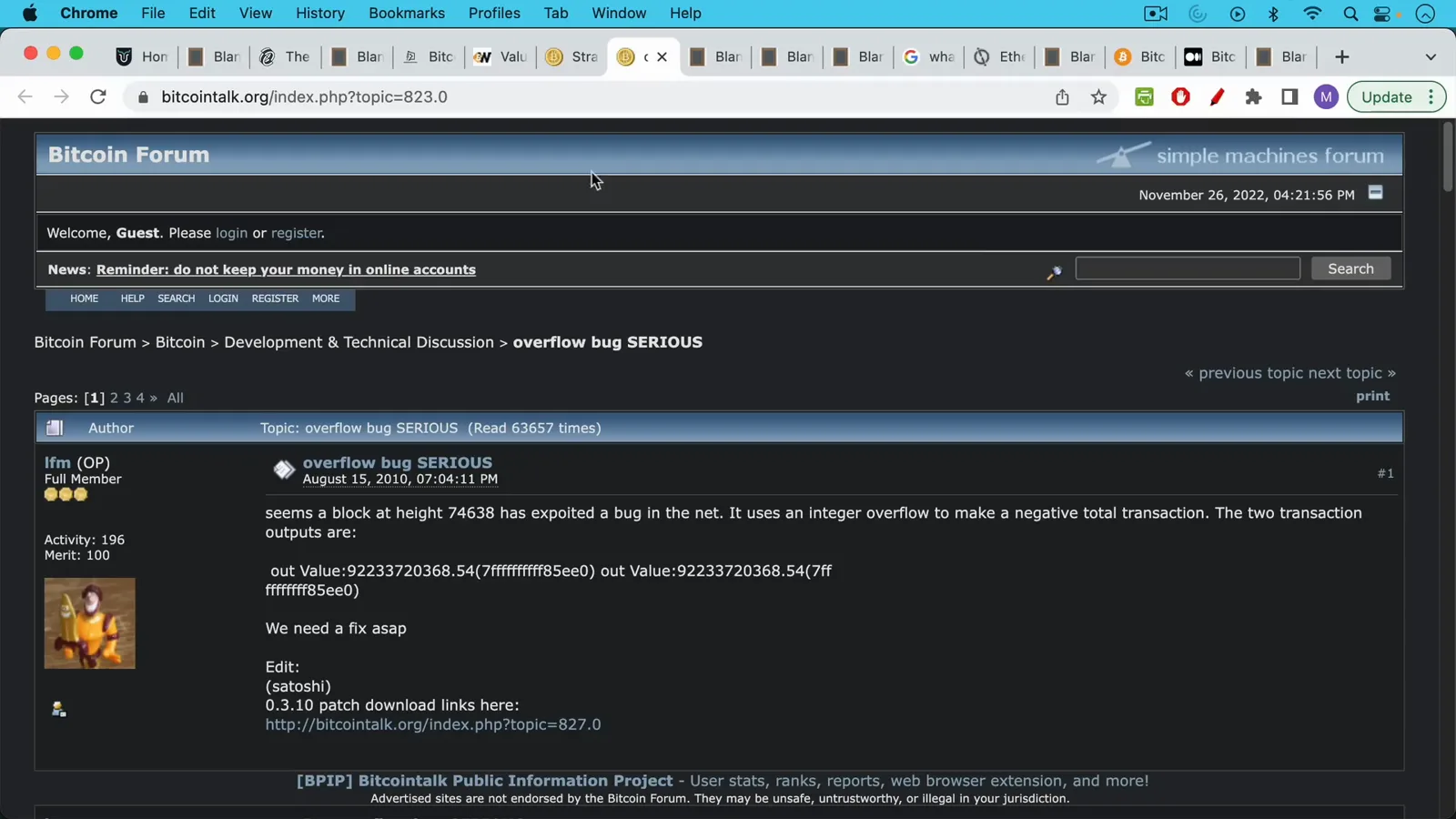
An emergency release, assembled in public.Watch at 4:14
Five Hours to a Fix, 53 Blocks to a Rollback
Patching the code was the easy part. The chain already carried the poison block — now the network had to agree on which history was real.
- 7
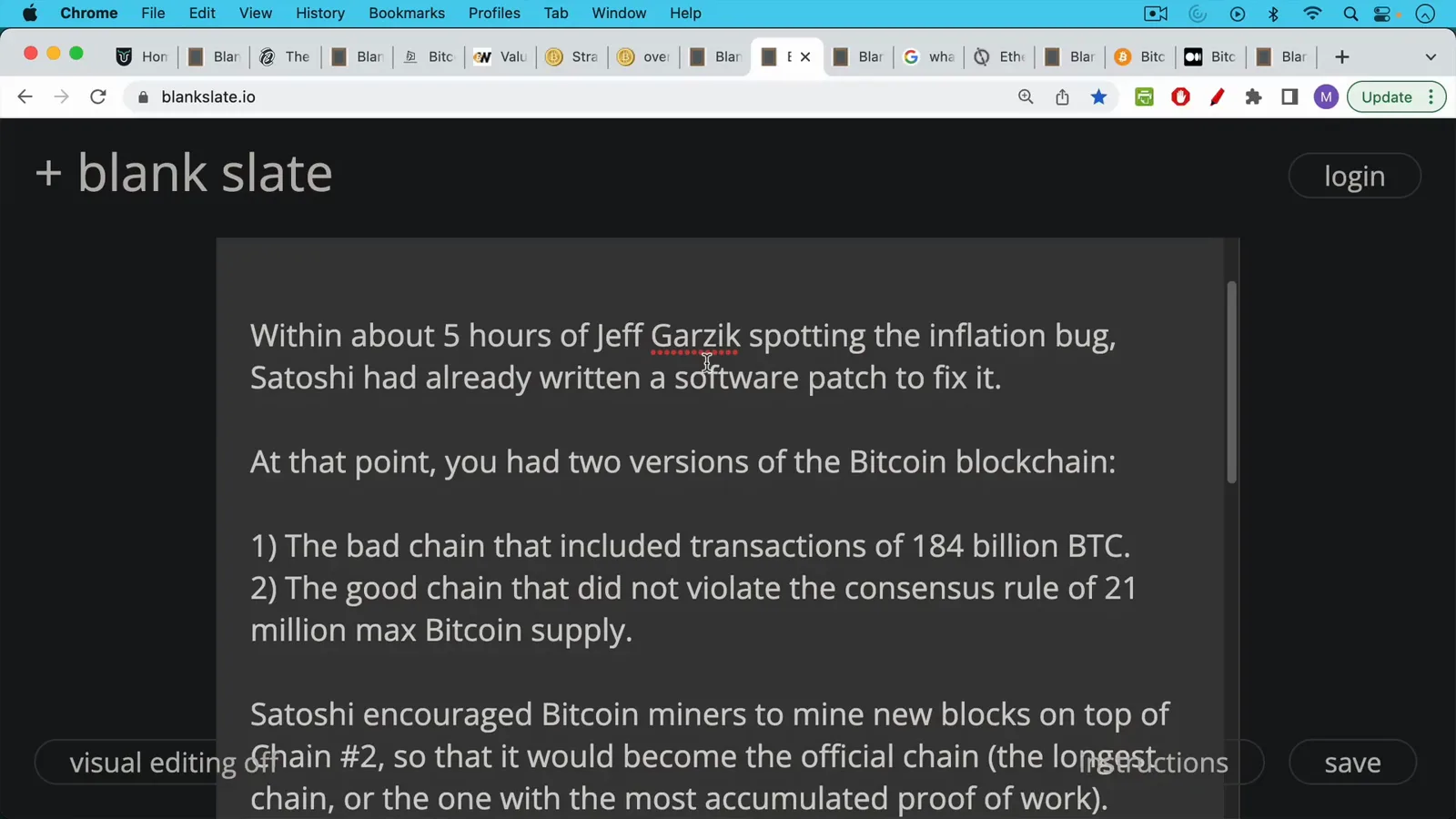
Satoshi's five-hour patch
Within about five hours of Jeff Garzik's post, Satoshi had written and shipped a software patch. Put that in perspective: five hours from "this looks strange" to a repaired consensus client — no foundation, no on-call rotation, no emergency hotline, just open-source collaboration over a forum. The patched client also hardened the rules permanently, rejecting any output over 21 million BTC so the same overflow could never pass validation again. Enterprise software teams measure vulnerability response in days; a pseudonymous programmer with a forum account set a bar in 2010 that most projects still haven't matched.
Bug report to fix: roughly five hours.Watch at 5:45 - 8
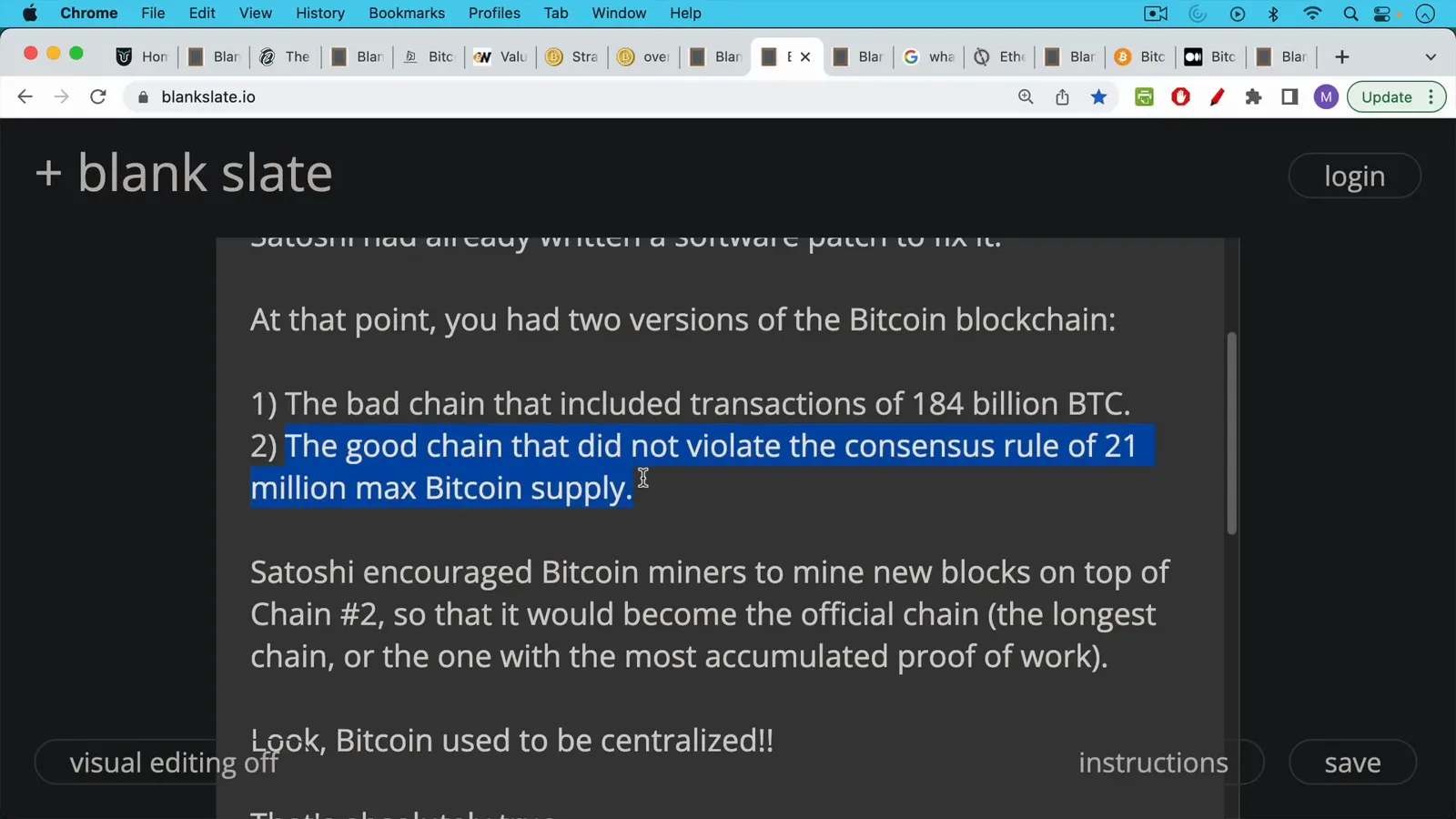
Two chains, one decision
The patch created a fork in the oldest sense: two versions of Bitcoin's history now existed. Chain one included block 74638 with its 184 billion BTC; chain two rejected the block outright. Every node and miner had to pick a side. Satoshi's instruction was simple — mine new blocks on the good chain only — and because the good chain carried valid work, it kept growing while the bad chain stalled. That is the entire mechanism: there was no editing of the ledger, no admin console, no undo button. The network chose, by proof of work, which history to keep extending — the same rule that settles every fork since.
Two histories; the network kept the honest one.Watch at 6:14 - 9
53 blocks overturned by proof of work
The end came at block 74691. Upgraded miners kept extending the good chain, and on August 16 it overtook the bad branch — making it, by Bitcoin's own rule of most accumulated proof of work wins, the one true history. Fifty-three blocks of the bad chain, poison transaction included, fell out of the canonical ledger and stopped existing. Query block 74638 today and you'll find an entirely ordinary block: the 184-billion transaction is not part of the chain Bitcoin kept. The only trace left is poetic — the 0.5 BTC the attacker spent to trigger the bug still sits unspent on chain, frozen in place for over fifteen years.
Block 74691: the good chain wins.Watch at 6:44 - 10
Yes, early Bitcoin was centralized
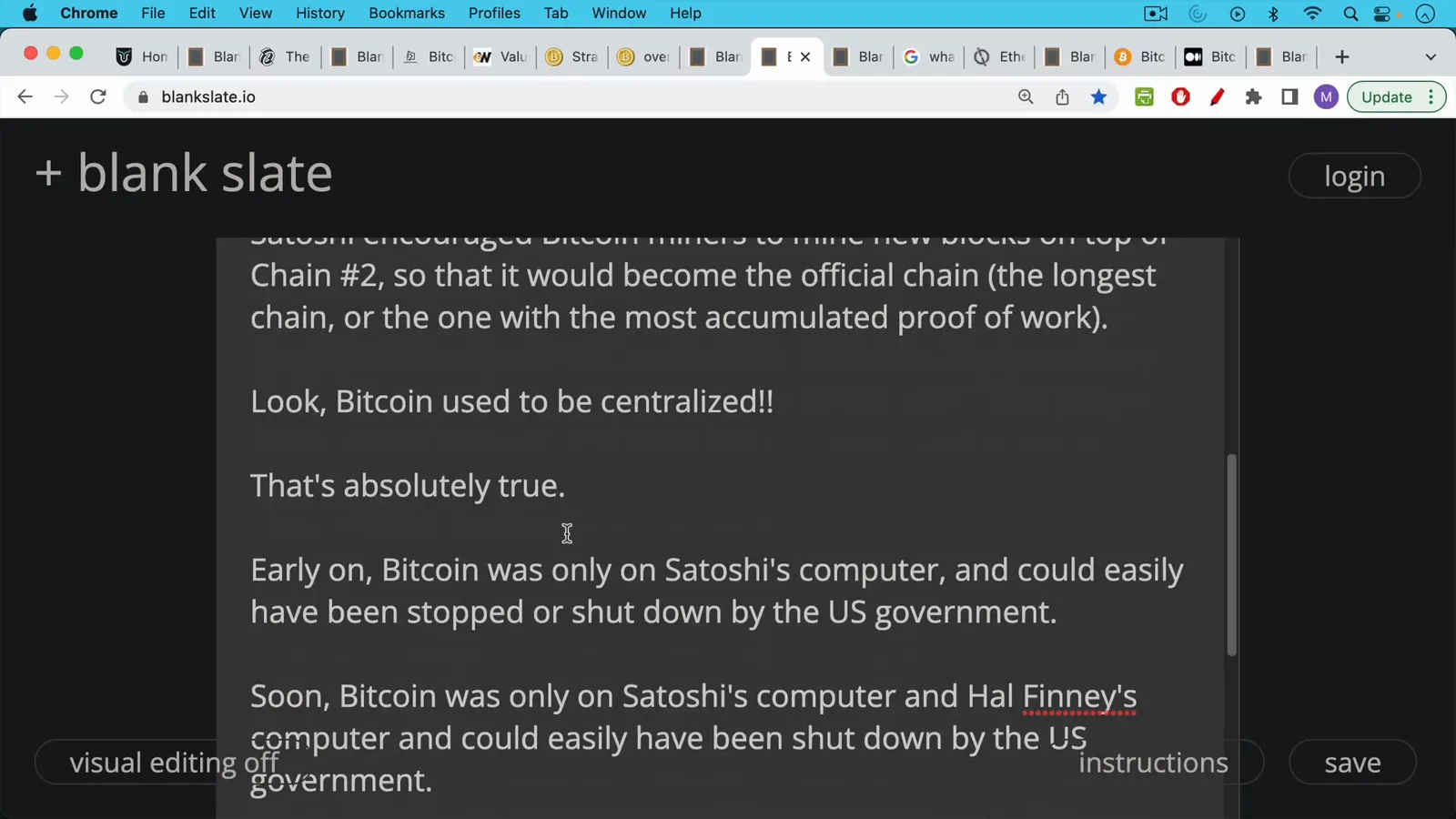
Critics cite the episode as proof that "Bitcoin used to be centralized" — which is true, and beside the point. In January 2009 the whole network ran on Satoshi's computer; soon after, on Satoshi's and Hal Finney's machines, either of which could have been switched off by anyone, including a government. Bitcoin's journey from a two-computer experiment to a globally distributed network nobody can stop is not a hidden embarrassment; it is the entire achievement. A coordinated fix like 2010's is no longer possible — and that is precisely the design working as intended.

From two computers to unstoppable.Watch at 7:20
'Satoshi Rolled Back Too' — No, He Didn't
The incident's afterlife as an altcoin talking point rests on one comparison the numbers refuse to support.
- 11
The Ethereum whataboutism
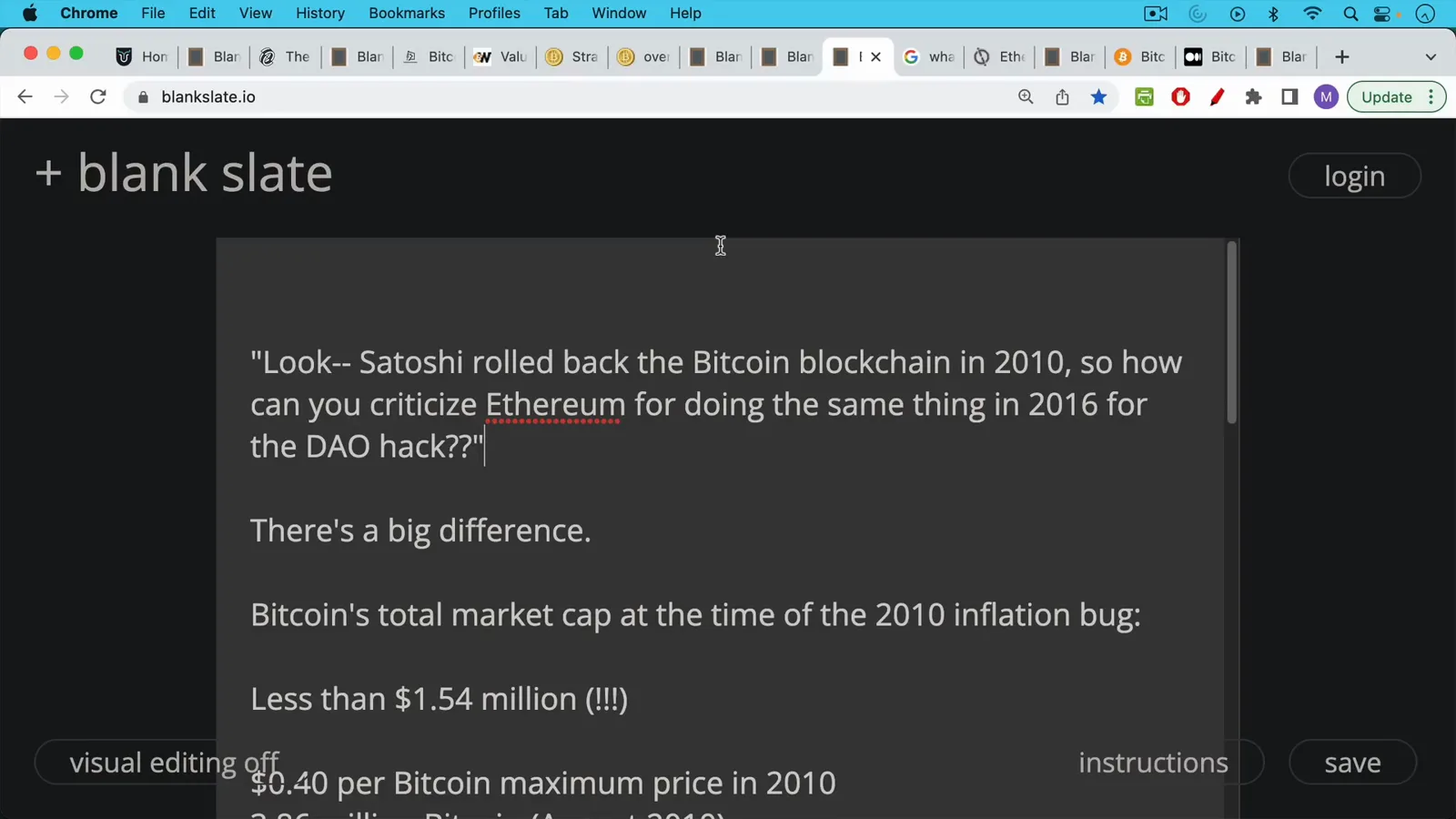
The most persistent use of the 2010 incident is rhetorical: "Satoshi rolled back the Bitcoin blockchain in 2010 — how can you criticize Ethereum for doing the same thing in 2016 for the DAO hack?" On the surface it sounds symmetric. In 2016, after an attacker drained millions of ETH from The DAO, a smart-contract fund that had raised about 14% of all ether, Ethereum's leadership hard-forked to reverse the theft — splitting off Ethereum Classic in the process. But symmetry is exactly what the comparison lacks: the two events differ in scale, in what was reversed, and in who benefited, as the next three frames show.
The question altcoin promoters always stop halfway.Watch at 7:50 - 12
A $1.5 million network versus a $1 billion one
Scale first. In August 2010 bitcoin's all-time high was about $0.40, roughly 3.86 million BTC had been mined, and the entire network was worth under about $1.54 million — a rounding error, followed by a small group of cypherpunks. Ethereum, by the time it reversed the DAO hack on July 20, 2016, was actively traded on Coinbase with a market capitalization around $1 billion — roughly 650 times larger — and much of that value belonged to insiders whose pre-mine allocations were trapped in The DAO. Reversing 2010 protected a network nobody yet owned; reversing 2016 protected wealthy holders from their own investment decision.
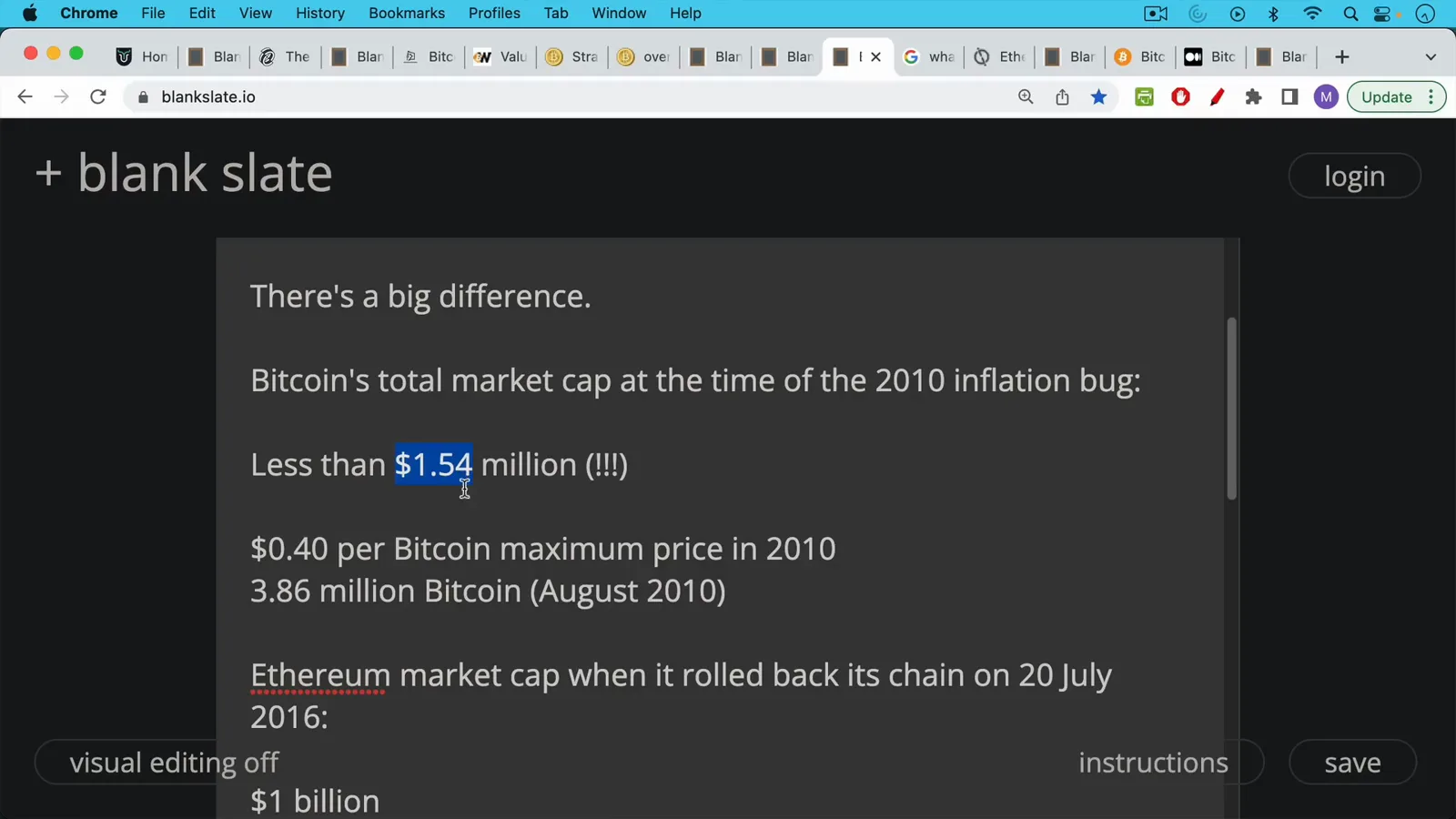
Under $1.54 million versus around $1 billion.Watch at 9:02 - 13
Checking the numbers: 40 cents was the ceiling
The figures behind the comparison are checkable in seconds — the video does it live. A search for bitcoin's highest price in 2010 returns the answer: per historical market data, bitcoin never broke above $0.40 that year, only touching that level in early 2011. Multiply by the roughly 3.86 million coins in circulation by August 2010 and the network's entire valuation lands under about $1.54 million — less than a suburban house. Whatever was at stake during the five-hour fix, it was not money in any modern sense. What was being defended was the idea that the rules hold — at a moment when enforcing them cost the community almost nothing.

Forty cents was the all-time high.Watch at 9:50 - 14
Ethereum's rollback, by the numbers
A market-cap chart makes the contrast vivid. Ethereum launched in 2015, and by July 20, 2016 — the day the DAO-reversal fork activated — its market capitalization stood around $1 billion, with years of growth still ahead of it. That is the entity that unilaterally rewrote its own history to reverse a hack, splintering into ETH and ETC in the process. Bitcoin in 2010 had no insiders to protect, no treasury to defend and no token sale to refund; it had a bug, a forum and a five-hour patch. The same word — "rollback" — describes two categorically different events.
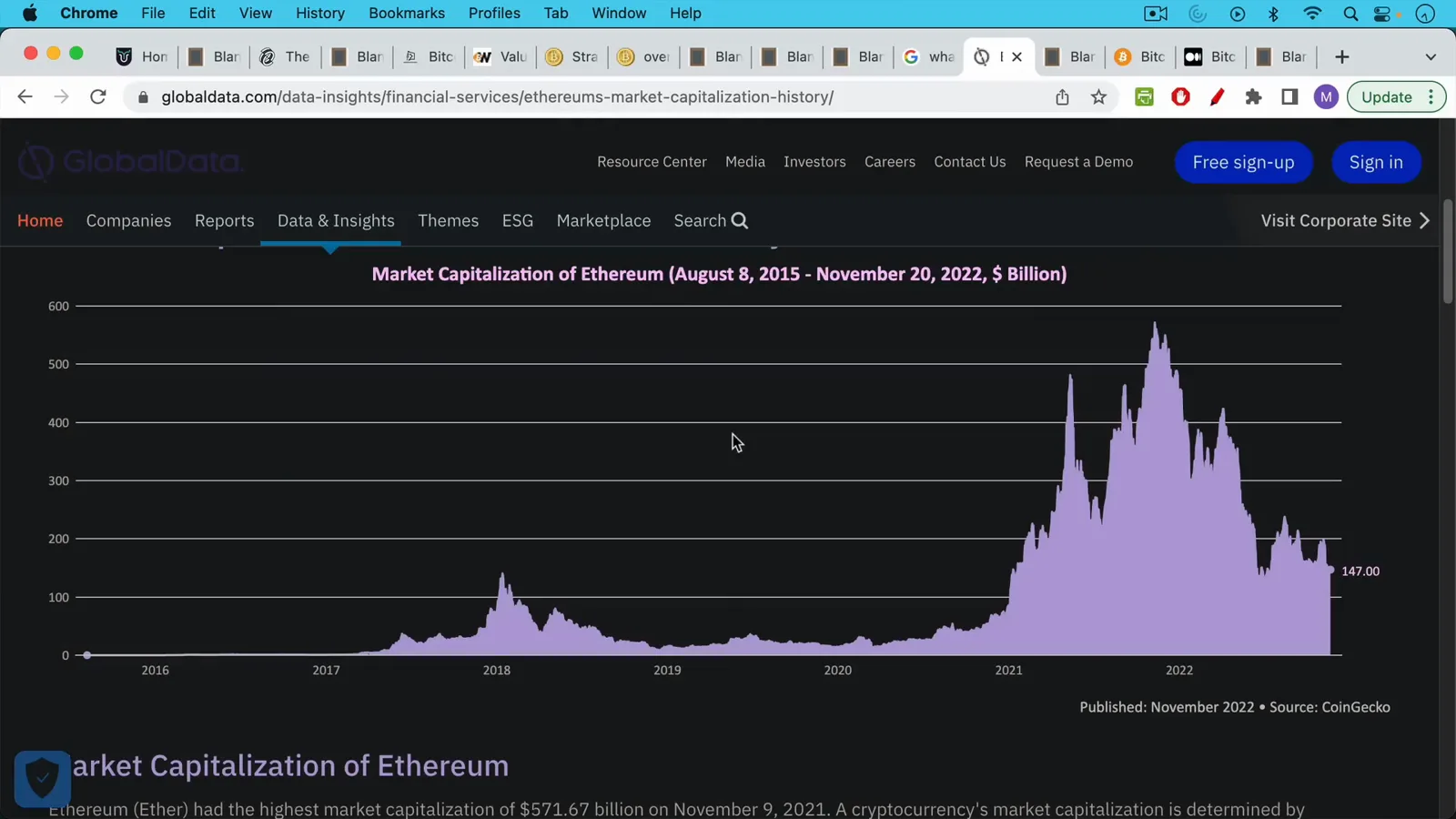
One billion dollars on the line in 2016.Watch at 9:57
Why It Can't Happen Like That Again
The 2010 fix relied on a level of trust that no longer exists — and no longer needs to.
- 15
The 21 million pillar and the social layer
The deepest lesson of 2010 is that software alone doesn't enforce the 21 million cap — people do. Bitcoin's ledger is open and transparent, thousands of eyes watch every block for anything weird (a miner paid too much, a transaction over 21 million BTC), which is why inflation bugs get spotted and fixed quickly. But the final backstop is the social layer: millions of holders around the world who would refuse to run any chain that violates the supply cap, no matter what the code said. Code can be changed by the community at any time; the shared conviction that 21 million is non-negotiable cannot be forked away. That conviction is why "oops, there are now 184 billion bitcoin" has never come true — and never will.

The supply cap is enforced by people.Watch at 10:40 - 16
The 2018 sequel that proved the system works
Bitcoin did have a second inflation bug — CVE-2018-17144, disclosed in September 2018 — and the way it ended is the strongest argument that the 2010 model still works. The flaw, introduced by a performance optimization the year before, could in theory have let a miner claim a transaction's inputs twice and inflate the supply. It was reported by a developer from the rival Bitcoin Cash community, patched in Bitcoin Core 0.16.3 within about a day, and never exploited on mainnet. Even Bitcoin's competitors audit Bitcoin. That is the many-eyes doctrine in action — and the best answer to anyone still selling the 2010 bug as evidence of fragility.

Reported by a rival, patched in a day.Watch at 12:59
Frequently Asked Questions
What was the Bitcoin value overflow incident of 2010?
How did the 184 billion bitcoin bug actually work?
Did Bitcoin ever roll back the blockchain?
How long did it take Satoshi to fix the 2010 bug?
Was any of the fake bitcoin ever spent or kept?
Has Bitcoin had other inflation bugs since 2010?
Continue the Story
What Is the Genesis Block? Bitcoin's First Block (2009)
Eighteen months before the overflow bug, the chain that the good miners defended in 2010 was a single block on Satoshi's computer.
Mt. Gox Collapse: The Complete Timeline (2010–2024)
The same August 2010 that produced the overflow fix also birthed the exchange whose 850,000 missing BTC became crypto's darkest chapter.
The History of Bitcoin Mining: From CPUs to 200 TH/s
The miners who abandoned the bad chain in 2010 were hobbyists with CPUs — trace how mining grew from laptops to industrial farms.
When Was Bitcoin Created? A Bitcoin History Timeline
Place the value overflow incident inside the full arc, from Satoshi's whitepaper to institutional adoption.
References
Extended Multimedia Reference
Visual sequences and chronologies in this guide cross-reference video documentation “184 Billion Bitcoin Bug” by Bitcoin University.
This illustrated guide is maintained strictly for educational, research, and historical documentation purposes. None of the materials constitute investment, financial, legal, or trading advice. Historical crisis and market events are documented from public archives. Digital assets involve significant risks.