The Merge: How Ethereum Actually Switched to Proof of Stake
On September 15, 2022, Ethereum stopped mining forever. This guide rebuilds the proof-of-stake machine that took over that day — the deposit contract, GHOST voting, committees, BLS aggregation and Casper finality — frame by frame from an animated explainer.
9 minutes • 16 illustrated steps • In-depth historical chronology & technical analysis
Editorial Research & Chronological Archive
Independently synthesized and cross-verified by The Blockchain History Editorial Board using primary whitepapers, historical archives, and on-chain records.
When did Ethereum switch to proof of stake?
Ethereum switched to proof of stake on September 15, 2022, at 06:42:42 UTC. The network had been waiting for its total cumulative mining difficulty to reach a pre-agreed value — the Terminal Total Difficulty of 58,750,000,000,000,000,000,000 — and block 15,537,393 pushed it past the line (to 58,750,003,716,598,352,816,469). That was the last proof-of-work block ever mined; the Beacon Chain's validators produced the first proof-of-stake block, 15,537,394, minutes later. Mining on Ethereum ended permanently, network energy use fell by about 99.95%, and the consensus machine explained in this guide — staking, GHOST voting, committees, BLS aggregation and Casper finality — has run every block since.
Key Takeaways
- The Merge executed on September 15, 2022 at 06:42 UTC: once total difficulty crossed the Terminal Total Difficulty of 58,750,000,000,000,000,000,000, block 15,537,393 became the last PoW block and 15,537,394 the first PoS block — mining ended overnight.
- Switching to validation cut Ethereum's energy consumption by about 99.95%, from roughly the electricity use of a mid-sized country to something ordinary home hardware can participate in.
- Each validator stakes exactly 32 ETH plus a public key and withdrawal address; by merge day the Beacon Chain — live since December 1, 2020 — held over 400,000 validators and more than 13 million ETH of stake.
- The 12,000-plus votes behind every block are aggregated through 128 subnets into a single BLS signature — the trick that lets hundreds of thousands of validators reach consensus on normal hardware.
- Thirty-two slots of 12 seconds form an epoch (6 minutes 24 seconds); once two consecutive epochs secure a two-thirds supermajority of stake, blocks are final — about 13 minutes end to end.
- 84.4% of validator income comes from attestations rather than block proposals; network issuance floats between 0.17% and 0.94% per year depending on total stake, and post-merge issuance dropped roughly 90% versus the PoW era.
The Consensus That Replaced Mining
The Merge was not a new coin or a reboot — it was an engine swap. Here is what Ethereum switched to, and how a deposit turns into proof.
- 1
No new chain, no downtime: an engine swap
On September 15, 2022, Ethereum's execution layer stopped listening to miners and adopted the Beacon Chain's consensus — a combined protocol called Gasper. Inside it, LMD GHOST decides which branch of the chain has the most validator support, while Casper FFG decides when that choice becomes irreversible. The animation this guide is built from walks through exactly that machine: the one that quietly took over from proof of work, one block after the last mined one.

Half of the machine that replaced mining. - 2
First register, then validate
Proof of stake starts with a register. To become a validator you deposit exactly 32 ETH — along with a public key and a withdrawal address — into a staking contract that lists every participant for the whole network to audit. The chain that keeps this register, the Beacon Chain, went live on December 1, 2020, and by merge day it held deposits from more than 400,000 validators: over 13 million ETH of stake. The Merge simply let this mining-free consensus layer take over block production.
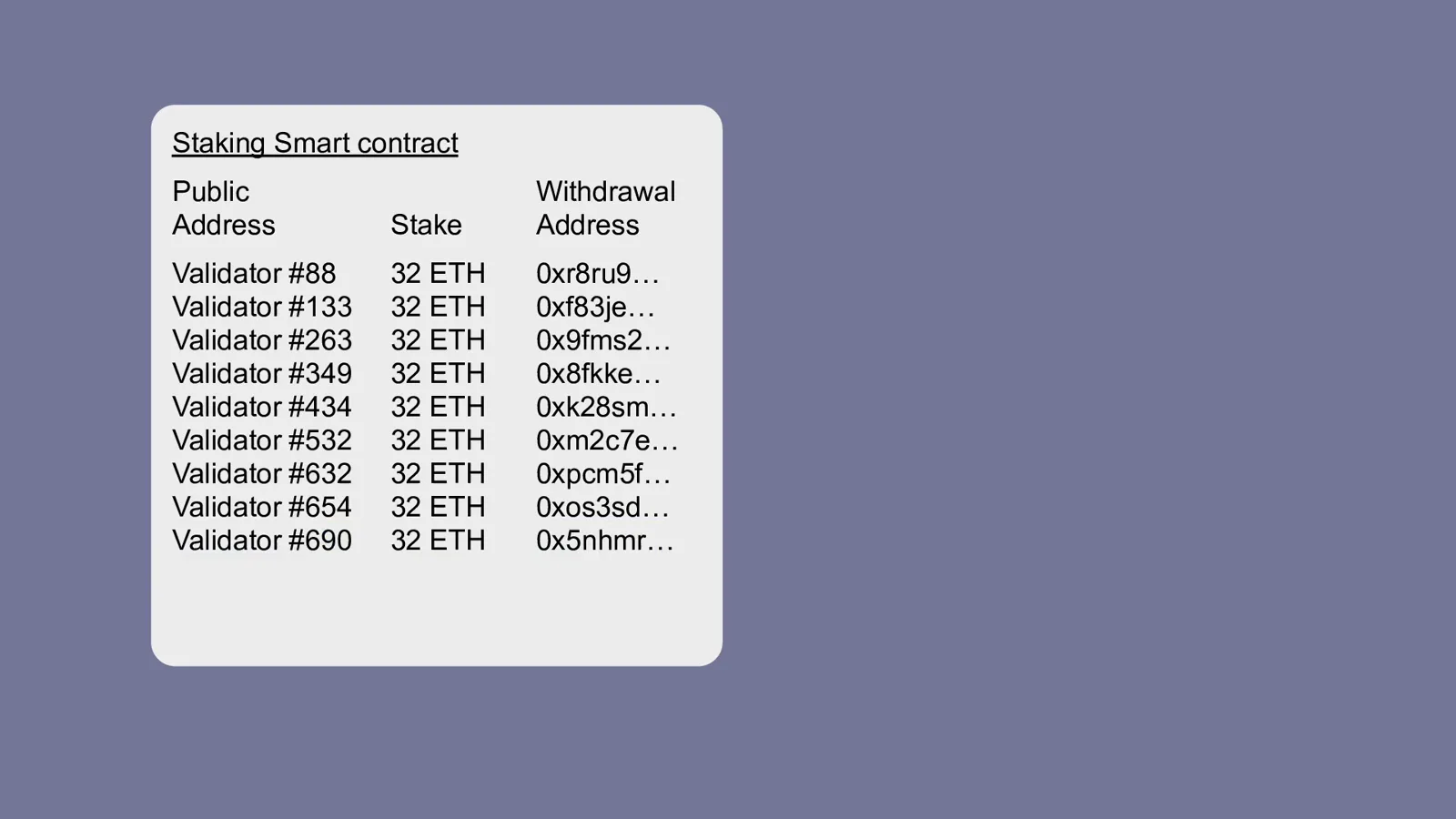
A roll call anyone on the network can audit. - 3
The signature is the proof
Whenever a validator signs something with its private key, anyone can check the register, confirm that this signer controls 32 ETH, and treat the signature as the proof of stake itself. Because the stake is locked up, it can be punished: get caught misbehaving and part of your 32 ETH is burned — a process called slashing. Fall below 16 ETH after penalties and you are ejected from the contract altogether, so an attacker gets a handful of attempts, not unlimited ones.
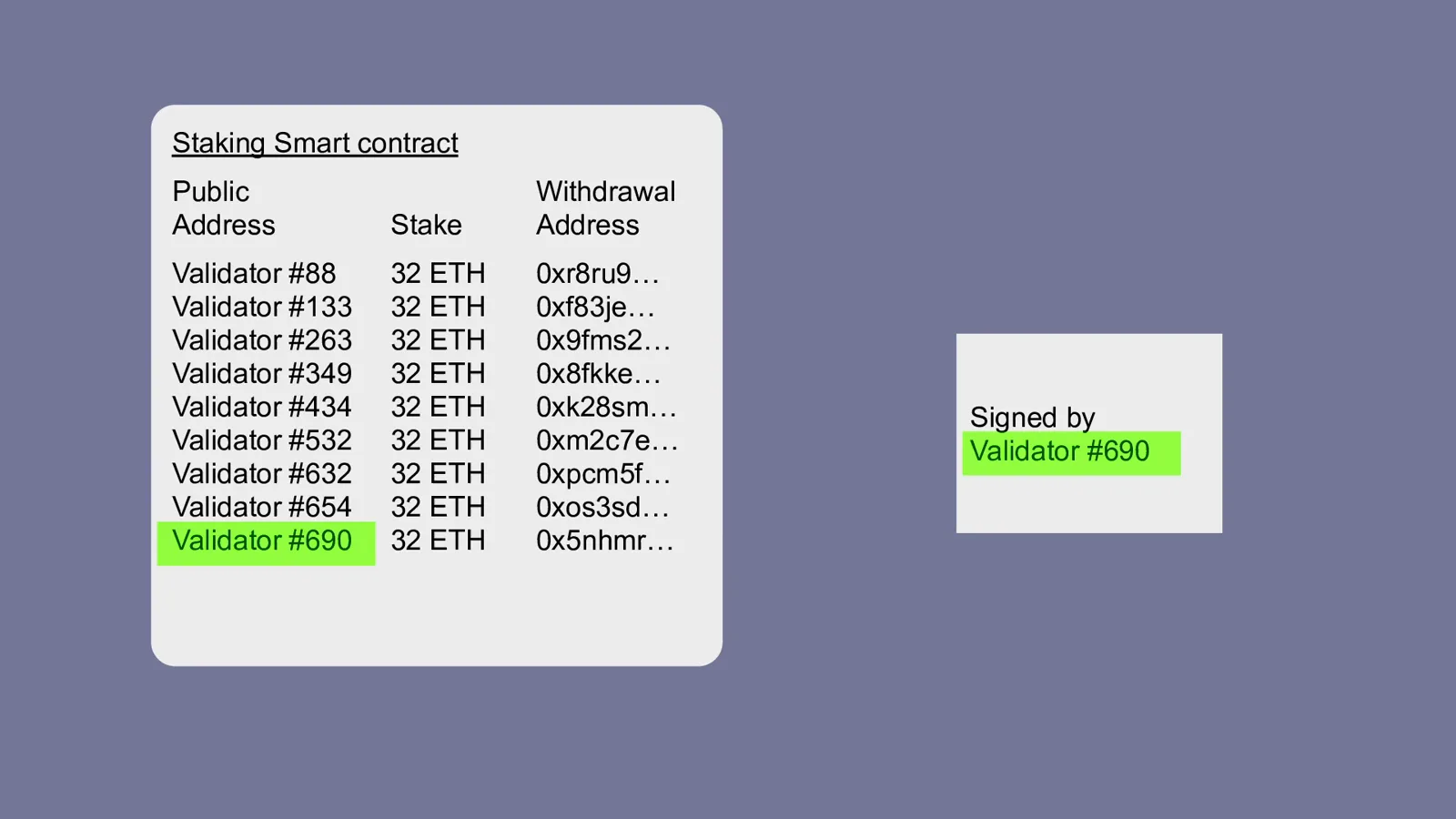
One signature, and the stake proves itself. - 4
Two families of consensus, one chain
Cryptocurrency consensus comes in two broad families. Longest-chain systems — Bitcoin's model — treat every block added to a branch as a vote for that branch, and the longest chain wins. BFT-style systems instead run rounds of explicit voting and finalize when a supermajority agrees. Ethereum ended up combining both: a tweaked longest-chain rule called LMD GHOST handles day-to-day fork choice, and a BFT overlay called Casper FFG stamps the result as final. The Merge put that hybrid in charge of mainnet.
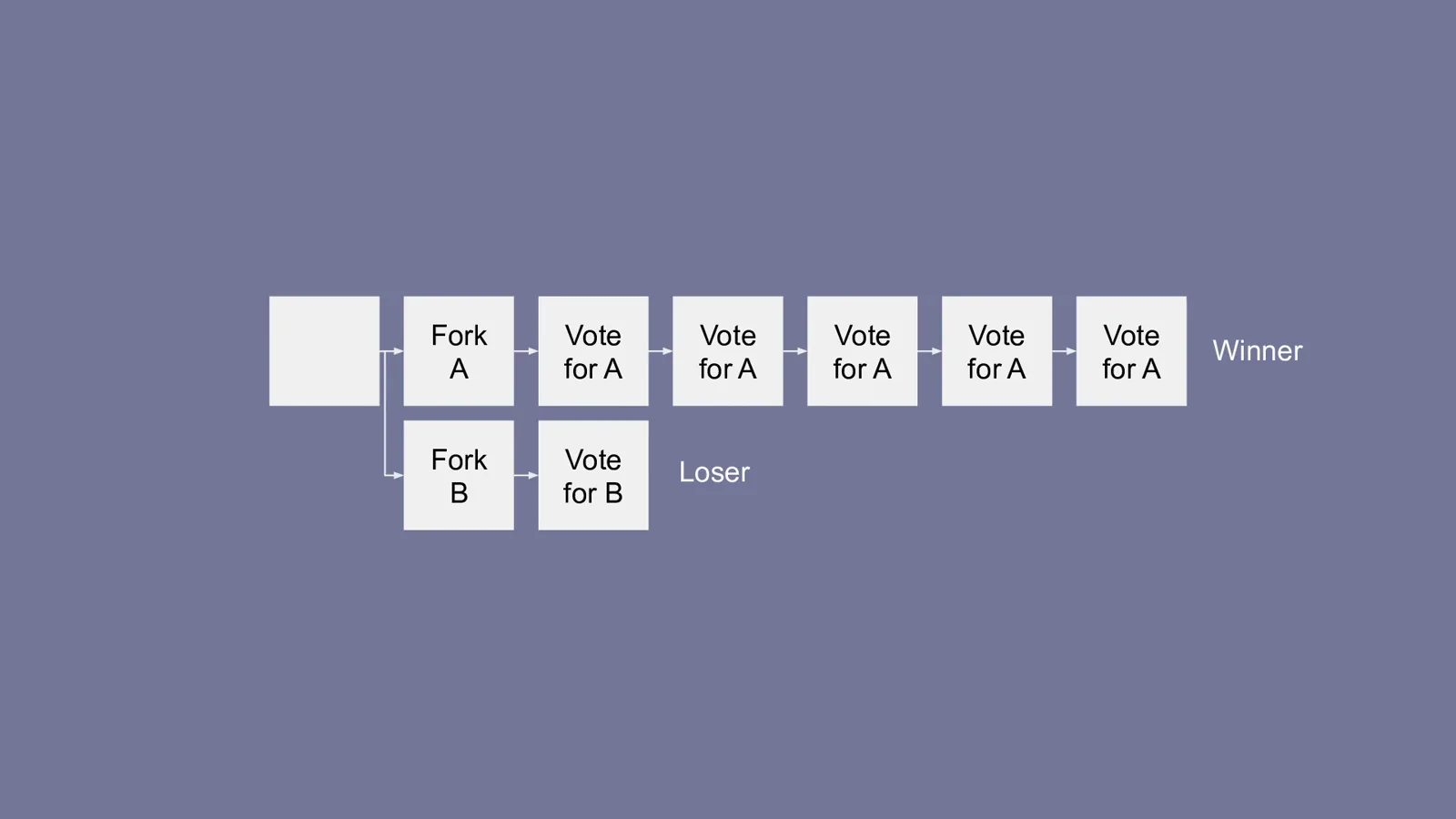
In the old model, the longest branch took all.
GHOST: How Validators Outvote the Longest Chain
Four hundred thousand validators cannot each produce a block — so Ethereum invented a much lighter way to vote.
- 5
One validator per slot: a two-month wait
Under proof of stake, blocks are produced in 12-second slots, and only one validator per slot gets to propose. With roughly 400,000 validators staking, the arithmetic gets ugly: any single validator would wait about eight weeks between proposals, and even collecting votes from just a tenth of them would take around five days. If producing a block were the only way to vote, consensus would crawl — so Ethereum invented a second, far lighter way to vote.
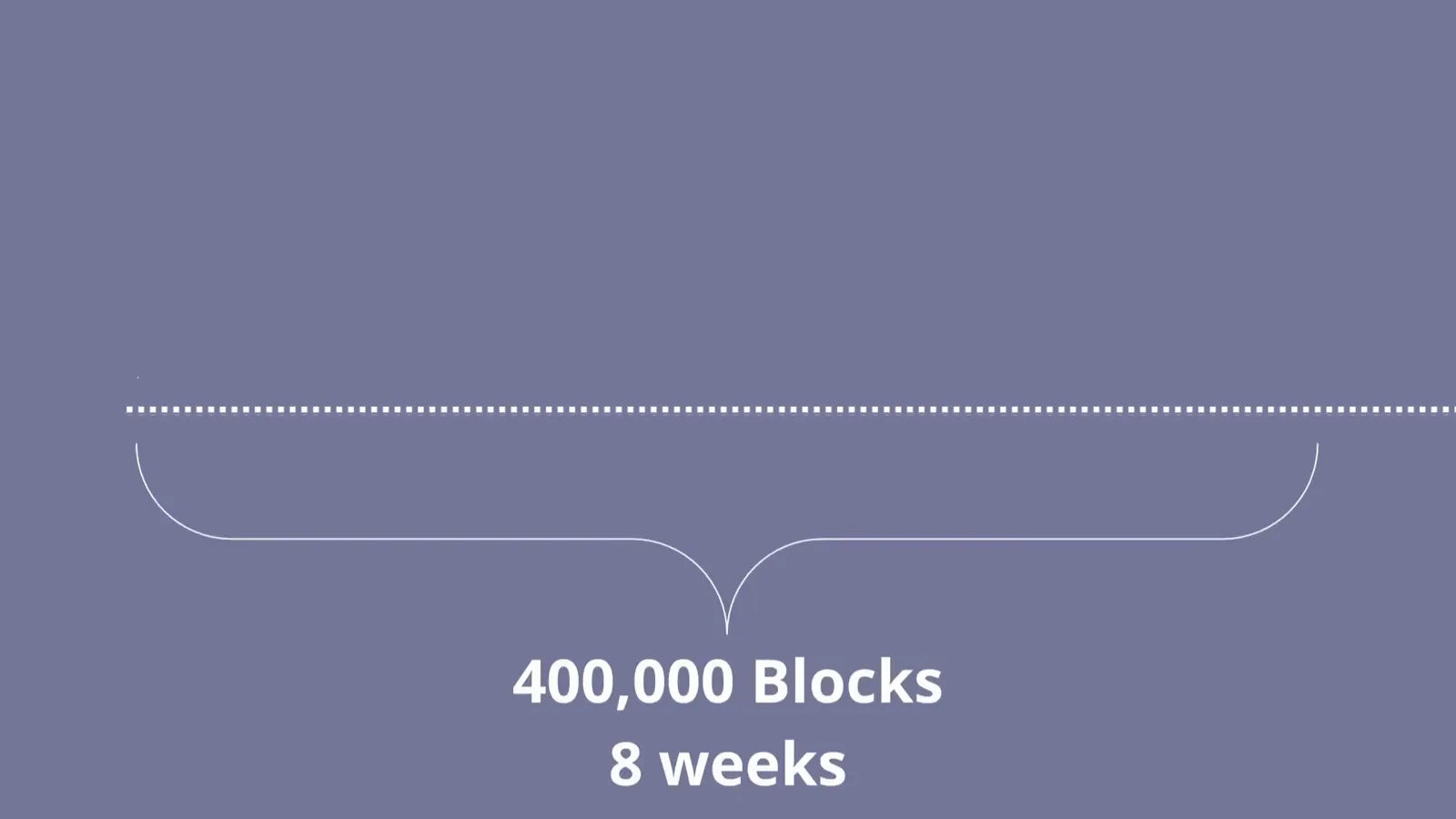
Block-as-vote could never scale to everyone. - 6
Attestations: voting without proposing
That lighter vote is an attestation. Instead of building a block, a validator signs a statement about which block it believes heads the chain — voting without proposing. Attestations carry real weight: when two forks compete, the one with more attesting validators behind it wins, even if it is the shorter branch. And if the designated proposer fails to produce within the first four seconds of a slot, the attesting validators vote for the previous block instead — the chain never idles.
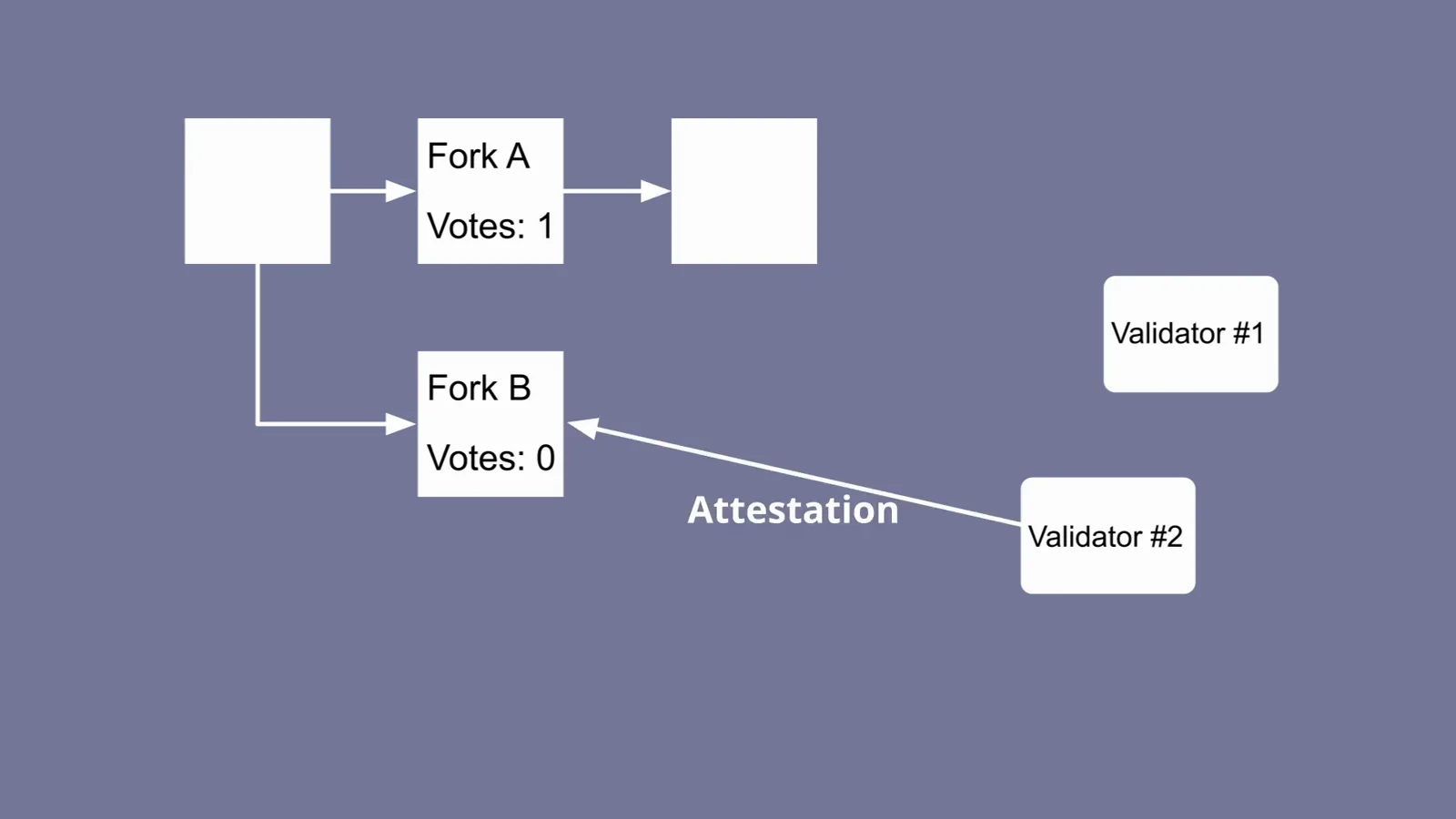
Most validators never propose — they vote. - 7
The heaviest chain wins
This is LMD GHOST in action: count the attestations on every branch, not just the blocks on the longest one. In the animation, Fork A is longer, but Fork B collects more attestation weight — so B is the heaviest chain, and the one new blocks should extend. Weight beats length. It was this rule, running on the Beacon Chain since December 2020, that let the execution layer be absorbed on merge day without a chain split.
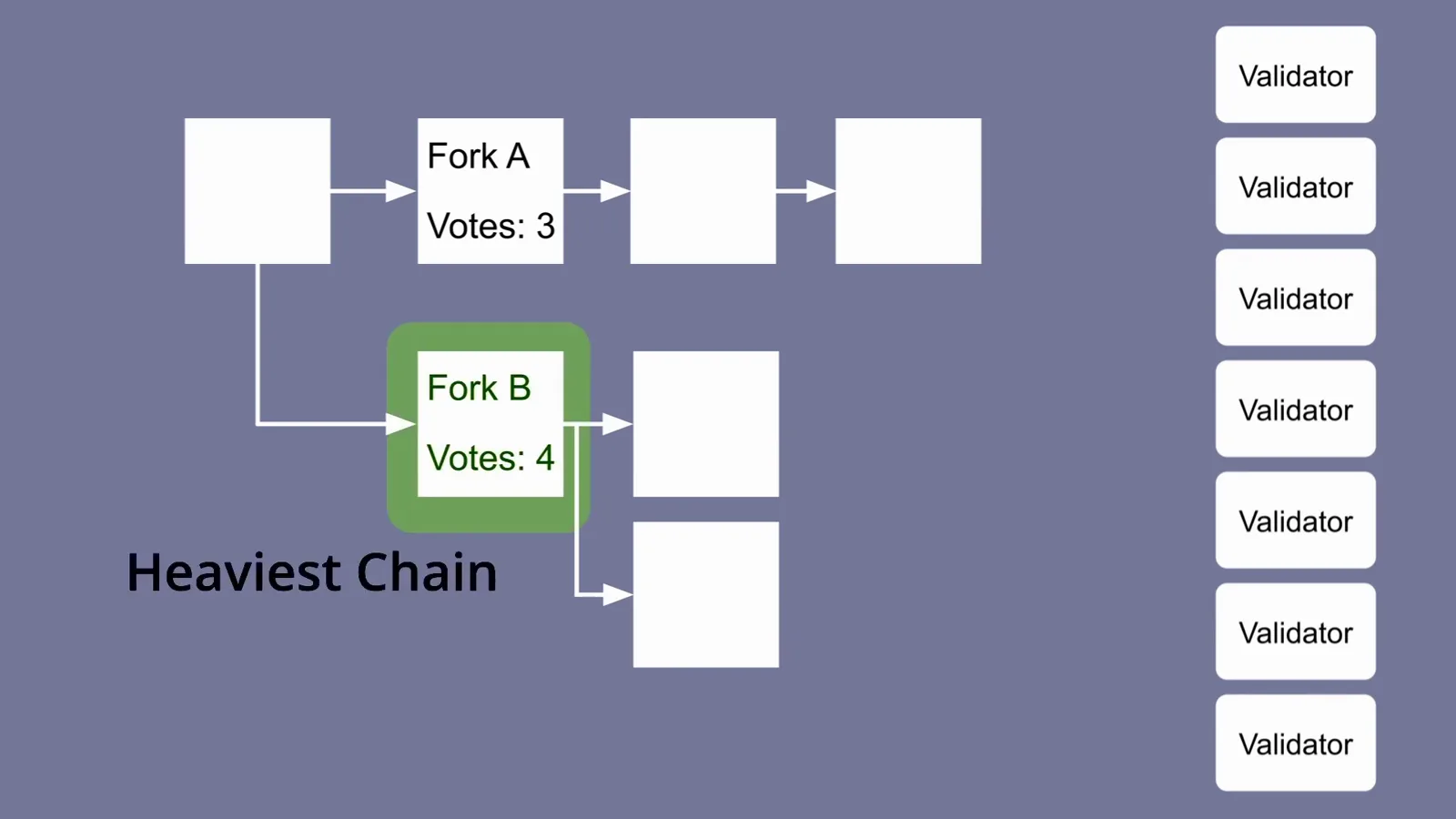
Weight beats length.
Epochs, Committees and the One-Signature Trick
A rota that lets hundreds of thousands speak in order — and the compression trick that fits all their votes into one signature.
- 8
Thirty-two slots make an epoch
Hearing from hundreds of thousands of validators takes rhythm. Ethereum slices time into slots of 12 seconds and groups 32 of them into an epoch — 6 minutes and 24 seconds, the heartbeat of proof-of-stake consensus. Every epoch the protocol reshuffles: all staked validators are randomly split into committees, one committee on duty per slot. Even the randomness is generated in-protocol: validators' BLS signatures are mixed into an unpredictable seed that no one can game as long as a single participant is honest.
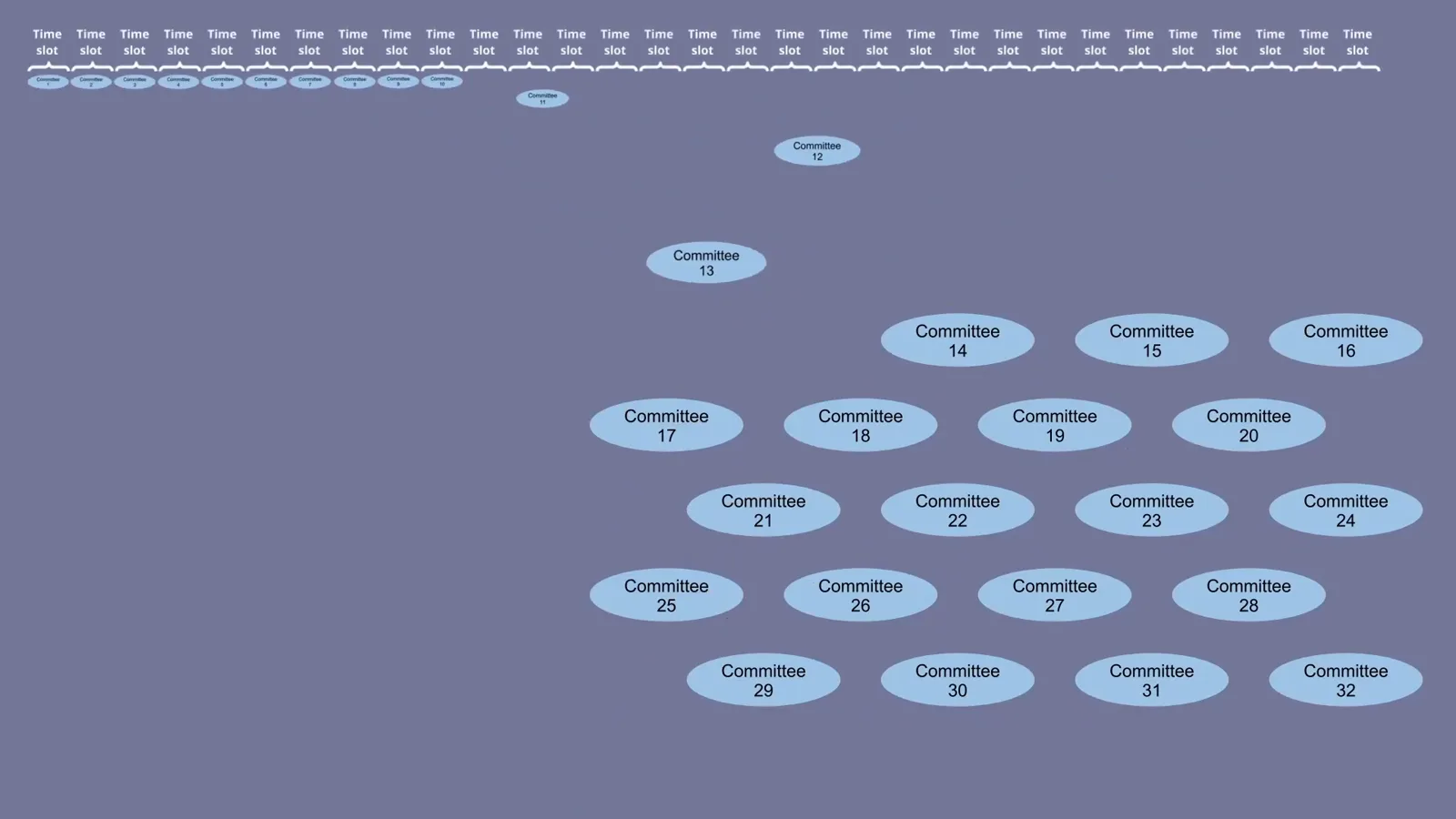
Every 6 minutes 24 seconds, the deck is reshuffled. - 9
One committee, one shift
A committee's shift lasts exactly one slot. Its first member proposes the block; everyone else attests to what they believe is the chain's head. Each validator may cast only one attestation per epoch — sign two conflicting votes and you have equivocated, slashable evidence. The constant reshuffling doubles as a defense: with committees redrawn every epoch, an attacker cannot know in advance which validators they would need to bribe or capture to sway a particular slot.
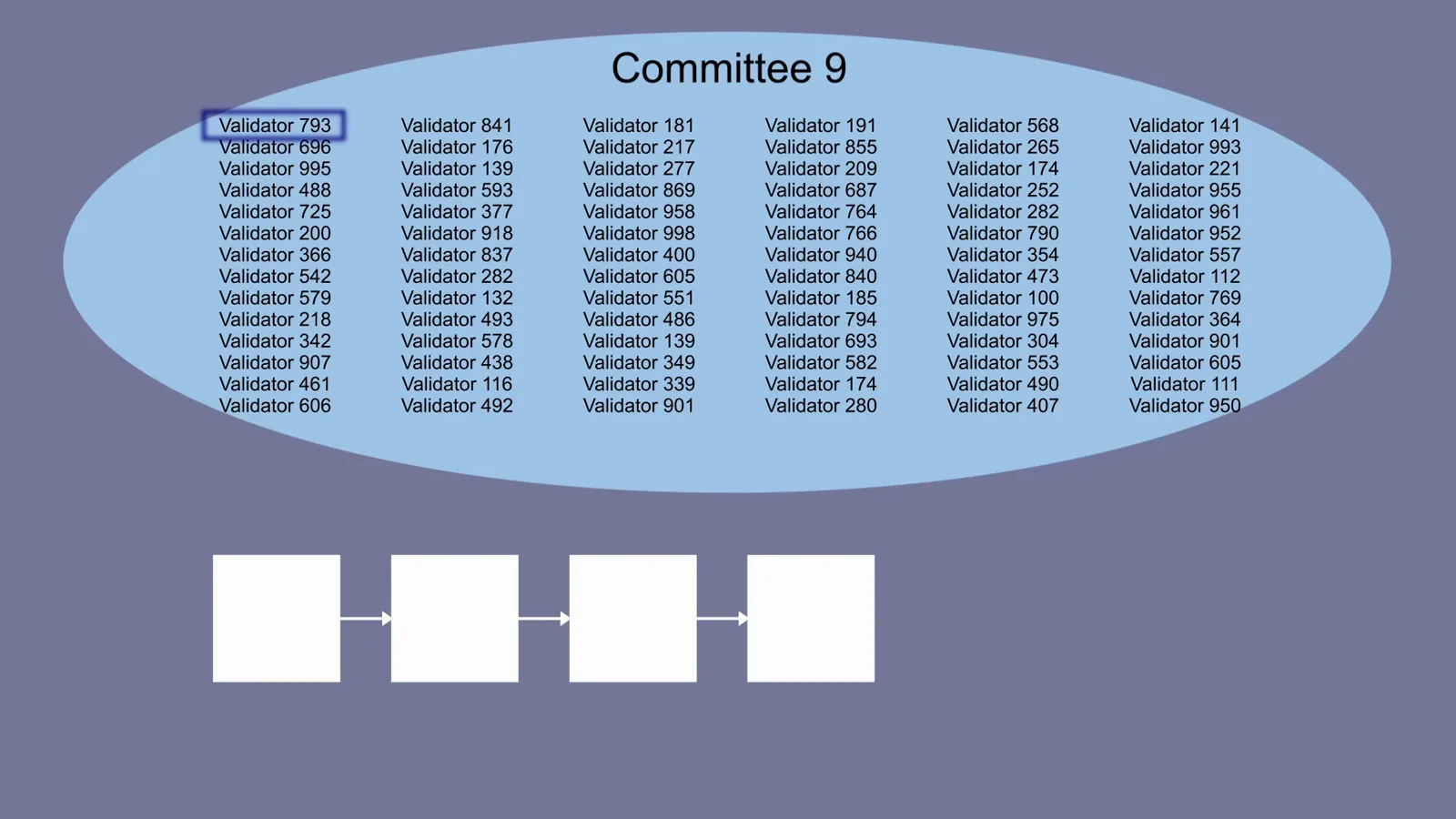
Random duty rosters keep bribery blind. - 10
12,000 votes in, one signature out
Twelve thousand attestations per block would drown the network in data, so Ethereum aggregates. Committees are divided into 128 subnets of roughly 100 signatures each; within every subnet, 16 randomly chosen aggregators compress their neighbors' votes into a single BLS signature. The block proposer collects the best signature from each of the 128 subnets and folds them together. What lands in the block is one BLS aggregate speaking for more than 12,000 validators.
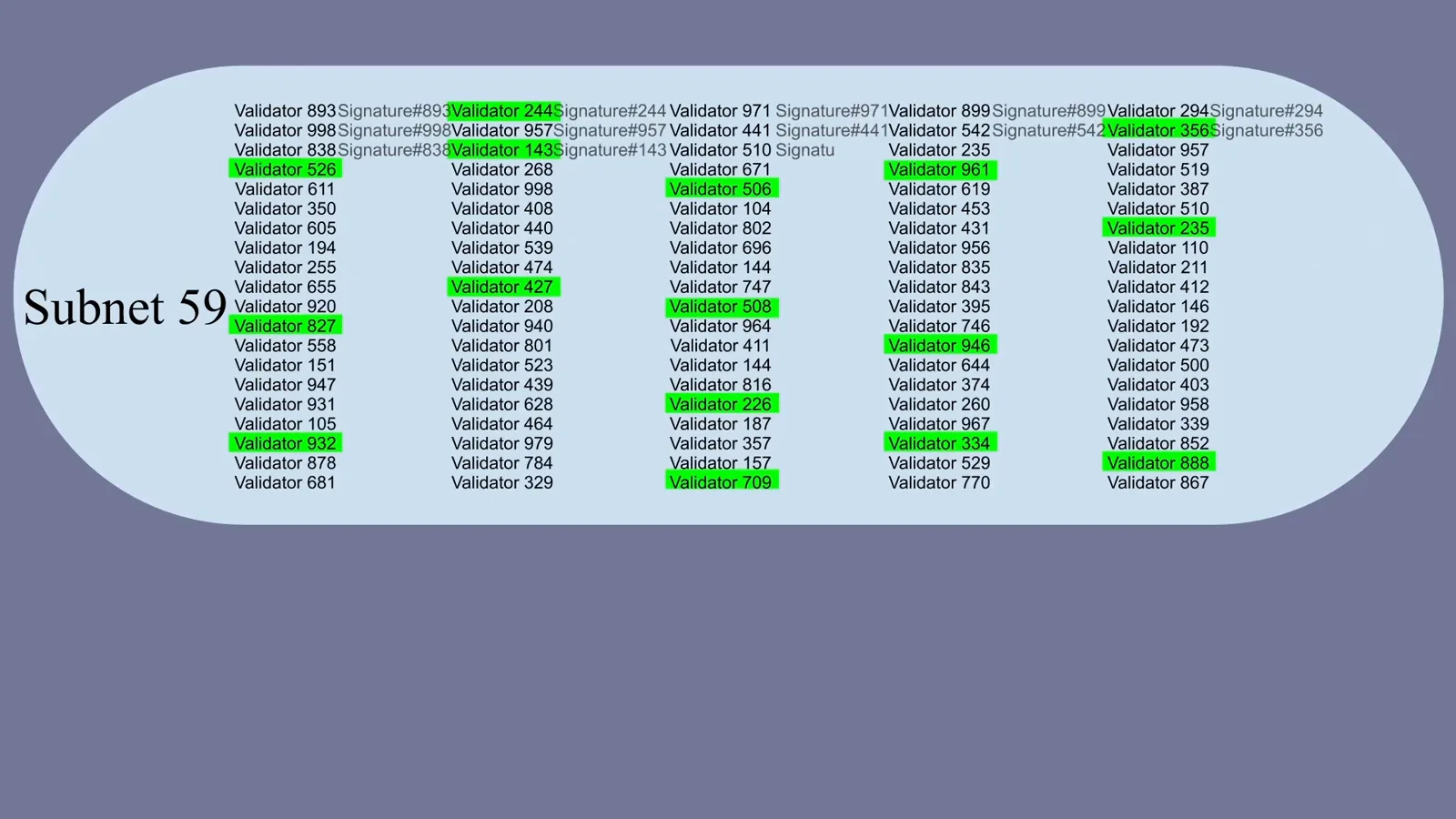
Thousands of votes, one representative. - 11
Why exactly 32 ETH
Because every validator is one signature, and signature count is the cost. The video runs the numbers: if the minimum dropped to 23.9 ETH, 120 million staked ETH would mean over 50 million validators and 157,138 signatures per slot; at 3.6 ETH it explodes past a million per slot. Holding the floor at 32 ETH makes every signature weigh the same and keeps the per-slot vote small enough to aggregate on ordinary hardware — decentralization as a design constraint, not a slogan.
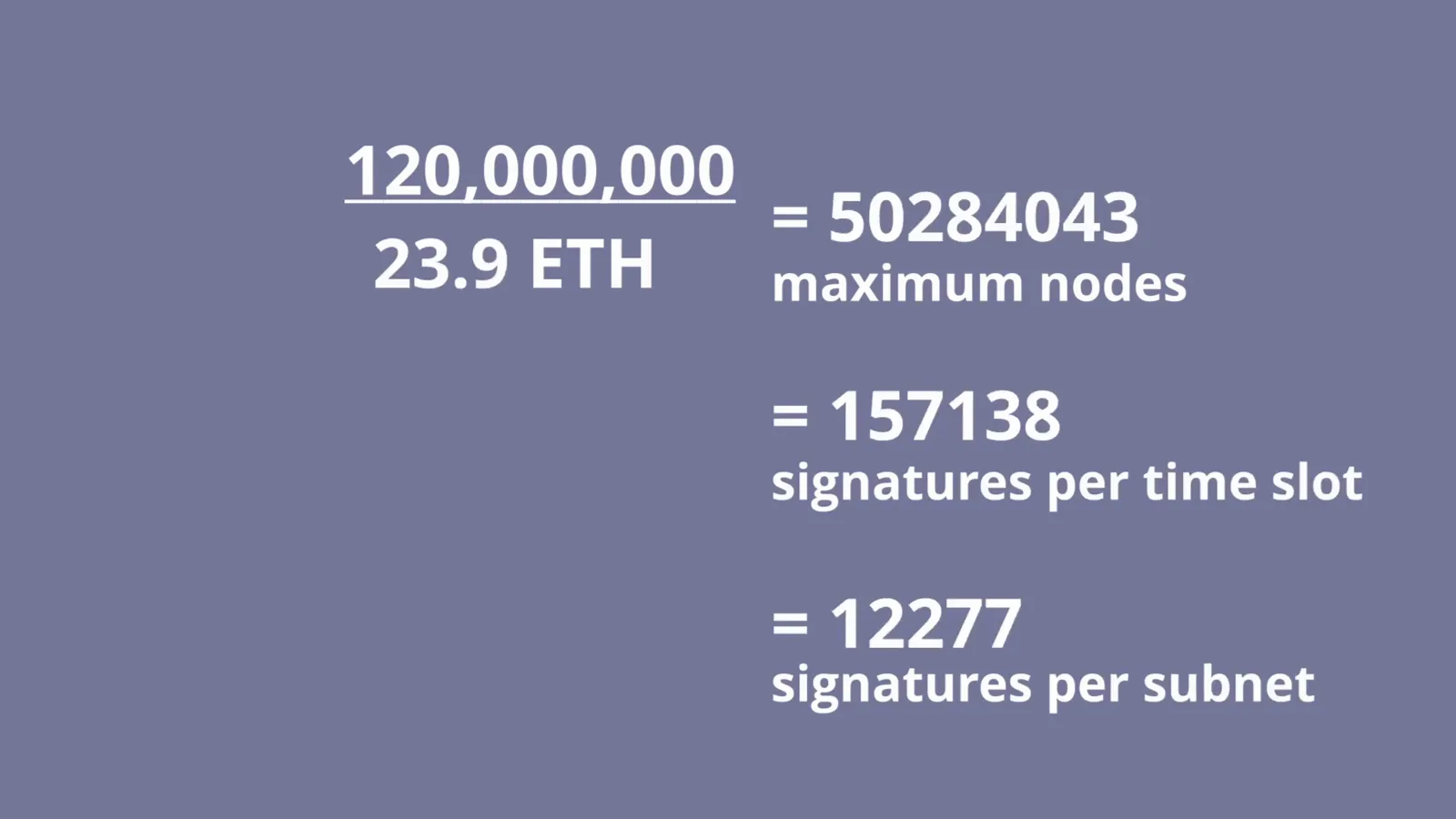
Lower the floor, flood the slot.
Rewards, Finality and the World After The Merge
With the miners gone: how validators get paid, when a block becomes irreversible, and what changed on September 15, 2022.
- 12
The income is in the voting, not the proposing
Validators are paid for showing up — but not equally for every task. The rewards pie tells the story: 84.4% of validator income comes from attestations, 12.5% from proposing blocks and 3.1% from sync duties for light clients. A proposal pays enormously more — the video estimates about 23.6 million Gwei versus 17,631 Gwei per attestation, roughly a thousandfold — but proposals arrive only a few times a year. For a steady return, attesting on time, every epoch, is the job.
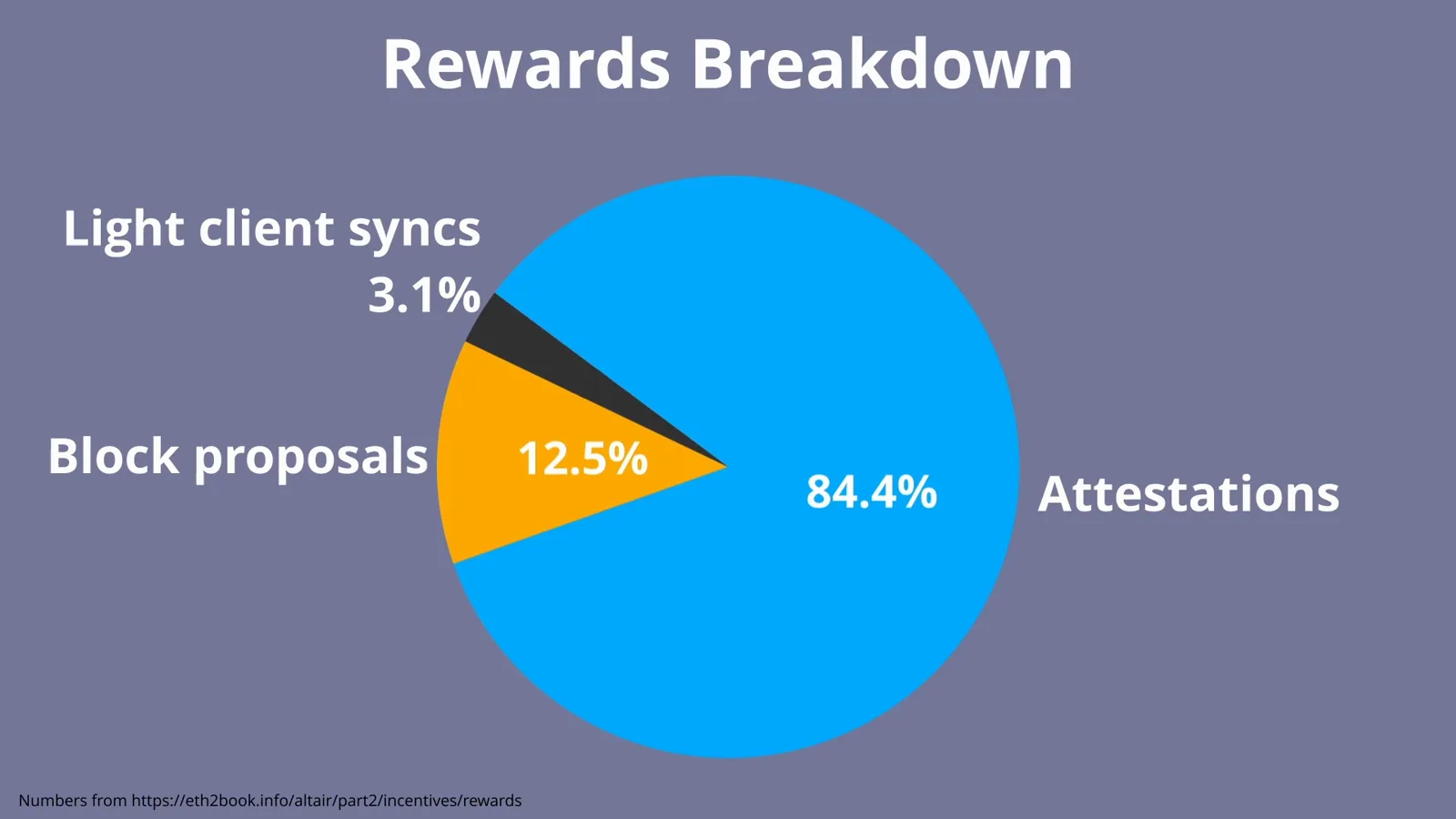
A validator's paycheck is mostly attendance. - 13
Issuance floats with the stake
None of these rewards are fixed. Total issuance scales inversely with how much is staked: the table shows 0.17% annual issuance at 1 million ETH staked, 0.54% at 10 million and 0.94% at 30 million — with validator APY of 5.72% at the 10-million mark, and 3.3% to 5.72% at the 13.4 million ETH staked when the video was made. After The Merge, mining rewards vanished entirely, cutting new ETH issuance by roughly 90% — the birth of the 'ultrasound money' era.
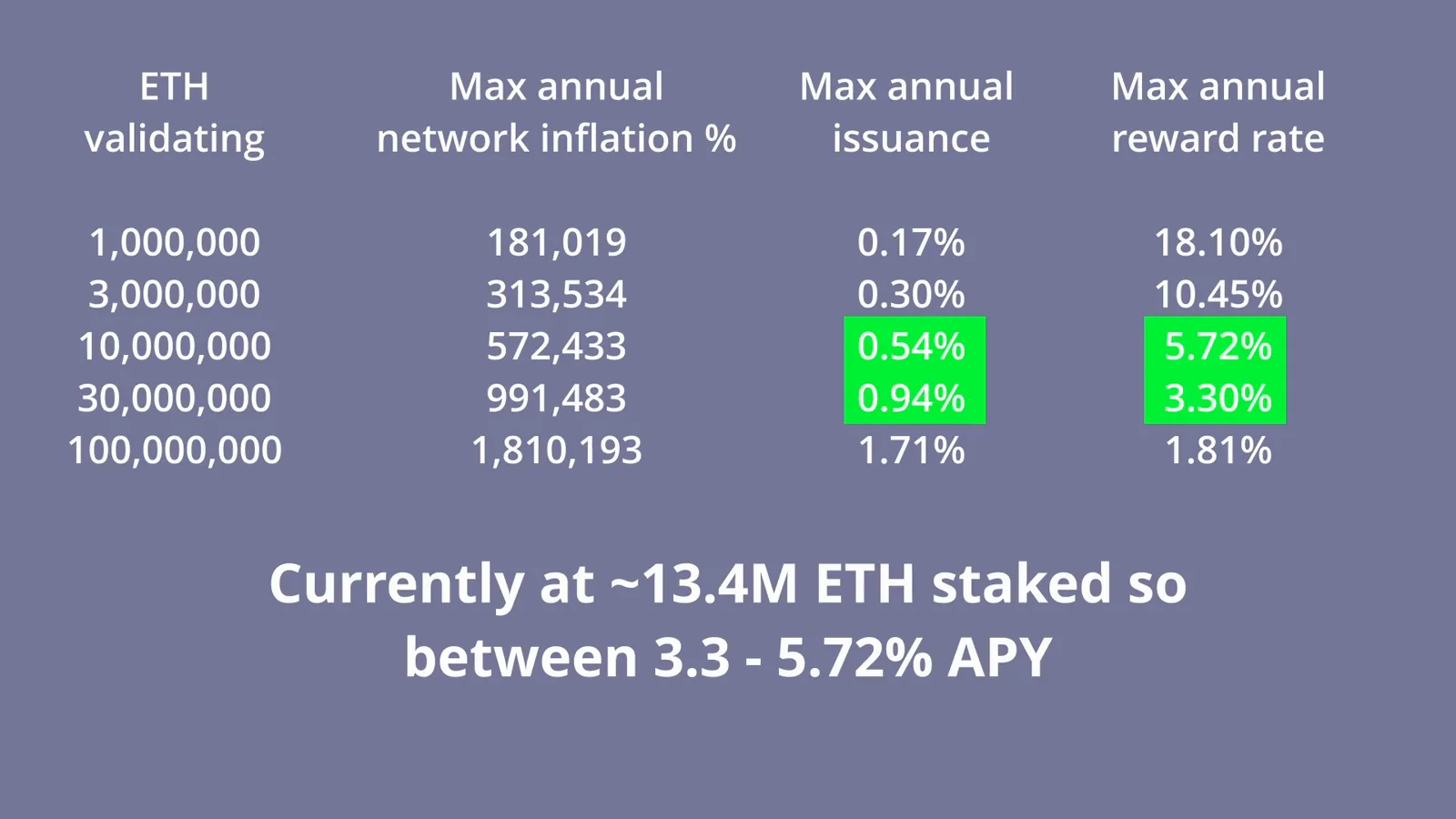
More stake, less new supply. - 14
Casper: the ghost that stamps 'final'
GHOST has a limit: it makes reverting the chain progressively unlikely, but it never declares the matter settled. That is the job of Gasper's second half — Casper, the Friendly Finality Gadget. Casper is a BFT-style overlay running on top of GHOST, voting in rounds: one round per epoch. When validators representing two thirds of the staked ETH agree on a checkpoint across consecutive rounds, that checkpoint is finalized — irreversible by economics and by consensus alike.

The ghost that signs off on history. - 15
Attack the vote, burn your own stake
The two-thirds threshold invites a tempting attack: an adversary voting for both sides of a fork could push each side past 67%. But double votes are self-incriminating — the same validator's signature appears on conflicting blocks, visible to everyone. Slashing burns the offender's stake, and once penalties eat it below 16 ETH the validator is removed from the contract, so the attack gets a handful of tries, not infinite ones. If finality ever stalls, inactive validators leak stake until two-thirds participation returns.
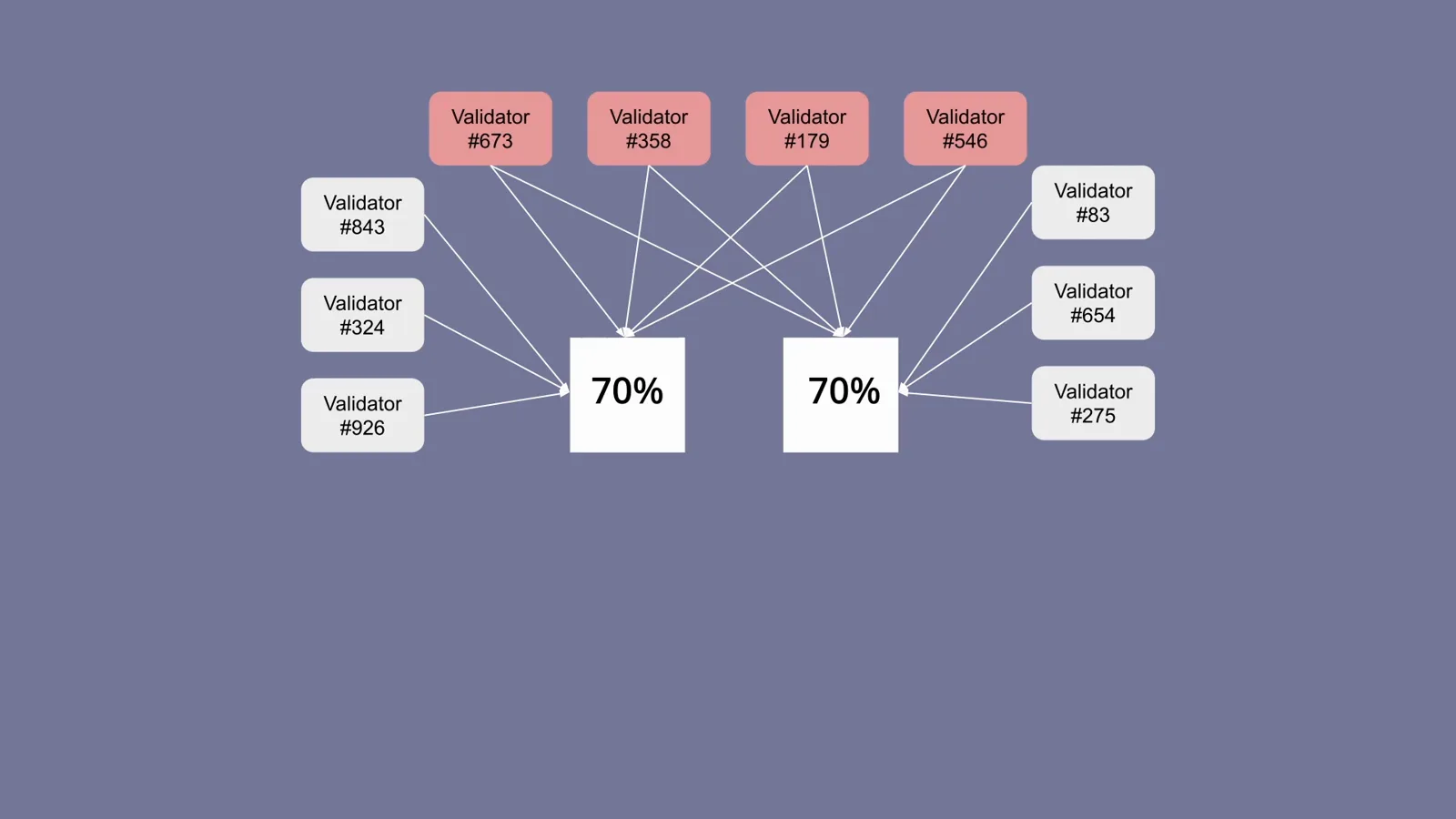
Double-voting, at the price of the stake itself. - 16
After The Merge: irreversible every 13 minutes
The end state is the checkpoint board: Epoch 0 and Epoch 1 stamped Finalised while later epochs wait for their votes to fill. Under proof of work, six confirmations gave probabilistic comfort; since The Merge, finality lands about every two epochs — under 13 minutes — and it is absolute. One trade-off remains: a brand-new node cannot work out from genesis alone which chain is real, so it accepts a recent checkpoint from peers — Ethereum calls this weak subjectivity, its most debated compromise.
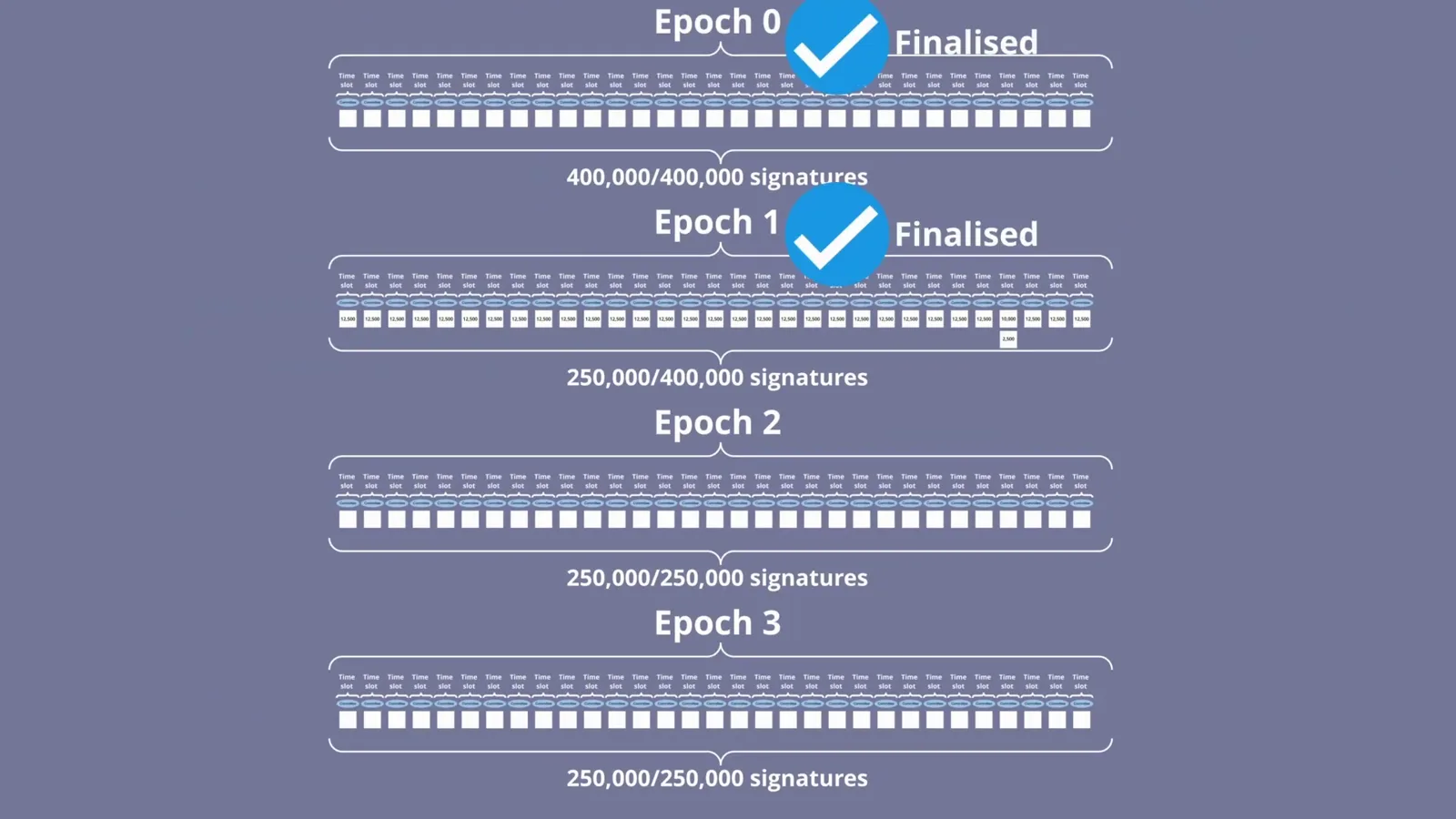
Probability gave way to certainty.
Frequently Asked Questions
When did Ethereum switch from proof of work to proof of stake?
Is Ethereum more environmentally friendly since The Merge?
What happened to GPU miners — and what is Ethereum Classic's role?
Do ETH holders need to do anything because of The Merge?
Why is it called 'The Merge'?
Why does Ethereum staking require exactly 32 ETH?
Continue the Story
The DAO Hack: The Heist That Split Ethereum
Ethereum's first existential fork — and the origin of Ethereum Classic, the chain that stayed with proof of work.
A History of Bitcoin Mining
What proof of work looked like at scale — the machine Ethereum retired on September 15, 2022.
Ethereum: The Complete History
From Vitalik's whitepaper to The Merge — the full arc this guide zooms into.
A History of Smart Contracts
The world computer's core idea — the engine whose consensus this whole upgrade rewired.
The Blockchain History Timeline
Every inflection point from the genesis block to The Merge, in one view.
Bitcoin Halving History
The other consensus economics: why Bitcoin kept proof of work and engineered scarcity through halvings.
References
Extended Multimedia Reference
Visual sequences and chronologies in this guide cross-reference video documentation “Ethereum's Proof of Stake consensus explained” by Alt Explainer.
This illustrated guide is maintained strictly for educational, research, and historical documentation purposes. None of the materials constitute investment, financial, legal, or trading advice. Historical crisis and market events are documented from public archives. Digital assets involve significant risks.