BRC-20 History: The Experiment That Congested Bitcoin
In March 2023 an anonymous developer called domo posted a six-part 'experiment': a token standard for Bitcoin, made by inscribing plain JSON on satoshis. He called the tokens worthless. Within eight weeks the BRC-20 mania had minted thousands of tokens, pushed ORDI to a billion-dollar-class valuation, driven a record 682,281 transactions in a single day, and forced Binance to pause Bitcoin withdrawals twice in 24 hours — while Bitcoin's own developers debated whether to censor the traffic. This is the complete BRC-20 tokens history, from the ordinals groundwork to the Runes succession, told through 16 archived screens.
10 minutes • 16 illustrated steps • From domo's March 2023 thread to Runes at the 2024 halving
Editorial Research & Chronological Archive
Independently synthesized and cross-verified by The Blockchain History Editorial Board using primary whitepapers, historical archives, and on-chain records.
What was BRC-20?
BRC-20 was an experimental fungible-token standard for Bitcoin, proposed by the pseudonymous developer domo (@domodata) on March 9, 2023. Instead of smart contracts, it used ordinals inscriptions: deploy, mint, and transfer operations were written as plain JSON and inscribed onto individual satoshis, with balances tallied off-chain by indexing services. The first deployment, ORDI, copied Bitcoin's 21 million supply cap. domo explicitly labeled the design a fun experiment whose tokens 'will be worthless' — but by early May 2023 the BRC-20 market cap had exploded toward one billion dollars, ORDI briefly traded at $4, and the minting flood pushed unconfirmed Bitcoin transactions toward 500,000, spiked fees, and twice forced Binance to halt withdrawals. Bitcoin developers publicly debated censoring the traffic and chose the status quo. Binance listed ORDI in November 2023, the token peaked at an all-time high of $95.52 before falling more than 96%, and Casey Rodarmor — ordinals' creator — answered the standard's flaws with Runes, launched at the April 2024 halving.
Key Takeaways
- BRC-20 was proposed on March 9, 2023 by the pseudonymous developer domo (@domodata) as 'an experiment into brc-20's and fungibility on bitcoin with ordinals' — a six-part thread, a GitBook spec, and the warning 'Read every word if you decide to test. These will be worthless. Use at your own risk.'
- The standard has no smart contracts: deploy, mint, and transfer are JSON inscriptions on individual satoshis, and balances exist only in off-chain indexes — a design domo himself called a 'fun experimental standard' that should not be considered Bitcoin's definitive fungibility standard.
- The first token, ORDI, mirrored Bitcoin's 21,000,000 supply cap with a 1,000-per-mint limit; the UniSat index shows it deployed March 8, 2023 at 6:16 AM and fully minted, with meme, punk, pepe, and gold following within a day.
- In under two months the mania produced over 8,500 tokens, pushed the combined BRC-20 market cap toward and by some indexes past one billion dollars, drove ORDI to $4 (from effectively zero), and set a daily record of 682,281 Bitcoin transactions with ordinal inscription fees topping 272 BTC (~$7.6M) in one week.
- The mint flood drove unconfirmed Bitcoin transactions toward 500,000 — versus under 50,000 for most of 2022 — and forced Binance to pause BTC withdrawals twice within 24 hours on May 7-8, 2023; Bitcoin developers then openly debated censoring ordinals traffic before keeping the status quo.
- Binance listed ORDI with a Seed Tag on November 7, 2023, the token later reached an all-time high of $95.52, and by late 2026 it trades around $3.66 — 96% below peak — while Casey Rodarmor's Runes protocol, launched at the April 20, 2024 halving, replaced BRC-20's inscription model with UTXO-native tokens.
The Setup: Bitcoin Learns to Carry Content (January-March 2023)
Before anyone minted a token, ordinals had already taught Bitcoin to hold arbitrary data — and Bitcoin's first spam war of the inscription era was one missed deadline away.
- 1
Ordinals put content on satoshis first
BRC-20 is unintelligible without its predecessor. In January 2023 developer Casey Rodarmor's ordinals protocol went live on Bitcoin mainnet, letting anyone 'inscribe' arbitrary content — images, text, whatever fits — onto an individual satoshi, the chain's smallest unit. The trick needed no sidechain and no separate token: inscription content rides inside taproot witness data, split into pushes of at most 520 bytes and wrapped in an envelope of no-op opcodes, committed and revealed in two transactions. Because sats are numbered by the protocol's ordinal theory, an inscription can be traced and traded like a serial-numbered collectible. By spring 2023 these 'Bitcoin NFTs' were already paying miners serious fee revenue and annoying exactly the people who would soon coin the word 'spam' all over again.
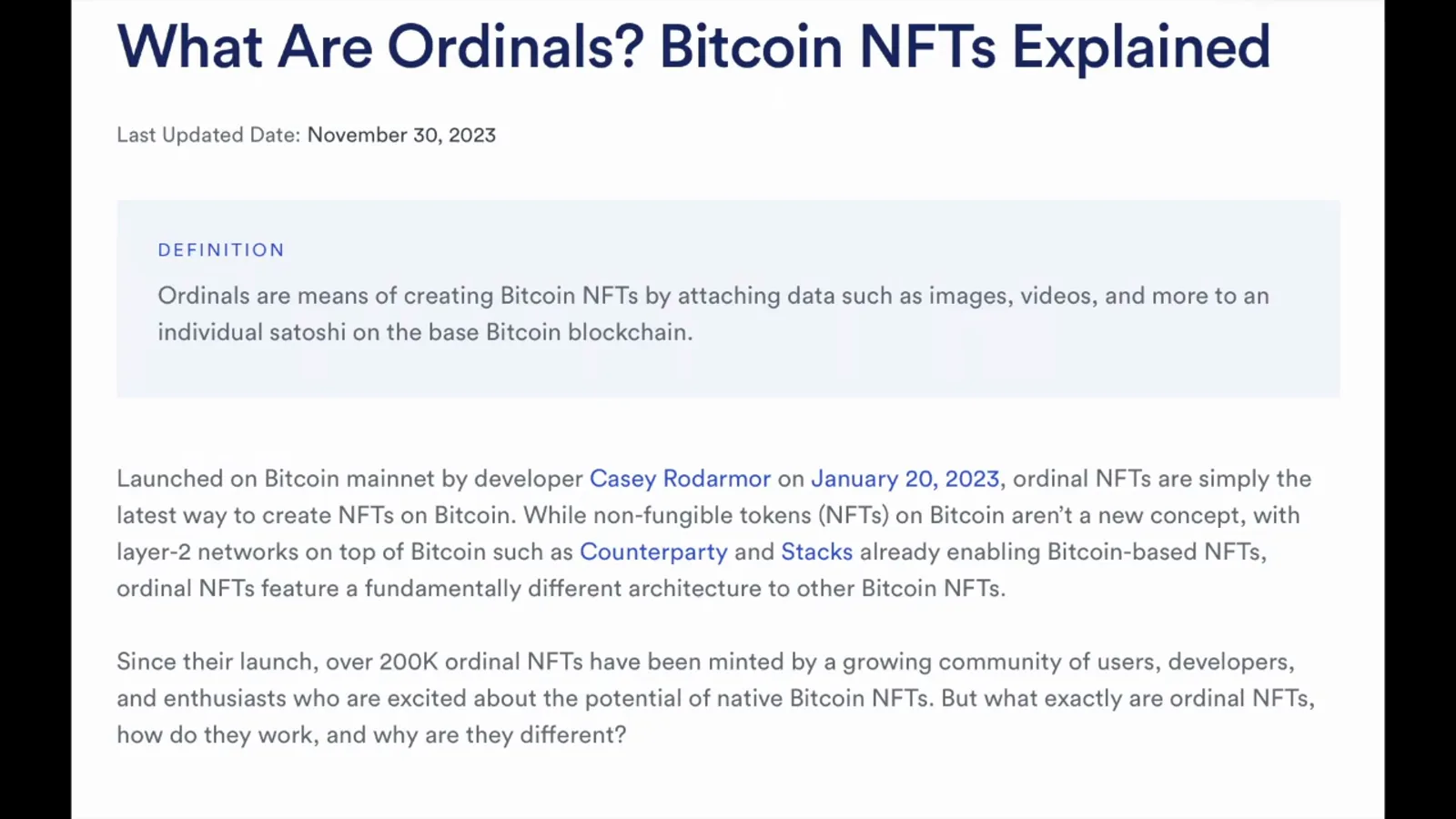
The primer slide: inscriptions arrived two months before BRC-20. - 2
Two named characters, one of them anonymous
The 2023 inscription era had a short cast list, and one 2024 podcast slide captures it perfectly. Casey Rodarmor — creator, artist, developer, founder — owns the Ordinals and Runes protocols. Domo, @domodata on X, is listed simply as 'Developer, BRC-20 Token Standard', and that is the entire public identity: an anonymous on-chain builder whose real name has never surfaced, in a scene where Satoshi-style anonymity is tradition rather than exception. The other names on the slide — Leonidas, Leo Callard — were the era's amplifiers, the accounts that turned ordinals from a dev curiosity into a movement. Keep the two founders separate in your head: Rodarmor built the rail; domo ran the experiment on it that got out of hand.
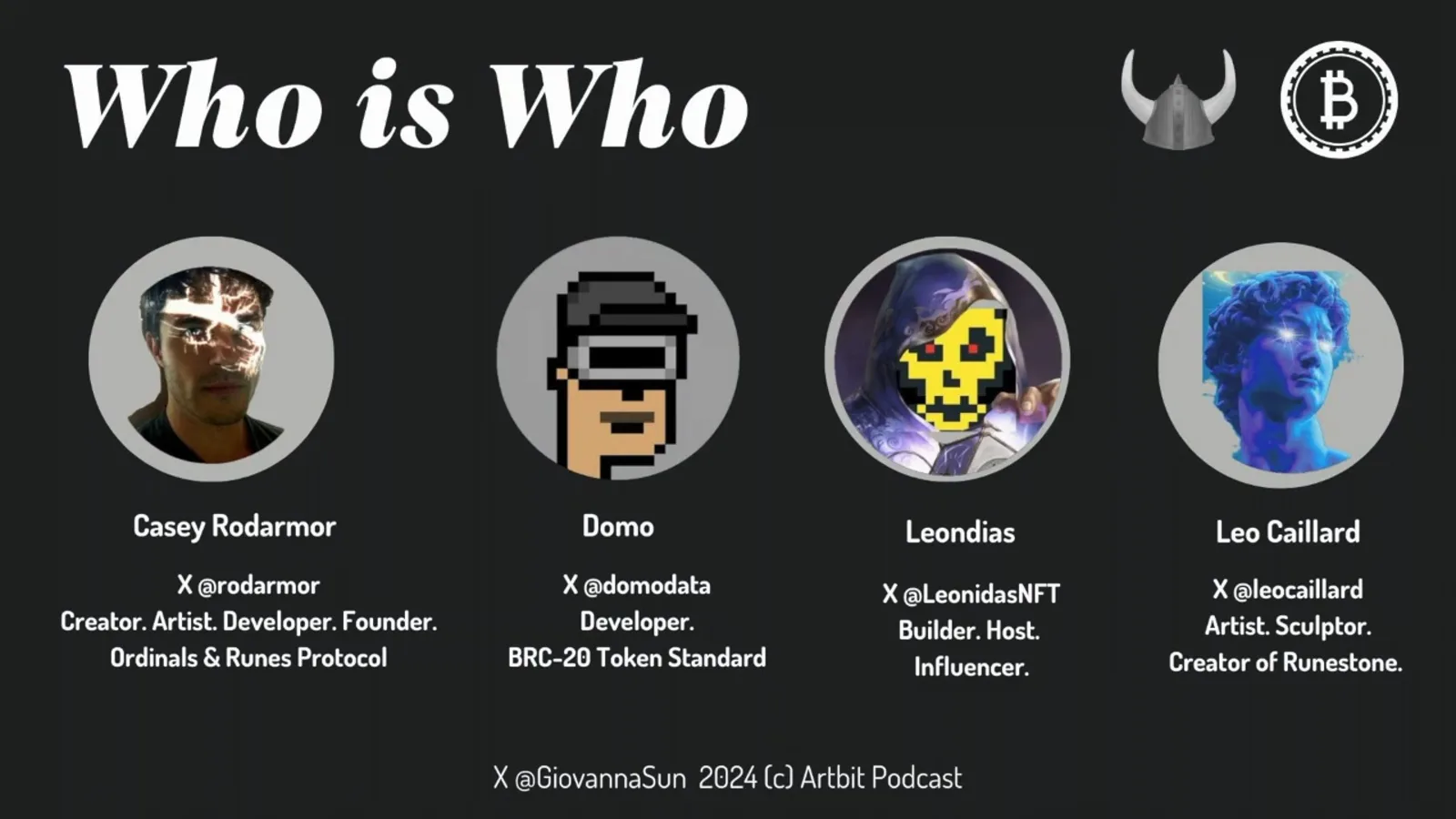
The whole drama had two authors: Rodarmor built the rail, domo ran the experiment. - 3
domo's six-tweet 'experiment' — and its honest warning
On March 9, 2023 (UTC), domo opened the thread that started everything: 'An experiment into "brc-20's" and fungibility on bitcoin with ordinals 1/x.' Six numbered posts followed (1/x through 6/x), linked to a GitBook spec, borrowed inspiration from @sats_names and @redphonecrypto, and established a 'first is first' rule for tickers. The documentation's warning deserves to be quoted in full: 'Read every word if you decide to test. These will be worthless. Use at your own risk.' domo even built a 'rudimentary frontend in Dune' to track balances, begged people to 'only use it for curiosity rather than a tool,' and closed with 'This is a raw idea and any feedback is welcome.' The mania that followed is exactly what the author said should not happen.
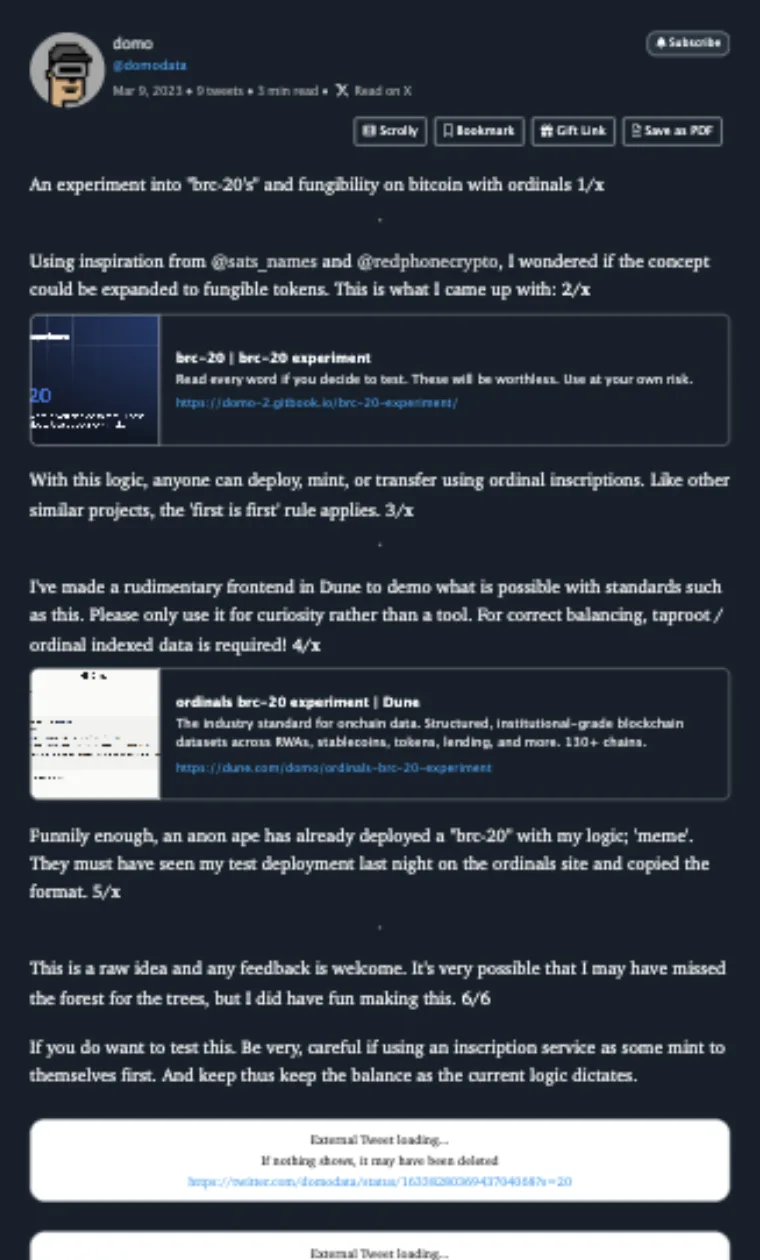
The founding document, preserved by Thread Reader App. - 4
The standard itself: JSON, not smart contracts
The mechanism was almost embarrassingly simple. A deployment is a JSON inscription: {"p":"brc-20","op":"deploy","tick":"ordi","max":"21000000","lim":"1000"} — protocol, operation, a four-letter ticker, maximum supply, per-mint limit. Minting and transferring use the same envelope with different 'op' values. There are no smart contracts and no on-chain balances anywhere; an indexer aggregates the inscribed function calls and keeps the ledger in a database, which is why domo stressed that 'taproot / ordinal indexed data is required' for correct balancing. Commentators immediately reached for the family tree: Crypto Koryo's viral May 2023 thread traced the idea back to the Colored Coins protocol of 2012, which had died under high fees and limited programmability. BRC-20 was Colored Coins with taproot's witness discount doing the heavy lifting.
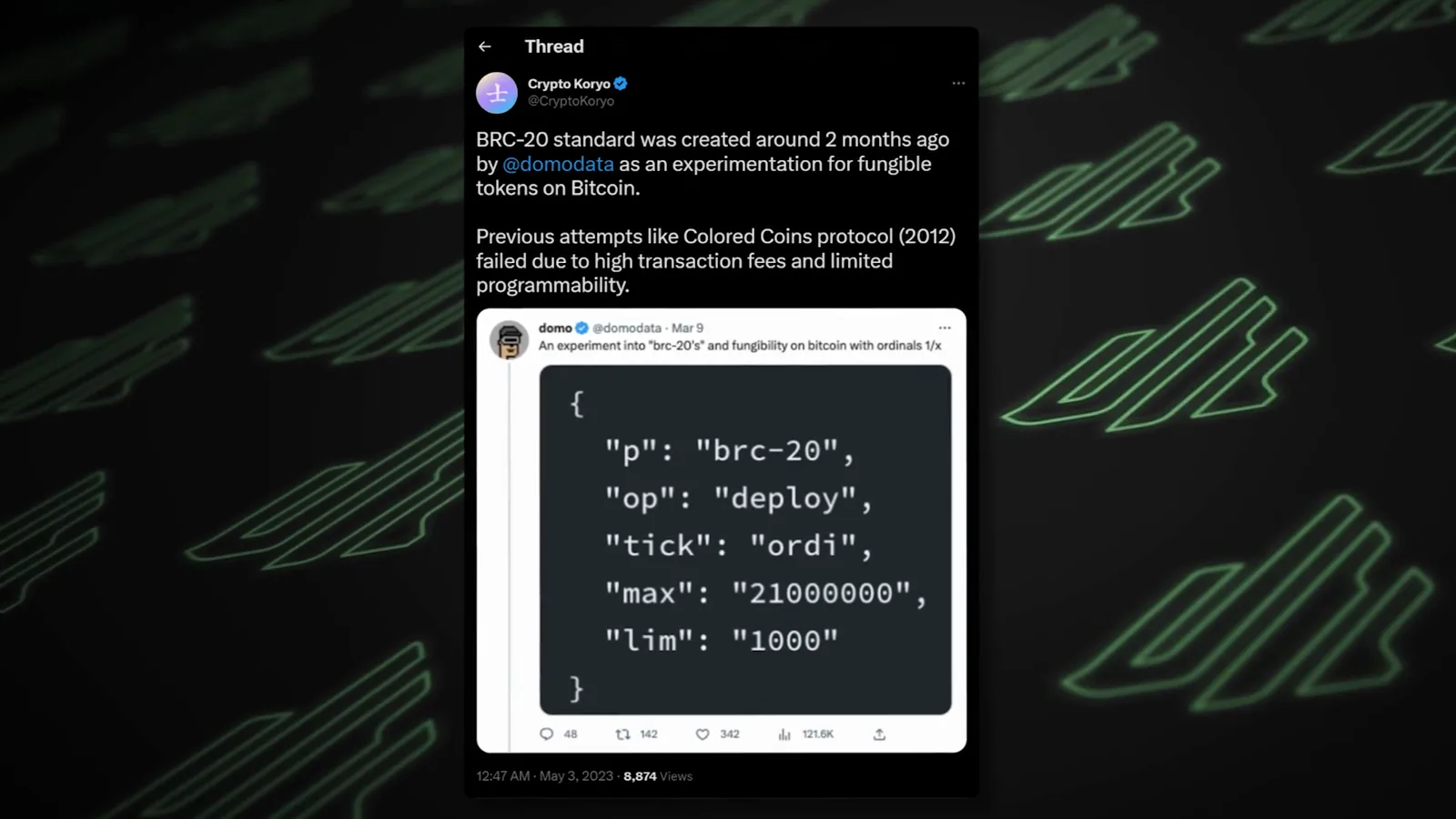
The whole standard fits in one screenshot of JSON.
The Mania: Fair Mints That Cost Real Fees (March-April 2023)
Deploy, mint, repeat: a fair-launch culture, a wallet that made it one click, and a marketplace that gave the tokens prices — all paid for with satoshis.
- 5
ORDI deploys first; the imitations follow within a day
domo's own test deployment of 'ordi' is timestamped March 8, 2023, 6:16:31 AM in UniSat's index — hours before the announcement thread, because domo had tested the format on the ordinals site the night before. The ticker's parameters were a wink: 21,000,000 max supply, 1,000 limit per mint, mirroring Bitcoin itself. The 'first is first' rule did the rest: 'meme' was deployed by an anonymous copycat that same day ('they must have seen my test deployment last night... and copied the format,' domo wrote), with punk, pepe, and gold following on March 9. Every token minted out 100% — no team allocation, no presale, no venture round. It was the purest fair-launch culture crypto had seen, and it was funded entirely by Bitcoin transaction fees.
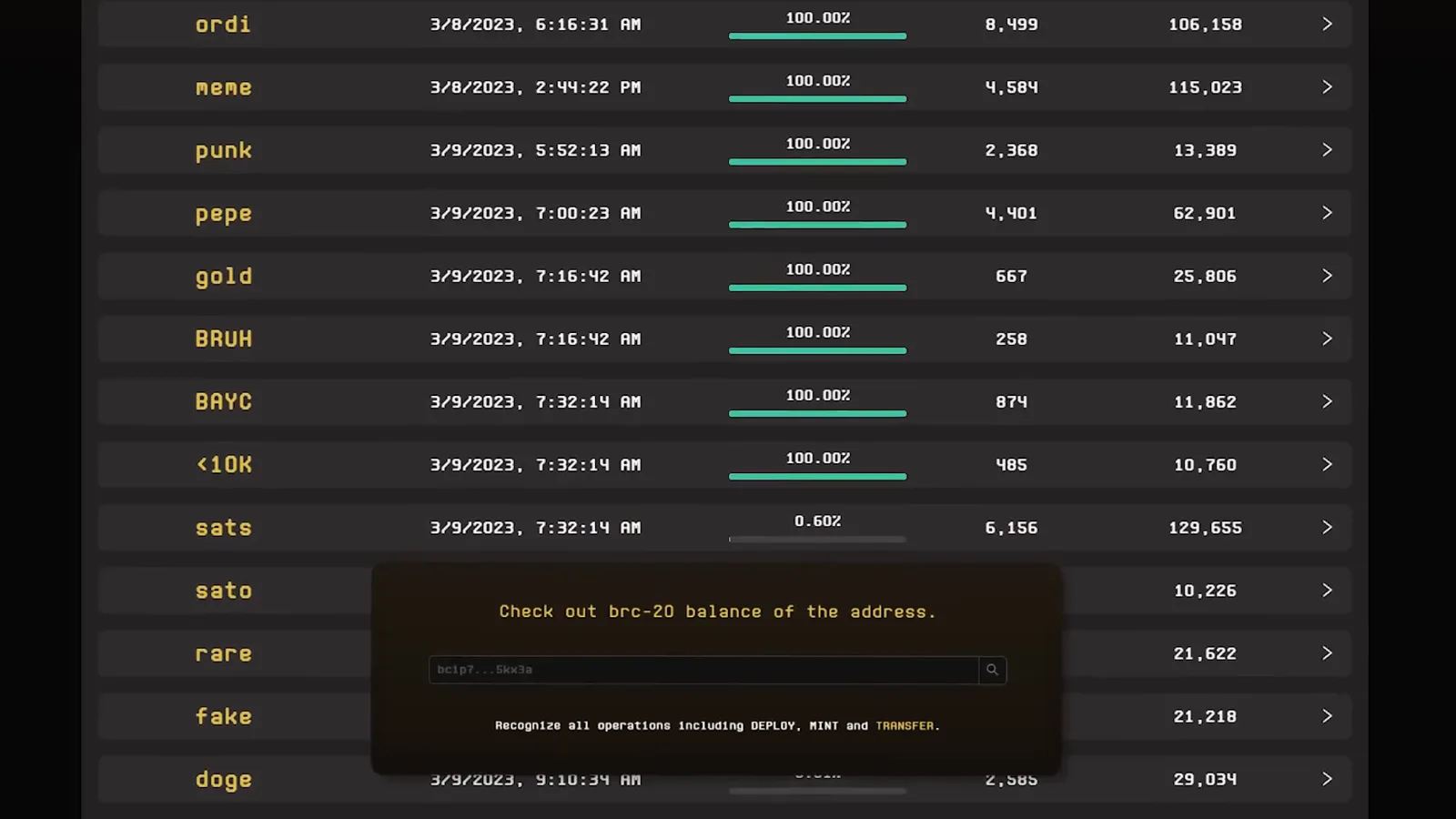
The index page: ordi first at 6:16 AM, the copycats by breakfast. - 6
Minting was just paying Bitcoin to inscribe JSON
To mint, you opened the UniSat wallet — 'basically MetaMask but for Bitcoin' — picked a token, and signed an inscription that wrote another tiny JSON onto a satoshi you owned. The VOSK example shown here, a token the VoskCoin channel deployed as a demo, shows the whole flow: tick, amount, repeat count, then fees. And there is the experiment's central irony in one warning banner: 'The current Bitcoin network is highly congested. The inscription count is limited to be 24 per order.' 'Free' tokens, minted for the cost of real Bitcoin fees, capped at two dozen per order because the chain could not breathe. Multiply that banner by thousands of degens refreshing a browser tab, and May 2023 is already visible in miniature.
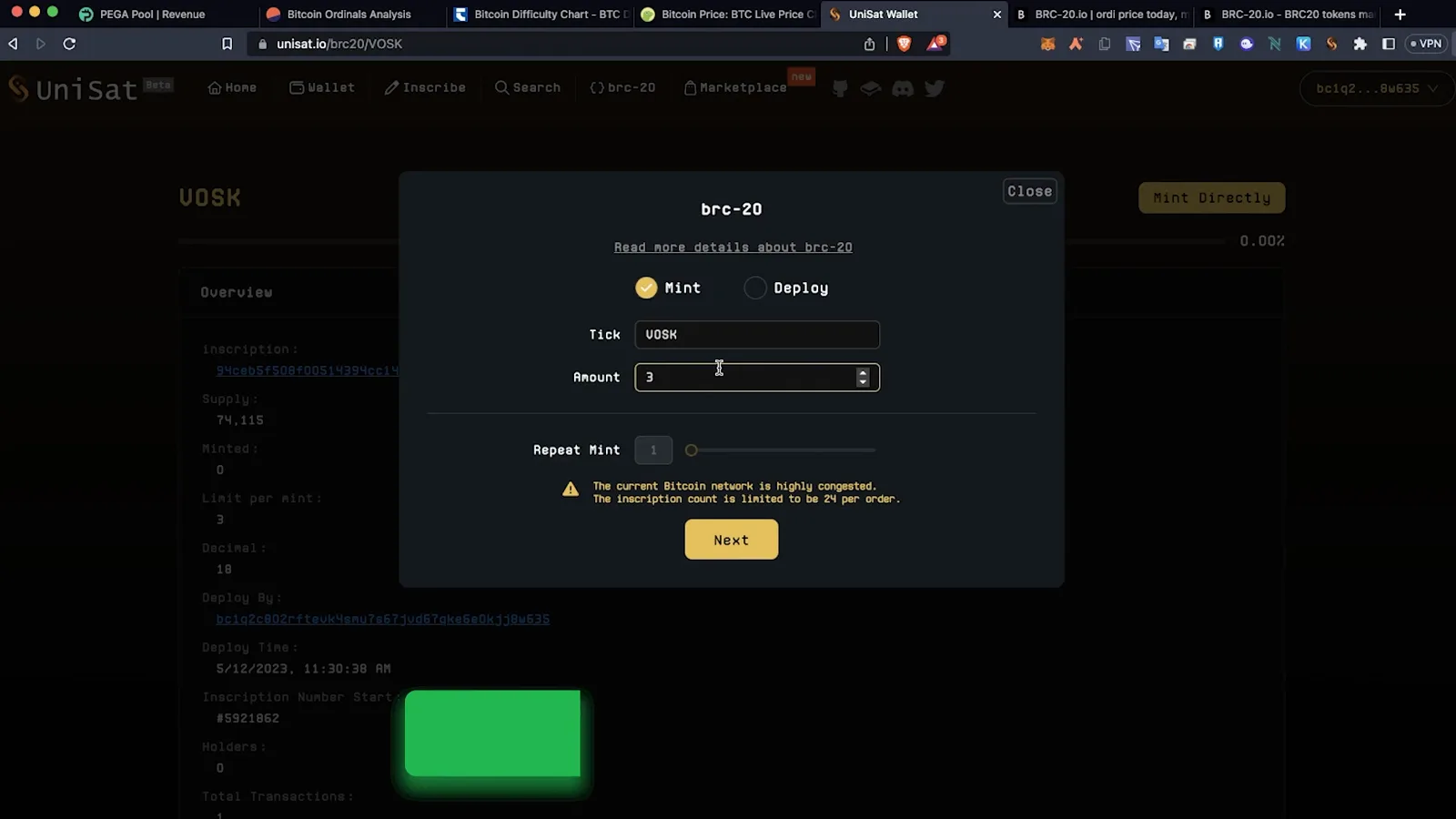
Free tokens, 24 per order, because the chain was drowning. - 7
A marketplace appears while the paint is still wet
Trading infrastructure materialized almost as fast as the tokens. UniSat's marketplace listed BRC-20 'transfer' inscriptions like collectible cards: ORDI lots of 300, 275, 350, and 500 units, bid at 6,000 to 8,810 sats per token — roughly $2 to $2.50 at May 2023 prices — each card an inscription that had to be inscribed, then spent, to change hands. Because a BRC-20 transfer is itself a Bitcoin transaction, every trade paid the network twice, and every listed card sat in the mempool queue like everything else. The prices were real, though: someone was paying actual Bitcoin for JSON that had not existed six weeks earlier. That is the moment an experiment becomes a market.
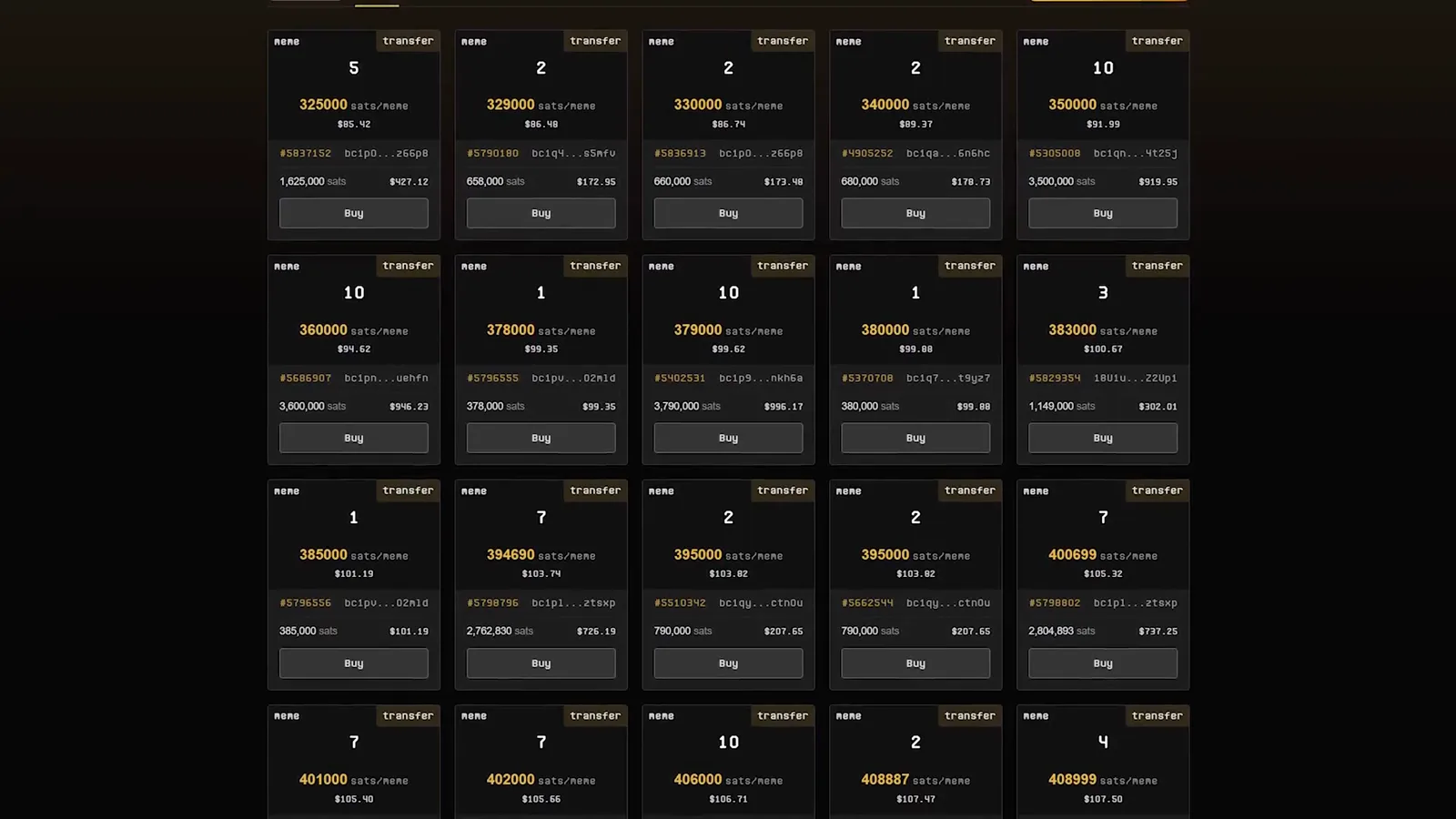
Every one of those cards is a Bitcoin transaction waiting to happen. - 8
$120 million and +600% in one week
By May 3, 2023, the numbers had stopped being funny. Crypto Koryo's thread — the most-cited summary of the moment — tagged BRC-20 as 'an experimental token standard for the Bitcoin blockchain. Inspired by Ethereum's ERC-20... Current market cap of BRC-20 tokens: ~$120M! Up 600% in the last week.' Read the framing twice: a standard whose own documentation promised worthless tokens had, in seven days, added six times its value. The same thread warned what the fine print had said all along — wallets like UniSat had already suffered exploits, memecoins were risky, and BRC-20 memecoins were 'even riskier. Total degen play.' Nobody trading the chart was reading the GitBook.
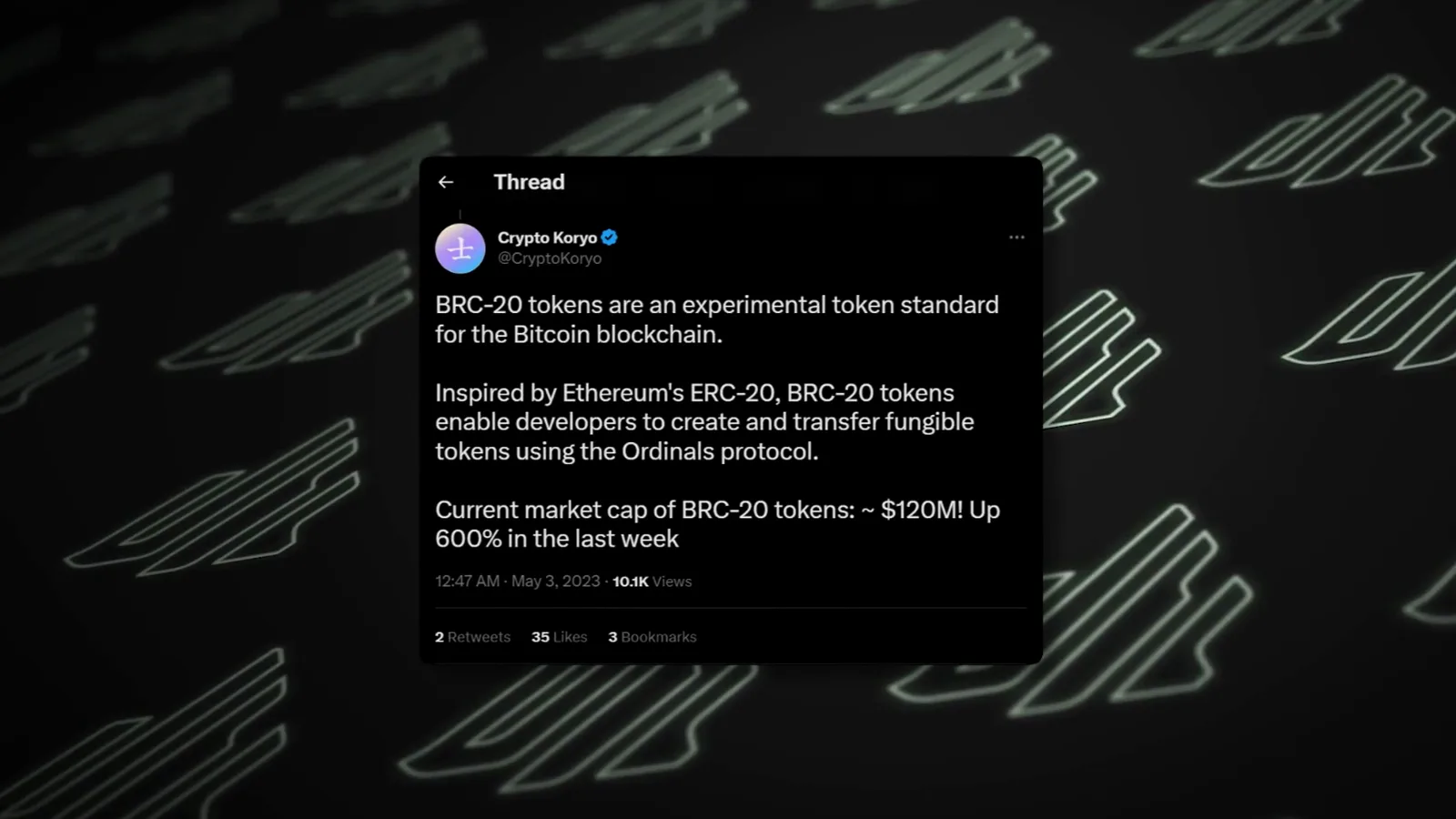
May 3, 2023: the experiment discovers gravity in reverse.
May 2023: Peak Congestion
The tokens got a price, the chain got a fever, and the world's largest exchange had to close its Bitcoin door — twice.
- 9
'These will be worthless' — ordi prints $4
The thread's next entry is the experiment's thesis statement turned inside out: 'BRC-20 tokens have gained over $120M market cap in less than 60 days. The creator of the protocol originally stated these tokens would be worthless, but "ordi" reached $4 per unit, providing astronomical returns to early minters.' A thousand-ordinance mint that cost a few dollars in fees in March was now a four-dollar asset; early minters who had paid pennies per token in inscriptions sat on four-figure multiples. This is the mechanism that made the frenzy self-sustaining — as long as a minted token traded above its mint cost, rational degens would keep minting, and every new mint made the mempool worse. domo's GitBook had literally predicted this outcome and begged people not to do it.
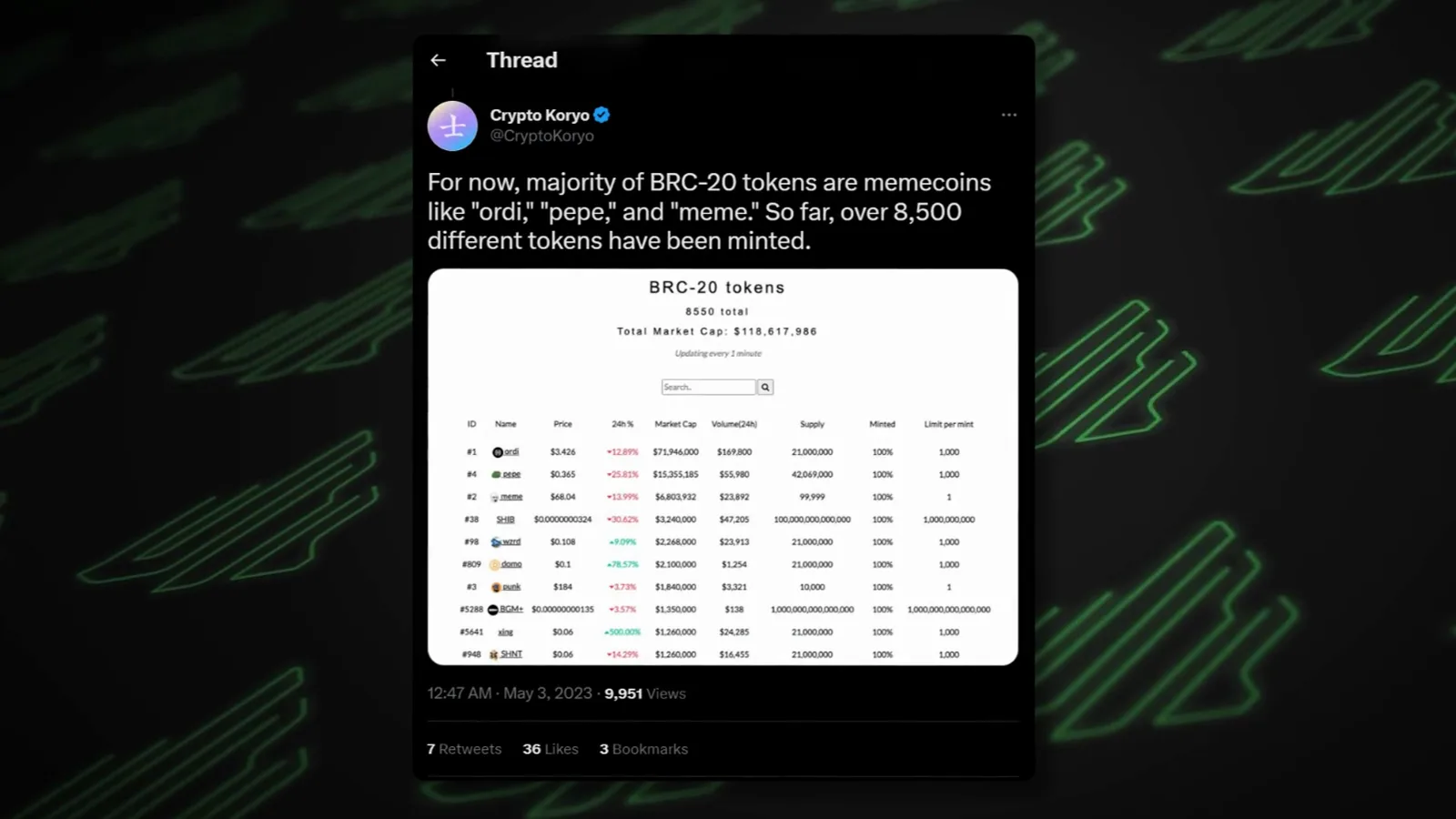
The author's disclaimer, repriced at $4 per unit. - 10
8,500 tokens and an index page worth $1.1 billion
'For now, majority of BRC-20 tokens are memecoins like "ordi," "pepe," and "meme." So far, over 8,500 different tokens have been minted,' Koryo's thread continued — and attached the index page to prove it. The table reads like a fever dream of finance: 8,550 total tokens, a summed total market cap of $1,118,617,956, ORDI at $3.426 (+12.89%, $71.9M), pepe at $0.365 (+25.81%), and a tail of joke tickers like SHIB, woof, and SHINT with nine-figure nominal supplies. Two weeks later CoinDesk would describe the sector's market cap as having 'approached $1 billion' — by whichever ledger you trusted, a JSON experiment was now a billion-dollar asset class. Each row of that table, remember, was minted by paying real Bitcoin fees.
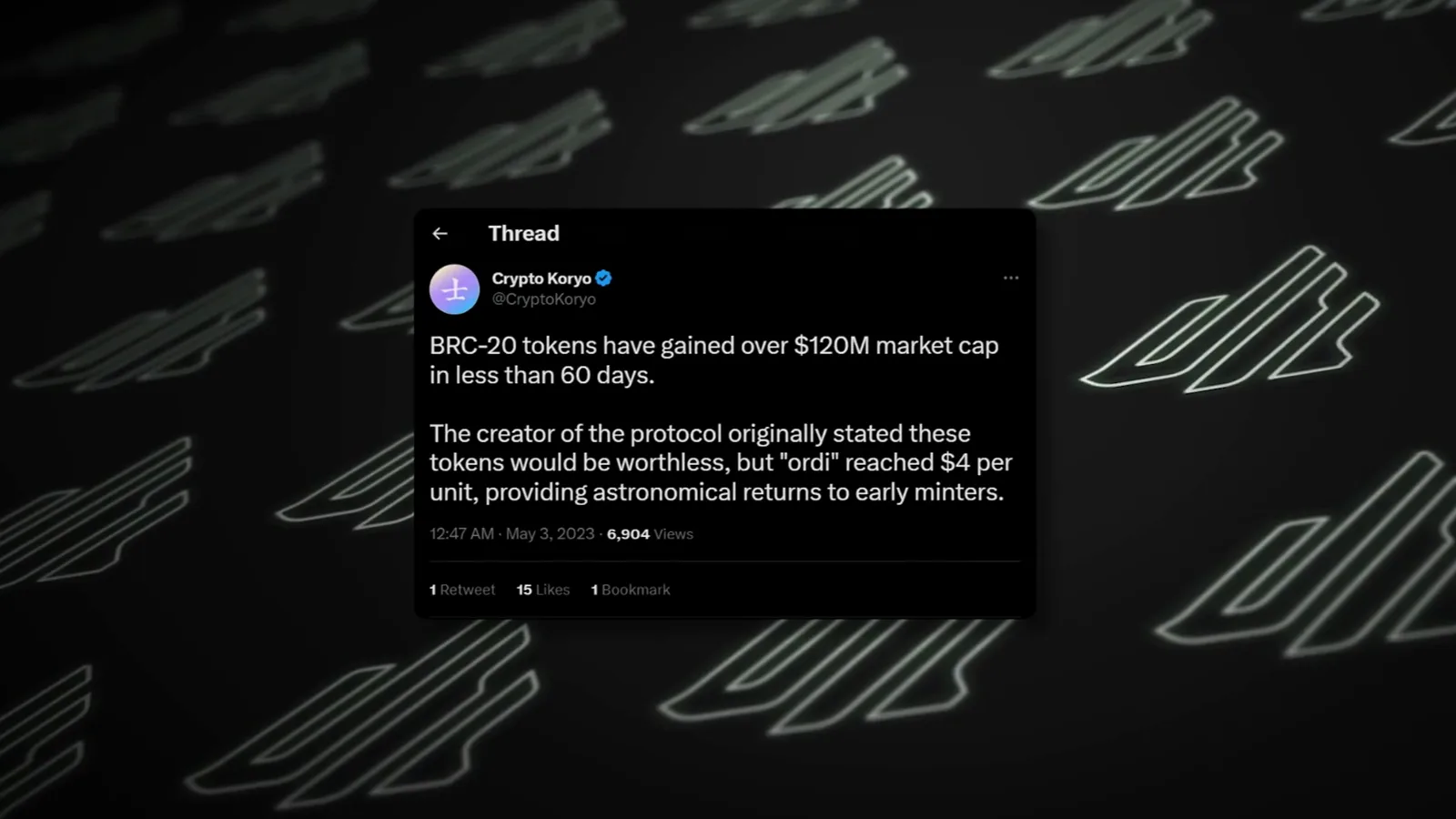
Eight and a half thousand tickers, none older than nine weeks. - 11
A record week: 682,281 transactions and $7.6M in inscription fees
Then the mania hit the chain's vitals. A market-recap quote card that circulated during the peak put numbers on it: total fees paid for ordinals inscriptions had topped 272 BTC — around $7.6 million — in a single week; over 372,000 inscriptions were created on the Monday alone; and the Bitcoin network set an all-time daily record of 682,281 transactions, with daily network fees hitting 23 BTC, about $656,000. Bitcoin's transaction ceiling is roughly 144 MB of blockspace per day, and BRC-20 minting was bidding it away from every other use. Miners, starved for fee revenue since the 2020 halving cycle, were suddenly printing subsidy supplements. Everyone else was paying for it at checkout.
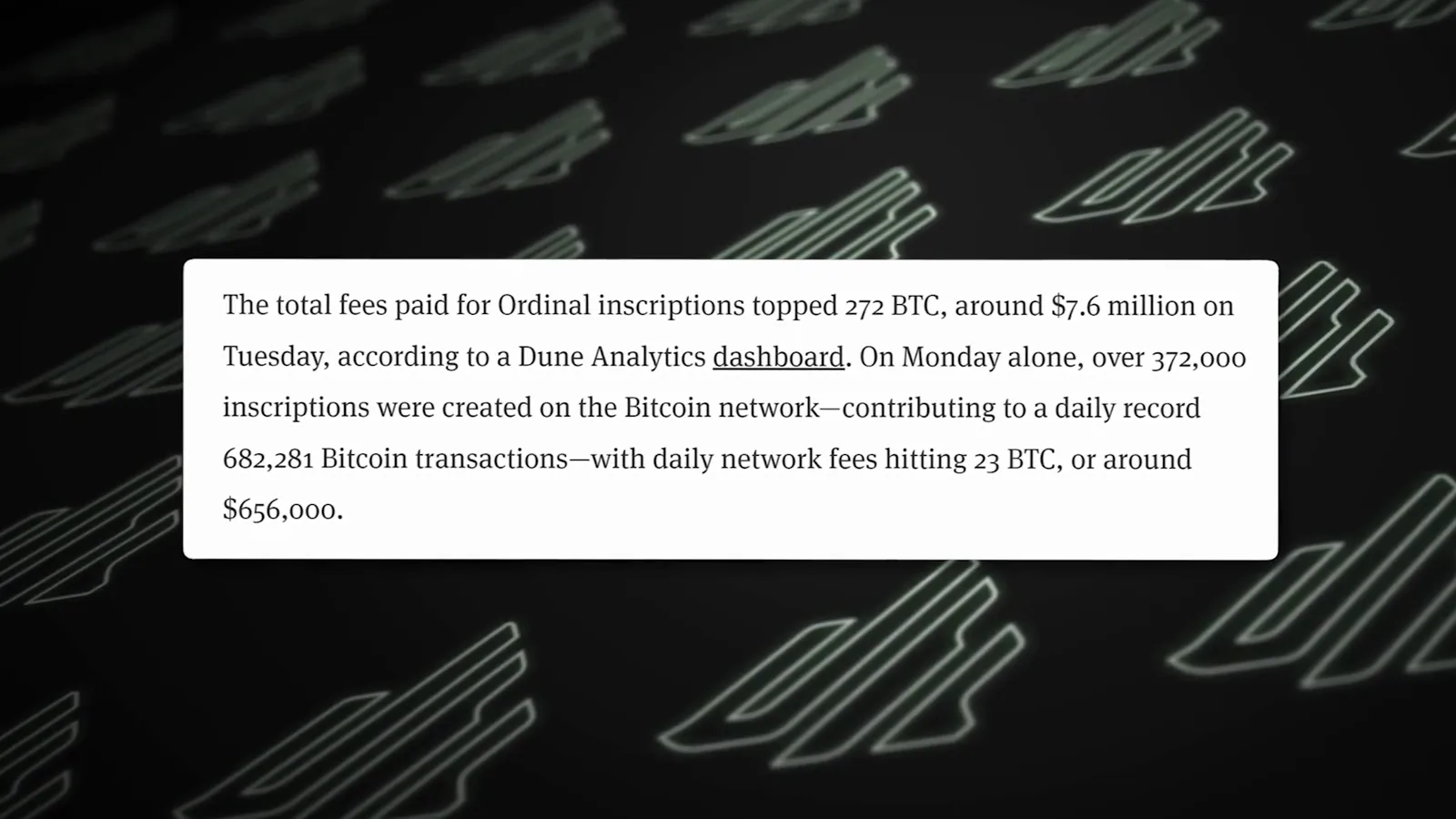
The week Bitcoin set its all-time transaction record. - 12
Binance closes the Bitcoin door — twice in 24 hours
The congestion got big enough to break the biggest company in crypto. On May 7, 2023, CoinDesk reported that 'Bitcoin Network Congestion Causes Binance to Pause Withdrawals,' with 'the world's biggest crypto exchange' resuming service only after hours of frozen BTC exits; the exchange paused withdrawals twice within roughly 24 hours as the mempool backlog climbed. Unconfirmed transactions approached 500,000 during this window — versus fewer than 50,000 for most of 2022 — because inscriptions and BRC-20 minting had filled every block. Binance's stated fix was to integrate the Lightning Network for withdrawals. For one weekend in May 2023, a meme-coin mint had done what no bear market ever had: made Binance unable to send your Bitcoin out.
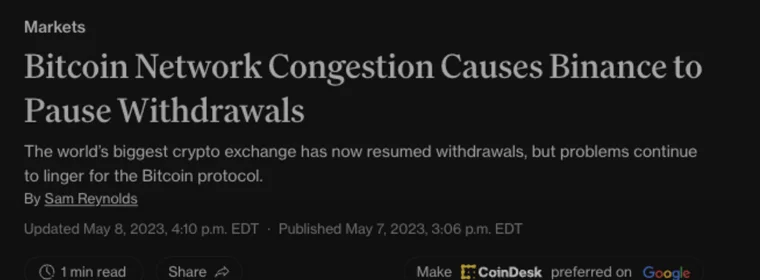
May 7, 2023: the exchange that moves the most Bitcoin stops moving Bitcoin.
The Reckoning and the Afterlife (May 2023 - 2024)
Bitcoin's developers debated censorship, Binance crowned ORDI, the price did what disclaimers say, and Rodarmor shipped the sequel.
- 13
The devs debate censorship — and blink first
CoinDesk's Frederick Munawa captured the showdown on May 12, 2023: 'Among Bitcoin Developers, Debate Is Raging Over Whether to Censor Ordinals BRC-20s.' On the bitcoin-dev mailing list, Ali Sherief argued that 'real bitcoin transactions are being priced out' and that 'such justifiably worthless tokens threaten the smooth and normal use of the Bitcoin network'; Luke Dashjr — author of the Ordisrespector spam filter since February 2023 — answered that 'spam filtration has been a standard part of Bitcoin Core since day 1'; Peter Todd noted the awkward fact that 'miners are making millions of dollars from these inscription transactions.' Michael Folkson held the status-quo line: 'Consensus rules are set and the rest is left to the market.' No protocol change happened. The same argument had been had over SatoshiDice in 2012, and it would be had again over OP_RETURN in 2025.
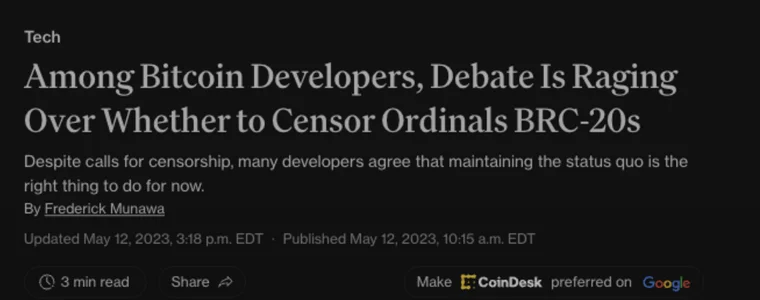
Bitcoin's oldest question, re-asked: is paid traffic spam? - 14
November 2023: Binance crowns ORDI
Six months after the mania, the establishment delivered its verdict. Binance's official announcement — 'Binance Will List ORDI (ORDI) with Seed Tag Applied' — opened spot trading for ORDI/BTC, ORDI/USDT, and ORDI/TRY at 10:00 UTC on November 7, 2023, with deposits open immediately and withdrawals the following day. The exchange's own description is the cleanest epitaph for the whole saga: 'ORDI is the first token created in accordance with the BRC-20 fungible token standard on the Bitcoin blockchain.' The Seed Tag — Binance's high-risk label — was the exchange hedging, and reasonably so: this was a listing for a token whose founding document called it worthless. The door domo's experiment had battered open in May was now officially open.
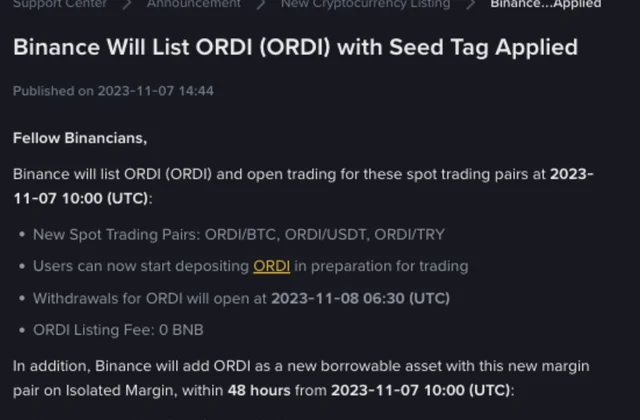
The experiment graduates to the world's largest exchange, Seed Tag and all. - 15
$95.52, then gravity: ORDI's arc completes
After the listing, ORDI ran with the liquidity — CoinGecko records an all-time high of $95.52, a level the March 2023 minters who paid pocket change in fees could hardly have imagined. Then the thesis reasserted itself: as of this guide's archive capture, ORDI trades around $3.66, down 96.16% from that peak with a market cap near $77 million, ranked #324 — its all-time low of $2.10 barely below the current price. The standard's structural weaknesses never went away: balances live in off-chain indexers, every transfer burns two fee-paying transactions, and the mint model produces infinite copycats with no cash flows. domo's GitBook closed with a line that reads like prophecy in hindsight: better designs exist, and the community should tinker with alternatives. One of those alternatives was already written by the person who built the rail.
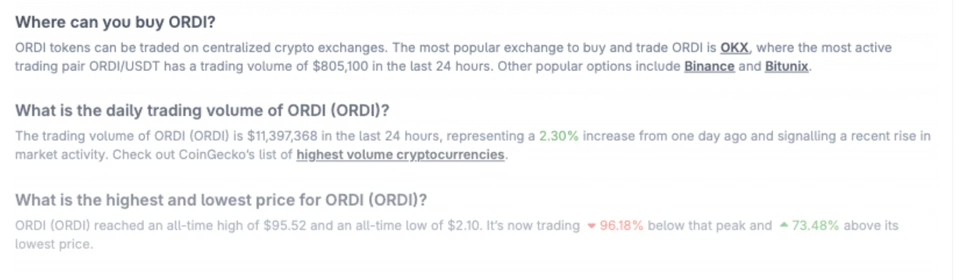
The disclaimer was right — eventually, and at $95.52's expense. - 16
Runes: Rodarmor's answer at the 2024 halving
On September 25, 2023, Casey Rodarmor published the protocol that BRC-20's critics had been asking for. He was blunt about the premise — 'Fungible tokens are 99.9% scams and memes' — but argued that since tokens were not going away, Bitcoin should capture the fee revenue with a design that avoids BRC-20's 'undesirable consequence of UTXO proliferation.' Runes keeps balances on real UTXOs and encodes its messages in OP_RETURN, so no junk outputs accumulate and the chain's index stays clean; the comparison slide used by ordinals educators sums it up as tokens stored in UTXOs 'much like a kangaroo's pouch.' Runes went live on April 20, 2024, timed to Bitcoin's fourth halving at block 840,000 — and BRC-20, the eight-week experiment that congested the chain, listed on Binance, and briefly touched a billion dollars, settled into its place in the history books as the draft that made the final version necessary.
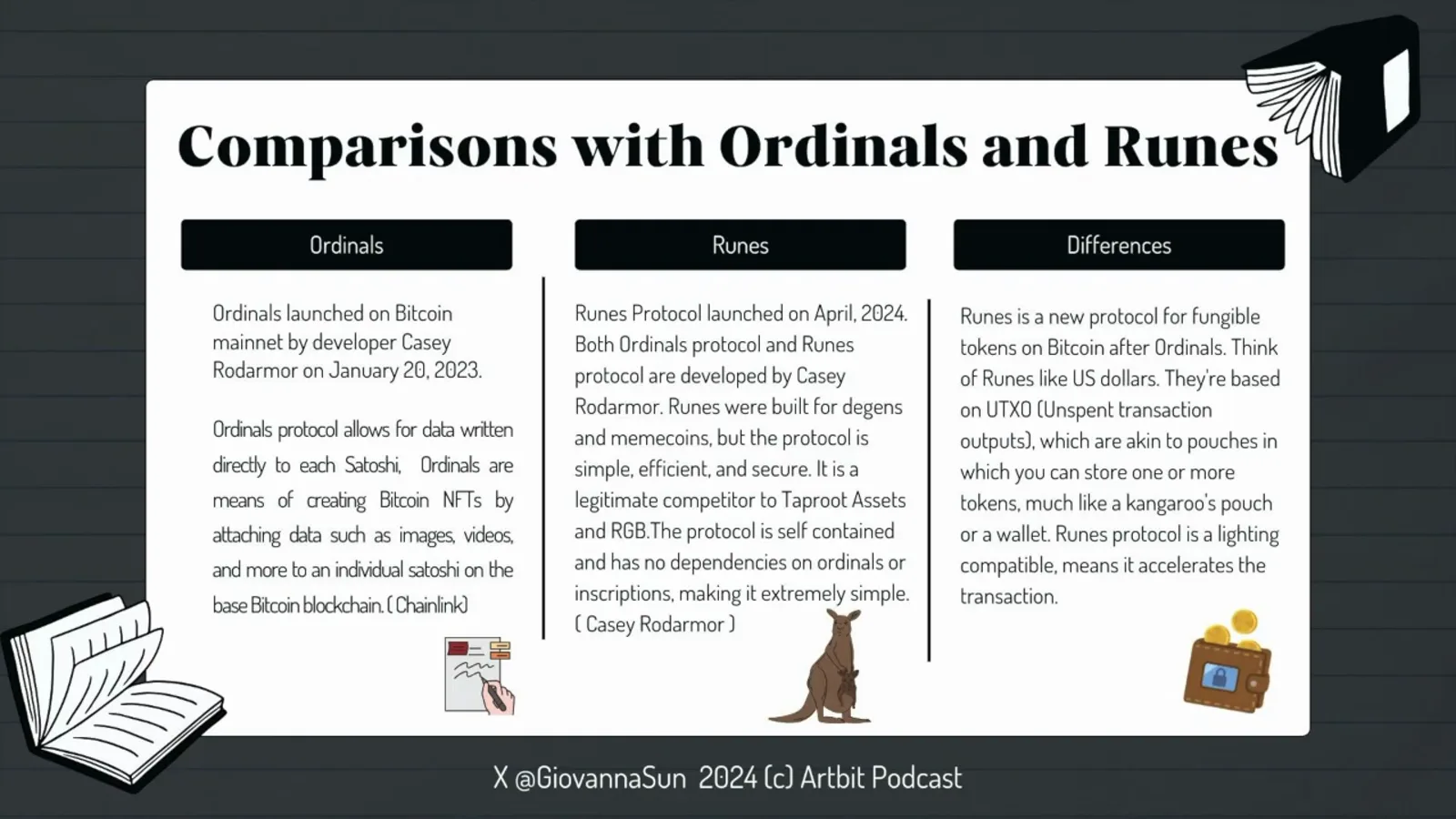
The sequel, launched at the halving: same author, cleaner rail.
Frequently Asked Questions
What is BRC-20 and who created it?
Why did BRC-20 tokens congest Bitcoin in May 2023?
How high did ORDI go, and where is it now?
What is the difference between BRC-20 and Runes?
Are BRC-20 tokens still a thing in 2024-2026?
Is BRC-20 the same as ERC-20?
Continue the Story
Quantum: The 2014 Namecoin Origin of NFTs
Writing assets into Bitcoin-adjacent chains predates ordinals by a decade — meet Quantum, the first NFT, minted into Namecoin in 2014.
SatoshiDice History: The Casino That Swallowed Bitcoin's Chain
The original 'is paid traffic spam?' war: the 2012 casino that took half of Bitcoin's transactions and started the filtering fight BRC-20 reheated.
Bitcoin Halving History, Frame by Frame
Runes chose the fourth halving for its debut — trace all four subsidy cuts and how each one pushed miners to live on fees.
The Genesis Block: Where Bitcoin Began
Every BRC-20 satoshi traces back to block 0 — start the story where Bitcoin did.
References
This illustrated guide is maintained strictly for educational, research, and historical documentation purposes. None of the materials constitute investment, financial, legal, or trading advice. Historical crisis and market events are documented from public archives. Digital assets involve significant risks.