SatoshiDice History: The Casino That Swallowed Bitcoin's Chain
In April 2012 a Bitcoin betting game appeared with a simple pitch: send coins to an address, and the blockchain itself settles the roll. Within weeks SatoshiDice was producing more than half of all Bitcoin transactions, flooding mempools, igniting Bitcoin's first great spam war among its own developers, and earning itself a chapter in Federal Reserve research. By July 2013 founder Erik Voorhees had sold it for 126,315 BTC — about $12.4 million — to a buyer whose identity is still unknown, and in June 2014 the SEC turned its forum share sales into the first enforcement case over bitcoin-denominated stock. This is the complete SatoshiDice history, told through 14 archived screens.
9 minutes • 14 illustrated steps • From 2012's mempool floods to the SEC's first bitcoin-stock case
Editorial Research & Chronological Archive
Independently synthesized and cross-verified by The Blockchain History Editorial Board using primary whitepapers, historical archives, and on-chain records.
What was SatoshiDice?
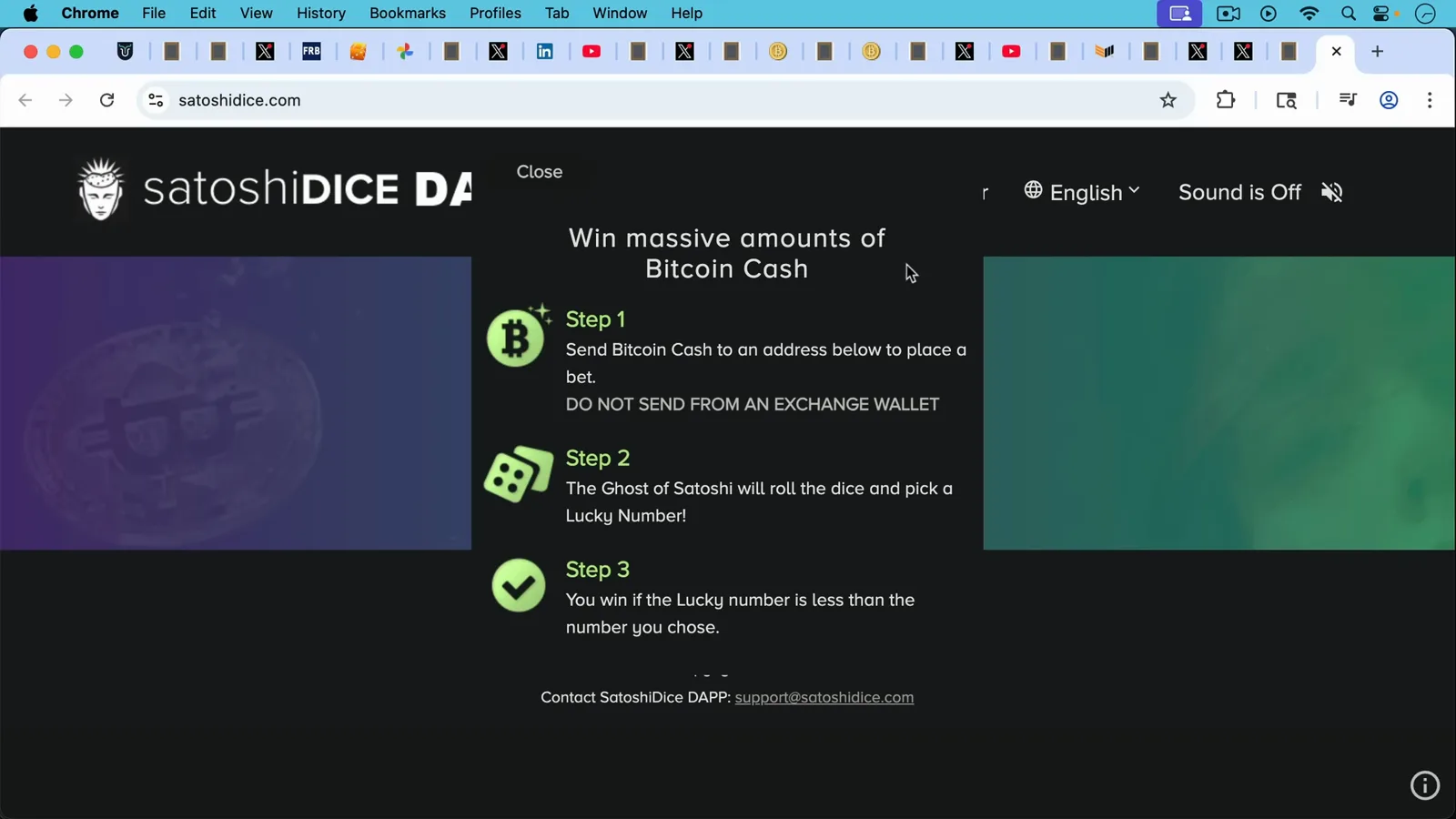
SatoshiDice was a provably fair Bitcoin betting game launched by Erik Voorhees on April 24, 2012. Players sent BTC to one of its published addresses; a hash of the site's secret number decided the roll, so every result could be independently verified on the blockchain. It grew absurdly fast — within weeks it accounted for more than half of all Bitcoin transaction volume, and Federal Reserve economists later concluded it drove almost all small-value transactions before mid-2013. That dominance made it Bitcoin's first spam villain: developers like Matt Corallo and Greg Maxwell built filters, and Luke Dashjr's Eligius pool refused its transactions. In July 2013 Voorhees sold SatoshiDice for 126,315 BTC (about $12.4 million) to an anonymous buyer, and in June 2014 he settled SEC charges that the game's S.DICE share sales were unregistered securities — the first case of its kind over bitcoin-denominated stock. The site survives today, accepting only Bitcoin Cash.
Key Takeaways
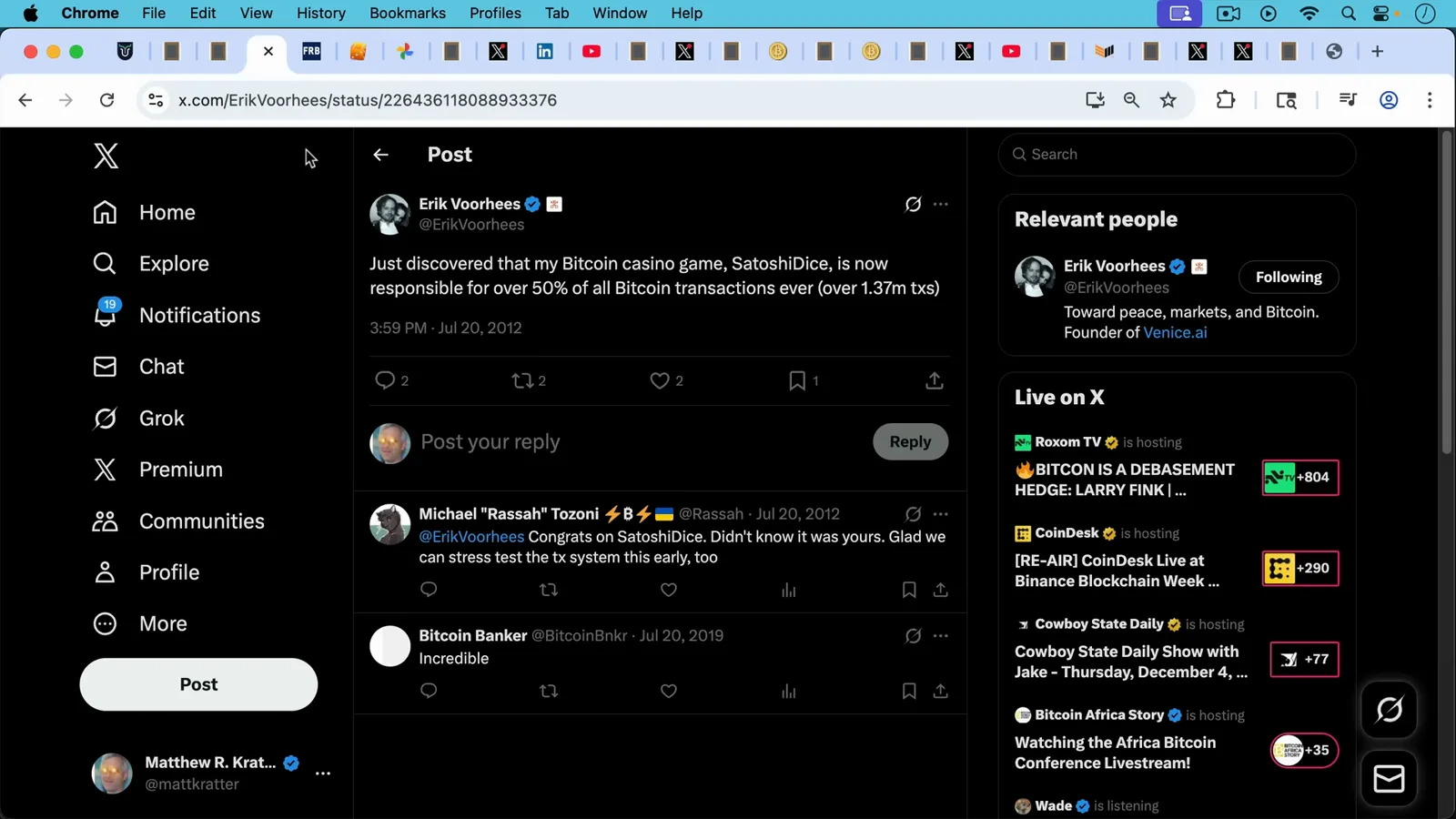
- SatoshiDice launched on April 24, 2012, announced by Erik Voorhees on the BitcoinTalk forum, and scaled faster than any Bitcoin app before it: on July 20, 2012 Voorhees tweeted that the game was responsible for over 50% of all Bitcoin transactions ever — more than 1.37 million txs in under three months.
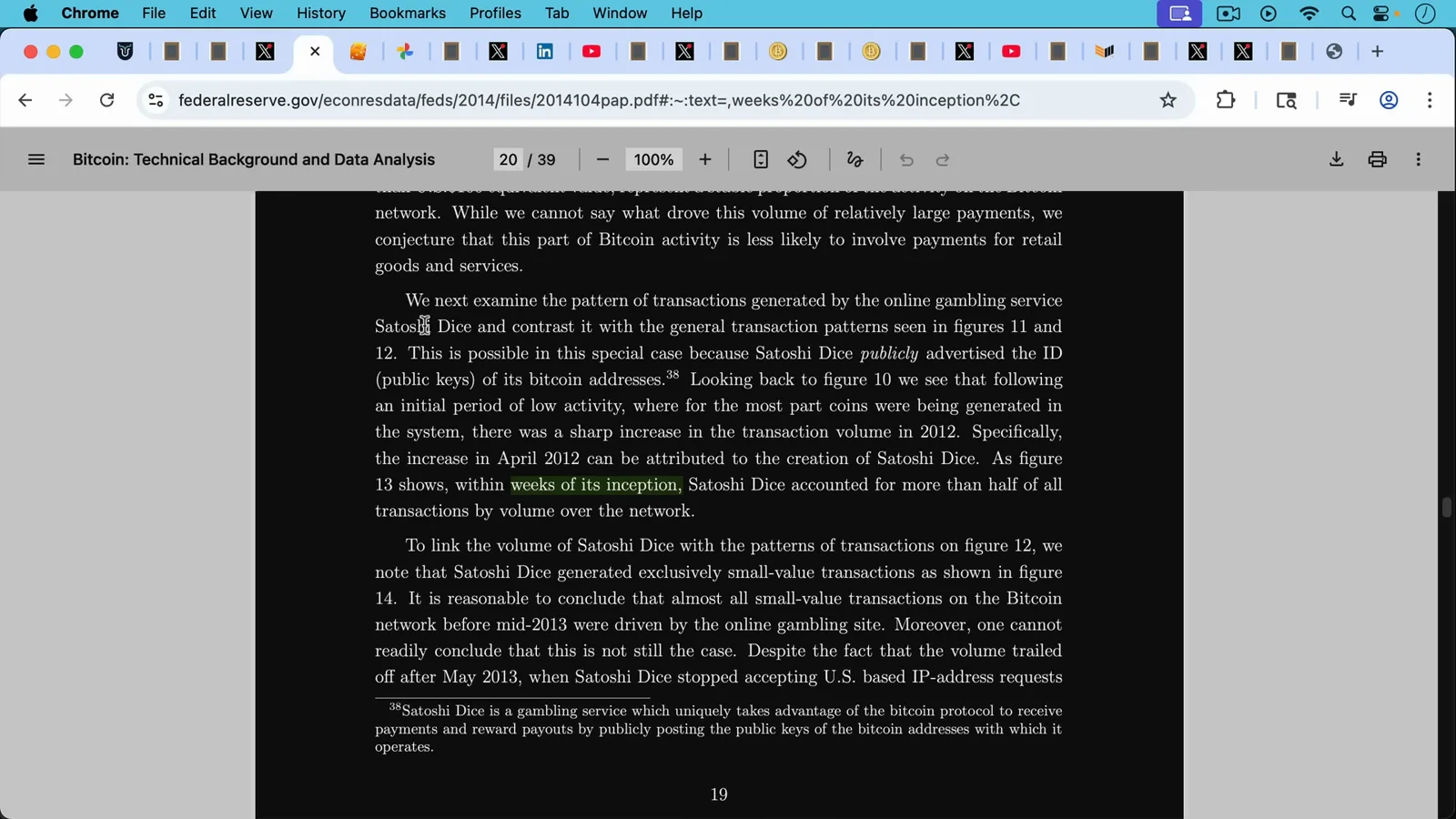
- The scale is confirmed by official research: Fed economists Anton Badev and Matthew Chen wrote in FEDS paper 2014-104 that, as figure 13 shows, within weeks of its inception Satoshi Dice accounted for more than half of all transactions by volume, that Bitcoin's April 2012 jump in transaction volume is attributable to its creation, and that almost all small-value transactions before mid-2013 were driven by the gambling site.
- The game was genuinely provably fair: the site hashed a secret number so any player could verify every roll on-chain, bets settled at zero confirmations (the payout transaction spent the bet's own output), and the betting ladder ran from even-money addresses up to a 65,536x jackpot.
- The spam war it started never really ended: Matt Corallo's June 13, 2012 thread reported 9,000-transaction mempools, the 'but they pay fees' defense was answered with 'fees have no effect on users who must store the transactions forever,' Greg Maxwell wrote a node patch that dropped SatoshiDice traffic, and Luke Dashjr filtered it at his Eligius pool — the same argument that resurfaced with inscriptions and the 2025 OP_RETURN fight.
- In July 2013 SatoshiDice was sold in full for 126,315 BTC — roughly $12.4 million at the time — in what was widely called the first major all-Bitcoin acquisition; S.DICE shareholders received 0.00928 BTC per share, about a 175% premium, and the buyer was never named.
- In June 2014 the SEC charged Voorhees over the game's unregistered share offerings (SatoshiDICE shares raised 50,600 BTC, FeedZeBirds 2,600 BTC); he settled for disgorgement plus a $35,000 penalty in the first case treating bitcoin-denominated stock as securities. SatoshiDice itself drifted to Bitcoin Cash, which is what satoshidice.com still accepts today.
2012: The Casino That Swallowed the Chain
On April 24, 2012, a betting game showed up on the BitcoinTalk forum. Within weeks it was half the network — and nothing like it had existed before.
- 1
The founder's counter crosses 50 percent
SatoshiDice went live on April 24, 2012, announced by early Bitcoiner Erik Voorhees: send BTC to a published address, and the chain itself settles your wager. Because the game advertised its bet addresses openly, anyone could count its traffic — and the numbers were absurd. On July 20, 2012, Voorhees tweeted that his 'Bitcoin casino game' had become responsible for over 50% of all Bitcoin transactions ever, crossing 1.37 million txs. Three months after launch, a dice game was out-transacting the network's entire monetary history put together. The replies already showed the split personality SatoshiDice would carry for the rest of its life: congratulations, and worry about stress-testing the system.
The founder's own victory lap, July 2012.Watch at 0:28 - 2
Even the Federal Reserve had to study it
The traffic was so large it forced its way into official research. In the 2014 Federal Reserve working paper 'Bitcoin: Technical Background and Data Analysis,' Board economists Anton Badev and Matthew Chen give the casino its own section: 'As figure 13 shows, within weeks of its inception, Satoshi Dice accounted for more than half of all transactions by volume over the network.' The paper attributes the sharp increase in Bitcoin's 2012 transaction volume — specifically the April 2012 jump — to the game's creation, and concludes that almost all small-value transactions on the network before mid-2013 were driven by SatoshiDice. A gambling site had become the dataset. (It also records the game's first regulatory retreat: volume trailed off after May 2013, when SatoshiDice stopped accepting U.S.-based IP addresses.)
Even the Fed had to give the casino a data section.Watch at 0:44 - 3
The house that explained itself with a joke
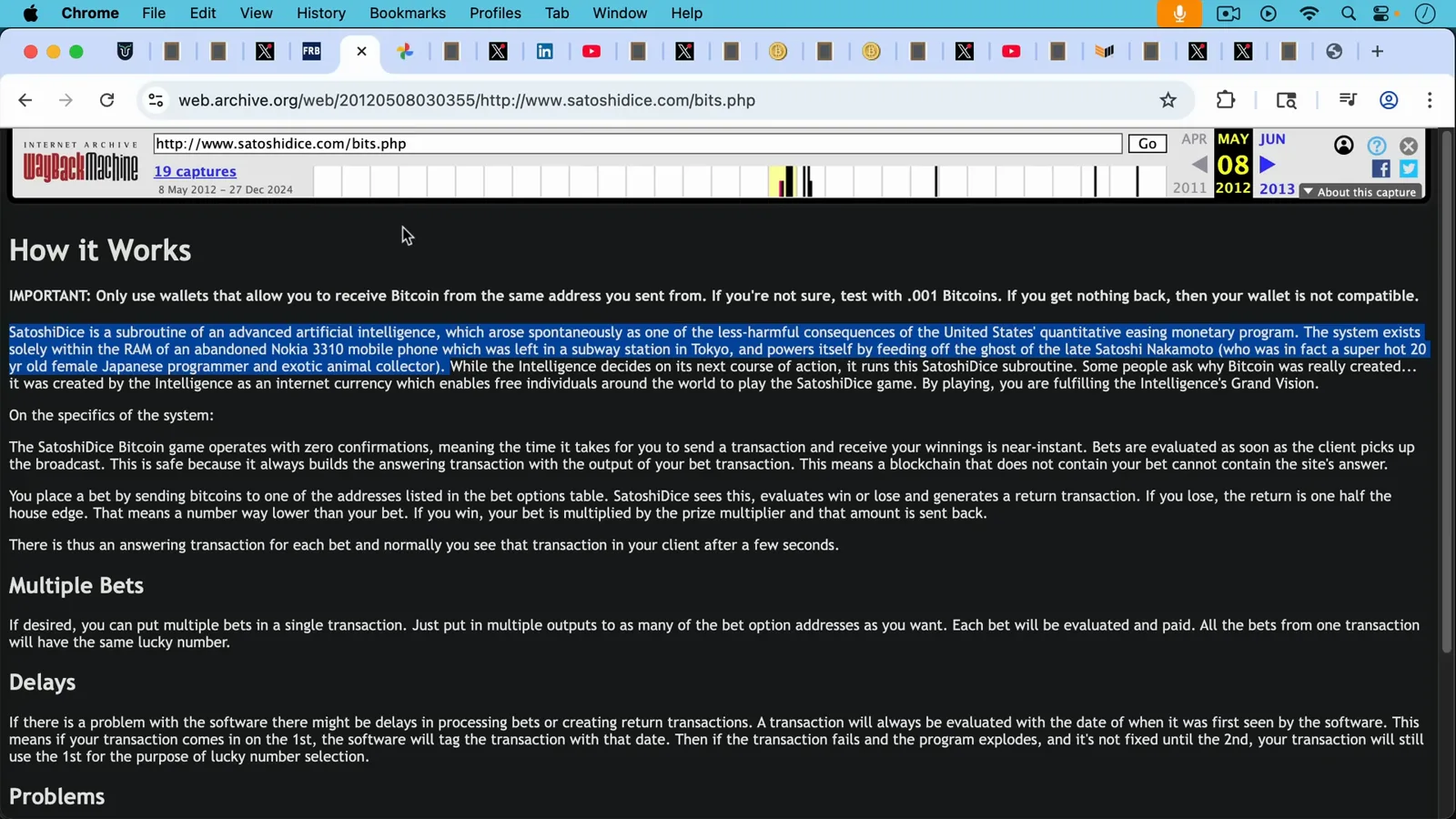
The archived 'How it Works' page opens with pure trolling: SatoshiDice is described as 'a subroutine of an advanced artificial intelligence which arose spontaneously as one of the less-harmful consequences of the United States' quantitative easing monetary program,' existing 'solely within the RAM of an abandoned Nokia 3310 mobile phone which was left in a subway station in Tokyo,' and powering itself 'by feeding off the ghost of the late Satoshi Nakamoto.' Below the prank sat genuinely novel engineering: bets settled at zero confirmations, because the house constructed each payout transaction to spend the player's bet output the moment it saw the broadcast — wins landed near-instantly, secured by the chain itself.
The house's self-description: an AI on a Nokia 3310.Watch at 0:55 - 4
Pick an address, send BTC, meet the Ghost of Satoshi
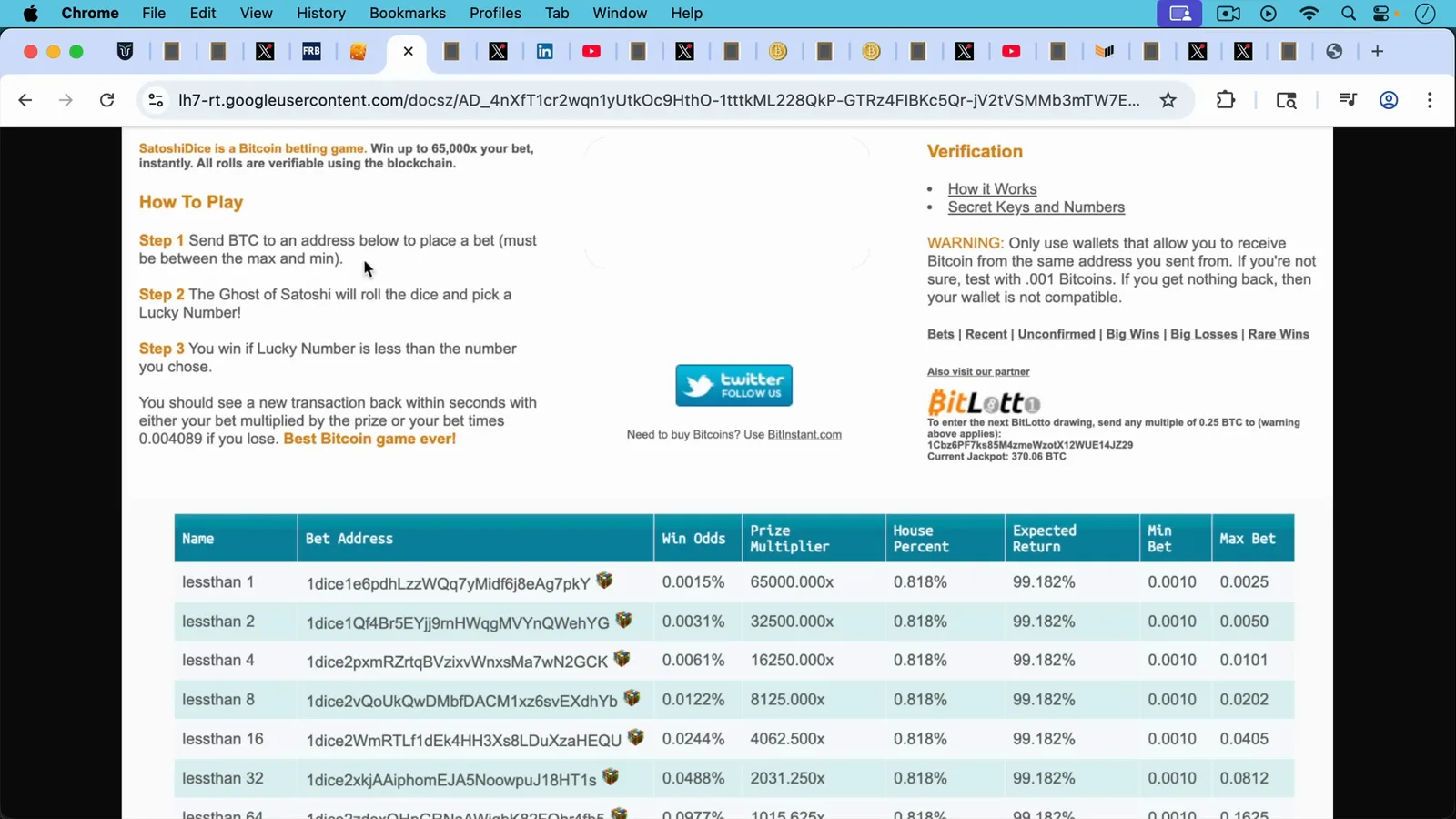
Playing was deliberately dumb-simple. The site published a ladder of wager addresses — Leather 1 through Leather 19 — each with fixed odds published on-screen: multipliers from roughly even money up to 65,536 times your bet, under the banner 'Win up to 65,536 times your bet instantly. All rolls are verifiable using the blockchain.' You sent any amount to the address matching your risk appetite; SatoshiDice evaluated the bet against a hash of its secret number, and a 'return transaction' came back to your wallet — stake plus profit if your Lucky Number cleared the bar, a dust refund if it didn't. Every roll could be checked against the published hash, which is where the phrase 'provably fair' entered the gambling vocabulary.
Choose your odds, send coins, and hope the Ghost rolls low.Watch at 1:48
The Spam War on BitcoinTalk
Half the network's traffic was dice rolls. Node operators reached for a word Bitcoin has been arguing about ever since: spam.
- 5
The war was fought at the mining pools, too
Long before 'spam filtering' was a Bitcoin Core controversy, Luke Dashjr practiced it at production scale. His mining pool — then called Eligius, today Ocean — declined to include SatoshiDice transactions in the blocks it mined. Blockstream CEO Adam Back recalled the episode in a December 2025 post: his 2014 conversation with Greg Maxwell about filtering, and Dashjr's reaction that removing the gambling traffic was trivial work for a pool — while noting the same designs 'soon filtered other things he didn't like.' The post resurfaced during the 2025 inscriptions and OP_RETURN fights, when mempool policy went from obscure plumbing to the loudest argument in Bitcoin.
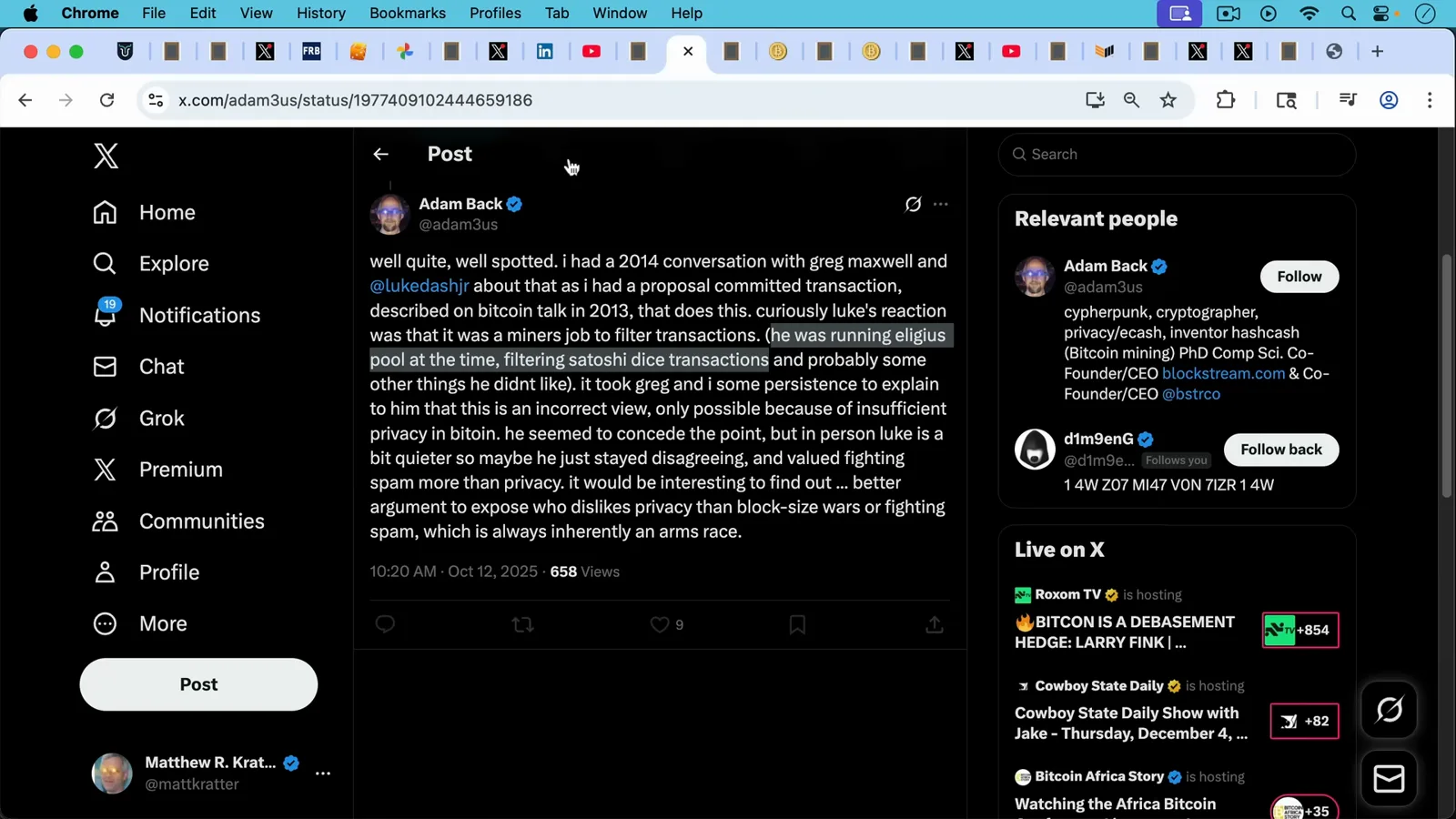
Blockstream's CEO, remembering the original filter fight.Watch at 4:47 - 6
June 13, 2012: 'It's time to start deprioritizing'
Matt Corallo — then a rising Bitcoin Core developer — opened the thread that gave the conflict its name: 'Huge increase in satoshidice spam over the past day.' His numbers: transaction memory pools at around 9,000 entries, with satoshidice spam 'already a huge % of current transactions. But now it's just ridiculous.' His proposal: 'It's time to start deprioritizing transactions which use very common addresses.' The date matters — barely eight weeks after the launch, one of Core's own was publicly proposing to rank traffic by purpose, and the word 'spam' was permanently bolted onto Bitcoin's vocabulary.
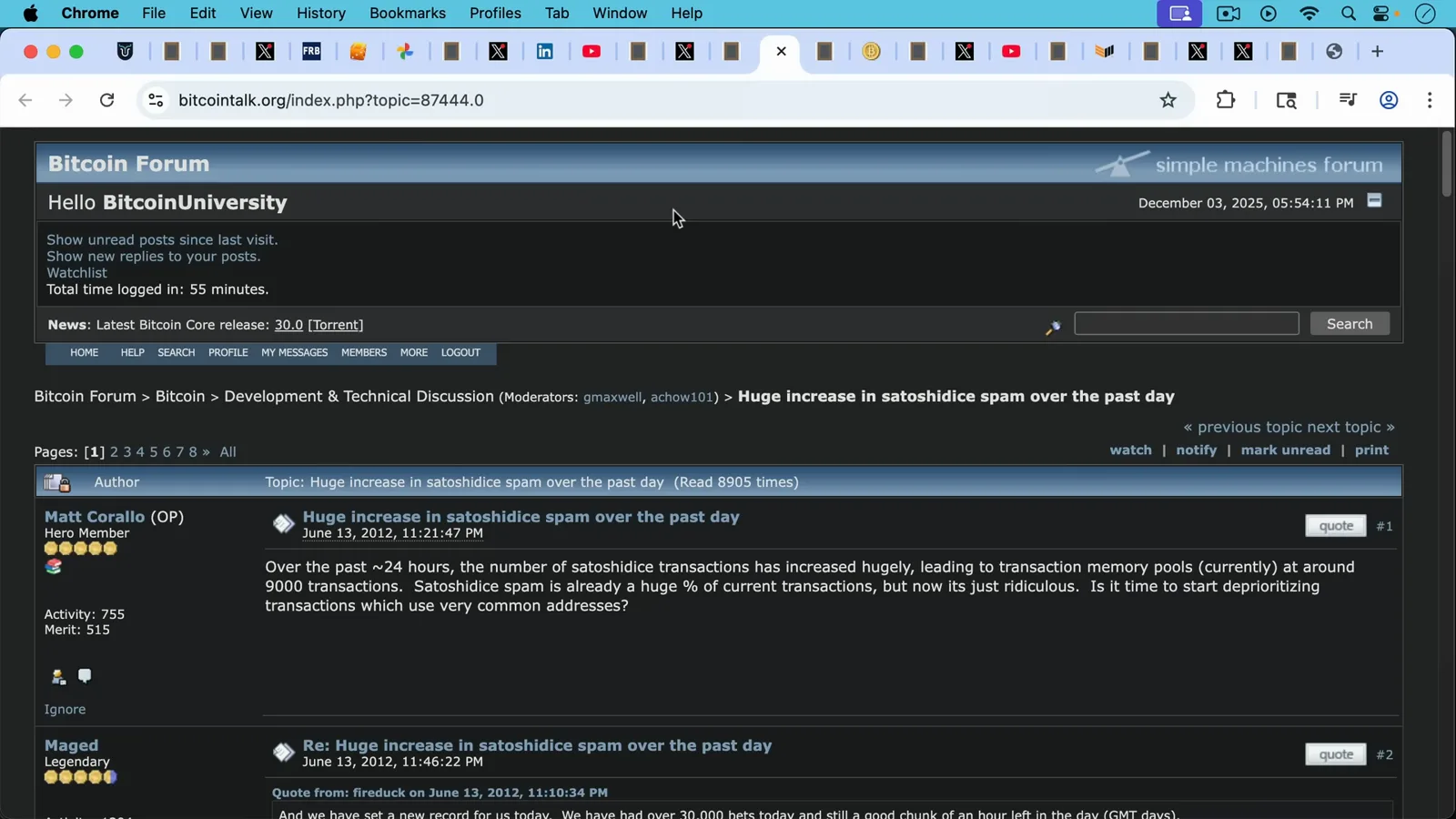
The word 'spam' enters Bitcoin's vocabulary.Watch at 5:52 - 7
'But they pay fees' — answered in 2012
The thread produced the argument you still hear today. A user replying as FreeMoney made the market defense: SatoshiDice 'pays a fee on all transactions,' so its bids deserved block space like anyone else's. Corallo's answer became the standard counter, and it has never been improved on: 'Paying a meaningful fee to miners has no effect on the thousands and thousands of bitcoin users who have to store the transactions on their disk basically forever.' Fees compensate miners; they compensate no one else who must carry the chain's history. Twelve years on, the same two sentences were repeated nearly word for word in the war over inscriptions.
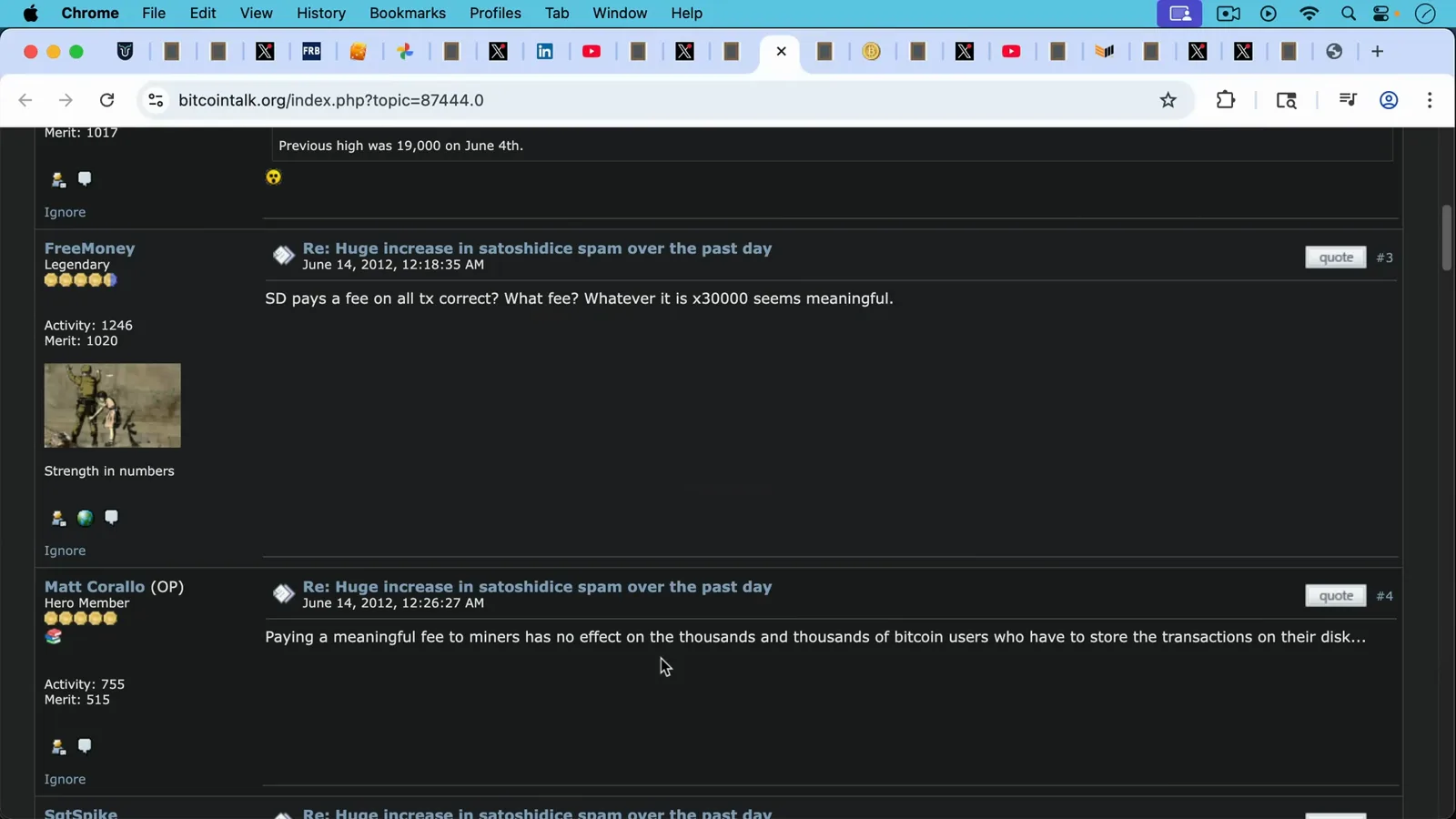
Fees pay miners. The storage bill goes to everyone.Watch at 6:48 - 8
Greg Maxwell wrote the filter himself
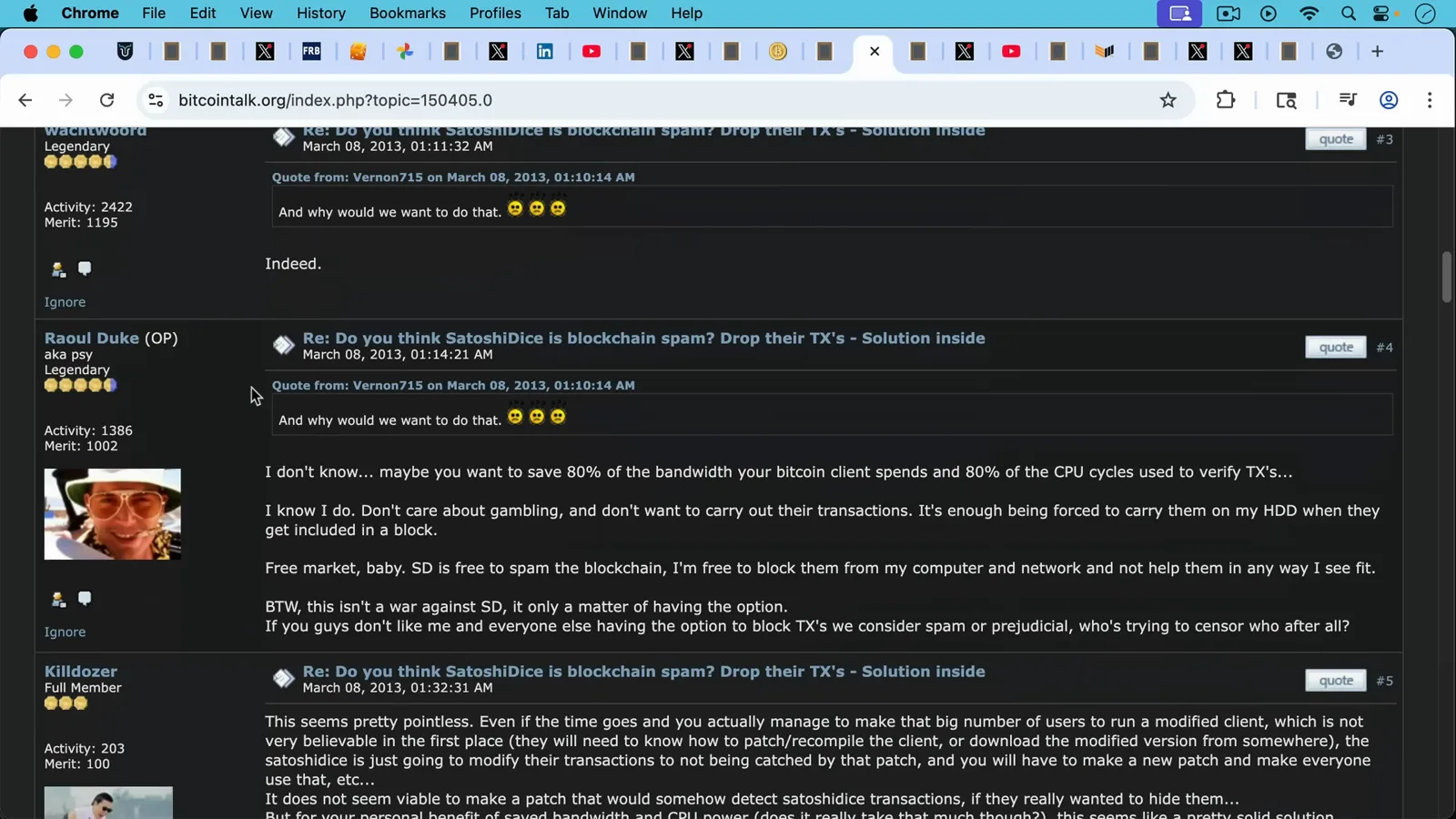
The anti-spam side had engineering, not just complaints. In a March 2013 thread, forum user Raul Duke published a patch for the Bitcoin client — 'as per my request, [Greg] Maxwell wrote' — that would drop every transaction to a SatoshiDice address, refusing to relay or even verify it, along with any transaction under 10,000 satoshis. The post shows the actual code: a diff against bitcoinrpc.cpp comparing scriptPubKeys against the game's known addresses. This was one of Bitcoin Core's most respected engineers authoring a filter for voluntary node use — years before running your own mempool policy became the most divisive act in Bitcoin.
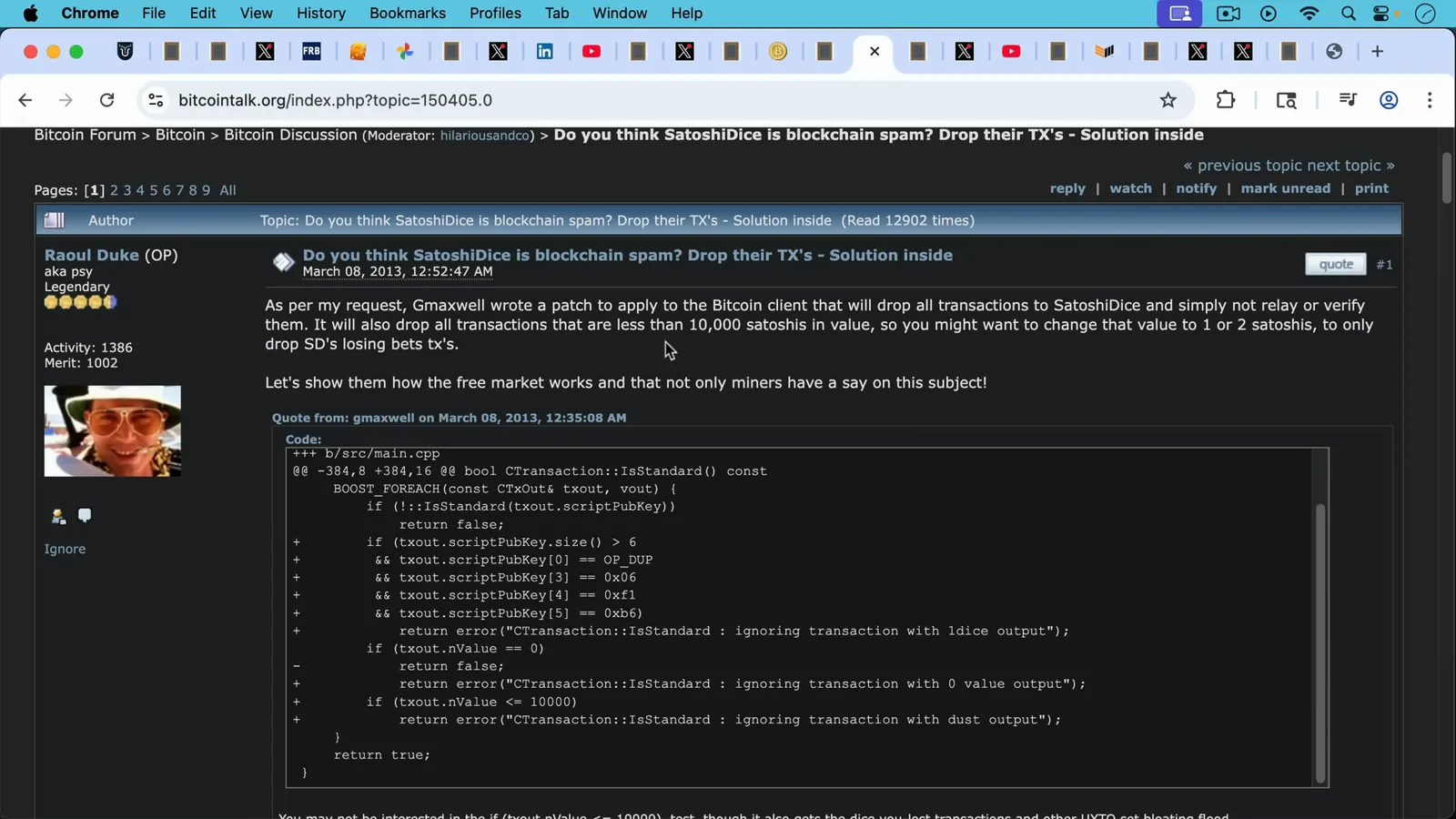
Don't want the bets? Don't relay them.Watch at 7:28 - 9
'Free market, baby': the debate never finds a definition
The replies read like today's timeline. Raul Duke defended the patch as property rights: 'SD is free to spam the blockchain. I'm free to block them from my computer and network and not help them in any way I see fit... If you guys don't like me and everyone else having the option to block TXs we consider spam or prejudicial, who's trying to censor who after all?' Another user dismissed the whole exercise as 'pretty pointless' since almost nobody would run a modified client. And the real question — what counts as spam when the sender willingly pays — was never settled. That non-answer is precisely what Ordinals, inscriptions, and the 2025 OP_RETURN fight reheated, word for word.
Everyone had an opinion. Nobody had a definition.Watch at 8:10
The 126,315 BTC Exit — and the SEC
In July 2013 the casino sold for one of the strangest price tags in tech history. A year later the SEC made it a landmark — and the site itself slipped away to another chain.
- 10
Sold in full for 126,315 BTC
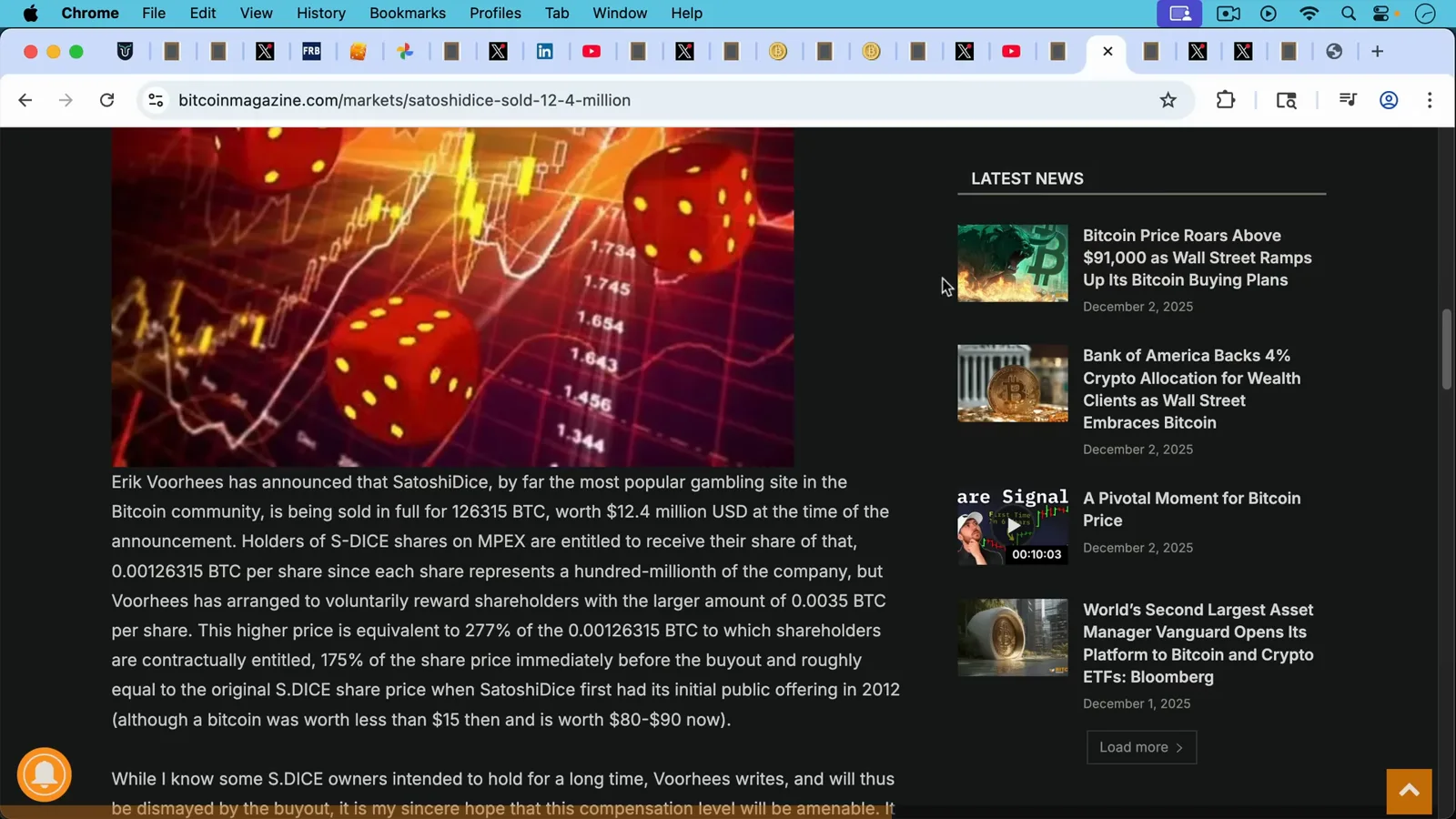
In July 2013, Bitcoin Magazine reported the news: SatoshiDice, 'by far the most popular gambling site in the Bitcoin community,' had been sold in full for 126,315 BTC — about $12.4 million at then-current prices — to a buyer who was never named. Shareholders of S.DICE, the sat-denominated stock Voorhees had offered on the forum since 2012, were bought out at 0.00928 BTC per share, roughly a 175% premium to the pre-announcement price; CoinDesk counted it as the first major all-Bitcoin acquisition. The identity of the buyer has never been confirmed. And the exit had a sting in its tail: the SEC had been watching those same share sales, and the settlement that followed would make SatoshiDice a piece of securities-law history.
The first great all-Bitcoin exit.Watch at 10:55 - 11
The SEC makes it securities-law history
On June 3, 2014, the SEC announced settled charges against Erik T. Voorhees for offering and selling unregistered securities: shares of SatoshiDICE, offered in two rounds from August 2012 to February 2013 that raised 50,600 BTC (about $722,659 at the time), and 2,600 BTC raised through 'FeedZeBirds.' The July 2013 buy-back returned 45,500 BTC to investors — worth roughly $3.8 million by then, thanks to Bitcoin's appreciation. Voorhees paid $15,843.98 in disgorgement plus a $35,000 penalty without admitting or denying the findings. It was the first case in which the SEC treated shares denominated in bitcoin as securities — the moment 'BTC-denominated stock' stopped being a forum experiment and became a compliance problem.
After the SEC case, the game itself slipped off Bitcoin entirely.Watch at 12:48
The Grudge Never Settled
A decade later the same fight came back with new names — inscriptions, OP_RETURN — and much of the same cast.
- 12
'Nothing special': the argument returns in 2025
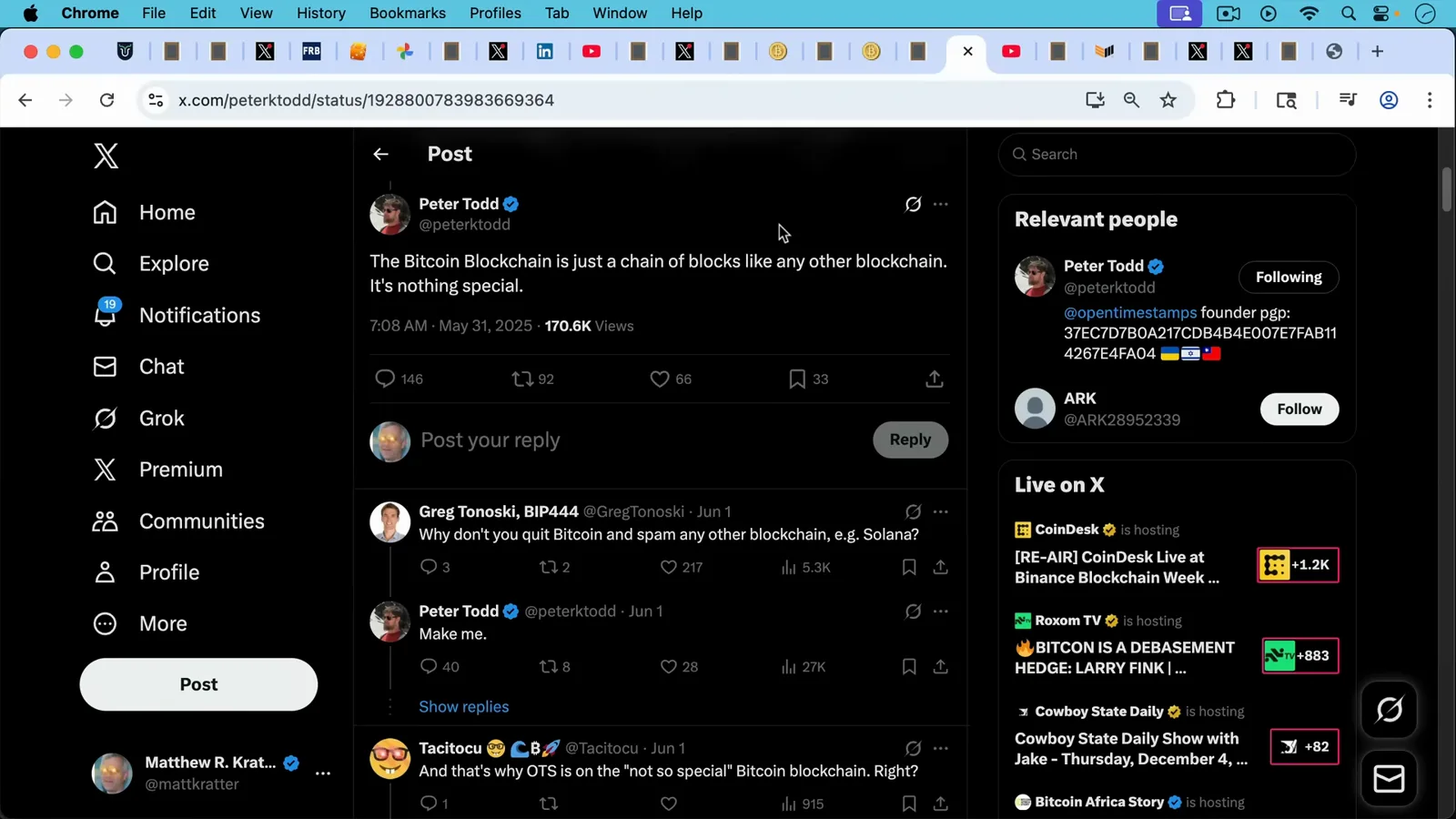
In May 2025, with inscriptions and oversized OP_RETURNs once again crowding the chain, Bitcoin contributor Peter Todd compressed one side of the debate into a single post: 'The Bitcoin Blockchain is just a chain of blocks like any other blockchain. It's nothing special.' The top reply — 'Why don't you quit Bitcoin and spam any other blockchain, e.g. Solana?' — drew his two-word answer: 'Make me.' Thirteen years after SatoshiDice, Bitcoin still has no agreed definition of spam, which means every fight about it is ultimately a fight about what the chain is for — and about whether users who don't like a use can refuse to carry it.
Thirteen years later, same fight, new spam.Watch at 9:40 - 13
The founder's next table: the venture circuit
SatoshiDice's afterlife runs through modern Bitcoin politics too. In 2025 a startup called Citrea — whose design depends on writing application data into Bitcoin, the exact use case at the center of the OP_RETURN controversy — raised a $14 million Series A led by Founders Fund. Its announcement graphic lists the angel investors, and among them sit Erik Voorhees, the SatoshiDice founder, and Jameson Lopp. Citrea co-founder Orkun made the lineage explicit on X: 'The first Bitcoin app was SatoshiDice, built by Erik Voorhees. And yes, he's an angel in Citrea.' The first on-chain app was a casino — and that fact still arranges the industry's alliances a decade later.
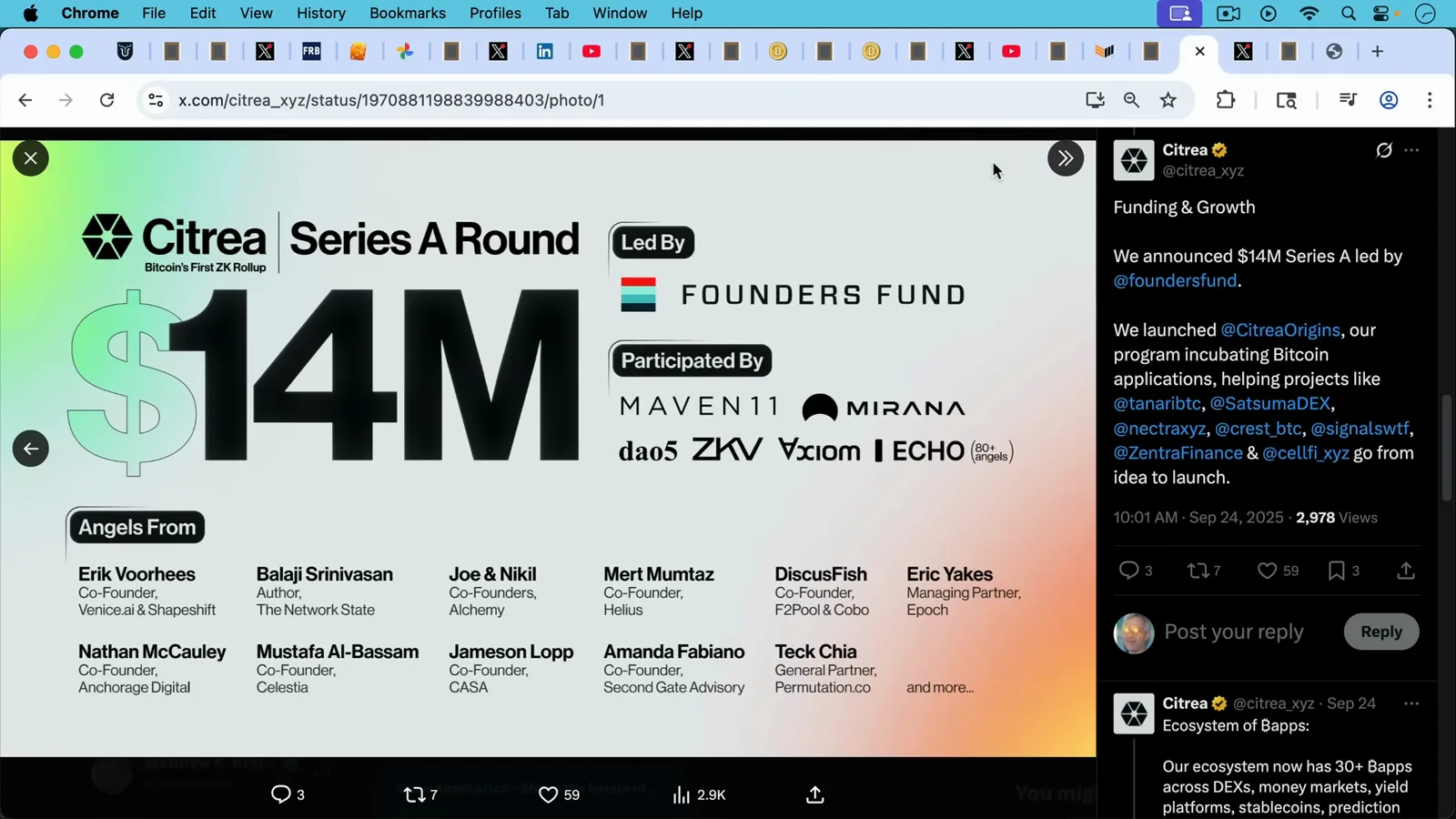
The founder's next table: venture capital.Watch at 11:28 - 14
'An attack on Bitcoin, nothing more'
The same thread drew the closing verdict from Luke Dashjr — the developer whose Eligius pool had filtered SatoshiDice's transactions thirteen years earlier: 'Satoshi Dice was an attack on Bitcoin, nothing more. Let that sink in.' That exchange is the whole legacy in miniature. To Citrea's co-founder, SatoshiDice was the first Bitcoin app — proof that a chain carrying real money would attract real use, fair or not. To its longest-running opponent, it was an attack. Every argument Bitcoin has had since 2012 about block space, spam, and purpose lives somewhere between those two sentences.
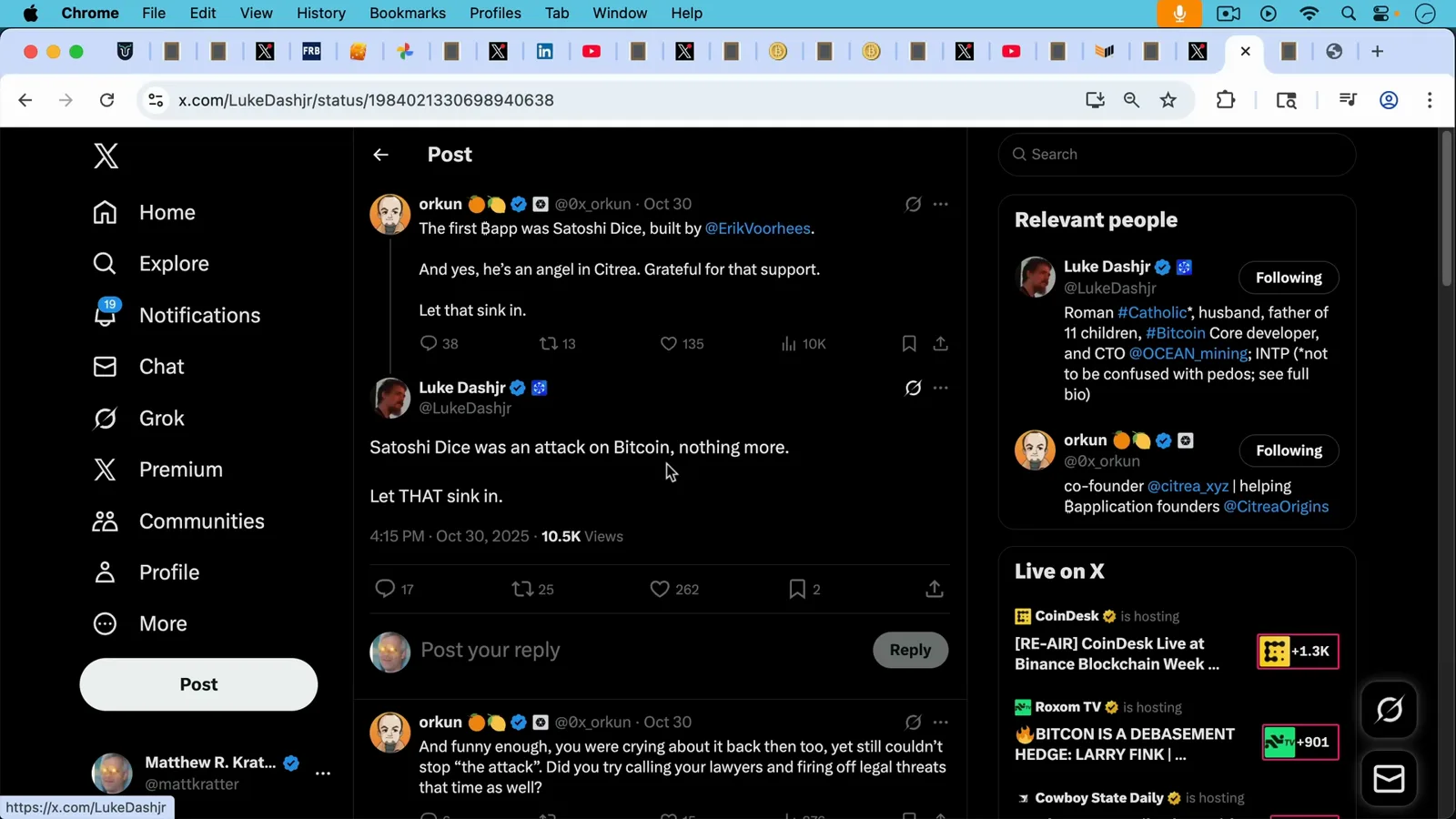
BitcoinTalk wounds, it turns out, are permanent.Watch at 11:56
Frequently Asked Questions
What was SatoshiDice?
How much of the Bitcoin network did SatoshiDice use?
Why was SatoshiDice called spam?
Who bought SatoshiDice and how much did it sell for?
Did the SEC sue Erik Voorhees over SatoshiDice?
Does SatoshiDice still exist, and does it still accept Bitcoin?
Continue the Story
Casascius Bitcoin History: Physical Coins, Keys, and Custody
Another 2011-2013 experiment in making Bitcoin usable — physical coins with private keys under holograms, and the regulatory questions that came with them.
Failed Crypto Exchanges: 6 Major Collapses Explained
The graveyards of Bitcoin's early economy: Mt. Gox and five more exchanges that never survived the era SatoshiDice helped fill.
History of Crypto Regulation: 2013-2026 Timeline & Key Laws
The 2014 SatoshiDice SEC case was an early shot across the bow — trace the whole regulatory arc from FinCEN's first guidance to today.
E-Gold History: Rise and Fall of the Digital Gold Currency
The digital currency that regulators shut down in 2007 — the precedent that hung over every early Bitcoin business, casinos included.
References
Extended Multimedia Reference
Visual sequences and chronologies in this guide cross-reference video documentation “The Secret History of Satoshi Dice” by Bitcoin University.
This illustrated guide is maintained strictly for educational, research, and historical documentation purposes. None of the materials constitute investment, financial, legal, or trading advice. Historical crisis and market events are documented from public archives. Digital assets involve significant risks.