BitConnect Collapse: Anatomy of a 1%-a-Day Ponzi
How a "bitcoin lending" platform promised 1% daily returns, rocketed into the top 20 cryptocurrencies, and vanished in January 2018 — wiping out life savings and leaving years of indictments behind.
9 minutes • 16 illustrated steps • sourced from iilluminaughtii's explainer
Source video
“Bitconnect: The Wannabe Bitcoin Ponzi Scheme | Multi Level Mondays”
Channel: iilluminaughtii
What was the BitConnect collapse?
BitConnect was a "bitcoin lending" platform launched in 2016 that promised investors up to roughly 1% daily returns — a "guaranteed" 91.25% a year on large deposits — supposedly generated by a volatility trading bot. Its BCC token surged into the top 20 cryptocurrencies in 2017 with a market value near $1.43 billion, powered by referral commissions for recruiting new lenders. After the Texas State Securities Board issued an emergency cease-and-desist in early January 2018, BitConnect shut down on January 17, 2018, and BCC crashed more than 99%, from over $470 in December to under a dollar. US prosecutors later put the global scheme at roughly $2.4 billion.
Key Takeaways
- BitConnect launched in 2016 with a three-step loop: deposit Bitcoin, exchange it for BCC tokens, then lend the tokens back for a "daily profit" paid in BCC.
- The promised math was impossible by design — 0.25% daily interest (91.25% a year, "guaranteed") on deposits of $10,000 or more, plus referral bonuses that pushed the claimed risk-free return to 127%.
- In 2017 BCC entered the top 20 cryptocurrencies at a $1.43 billion market value — small next to Bitcoin's $304.5 billion, but built almost entirely on new deposits.
- The claimed 0.5-1% daily trading-bot returns never had verifiable trade history; leaked promoter chats even called the bot "just a story".
- A Texas emergency cease-and-desist landed January 3-4, 2018; BitConnect shut down on January 17, and BCC fell over 80% in a day, then below $1 from a December peak above $470.
- The reckoning took years: founder Satish Kumbhani was indicted in the US in February 2022 and remains a fugitive, top promoter Glenn Arcaro pleaded guilty, and Indian investigators allege billions more were siphoned locally.
The Pitch: Lend Bitcoin, Earn One Percent a Day
BitConnect presented itself as a crypto savings account. Underneath, it was a machine that could only pay old users with new money.
- 1
Deposit Bitcoin, buy BCC, lend it back
Founded in 2015 and launched in 2016, BitConnect asked investors for Bitcoin in three steps: deposit BTC, swap it for BitConnect Coin (BCC) on the platform's own exchange, then lend the tokens back for a promised daily profit. The detail that mattered most: interest was always paid in BCC, not Bitcoin — so new buyers were constantly needed to turn tokens into spendable money.
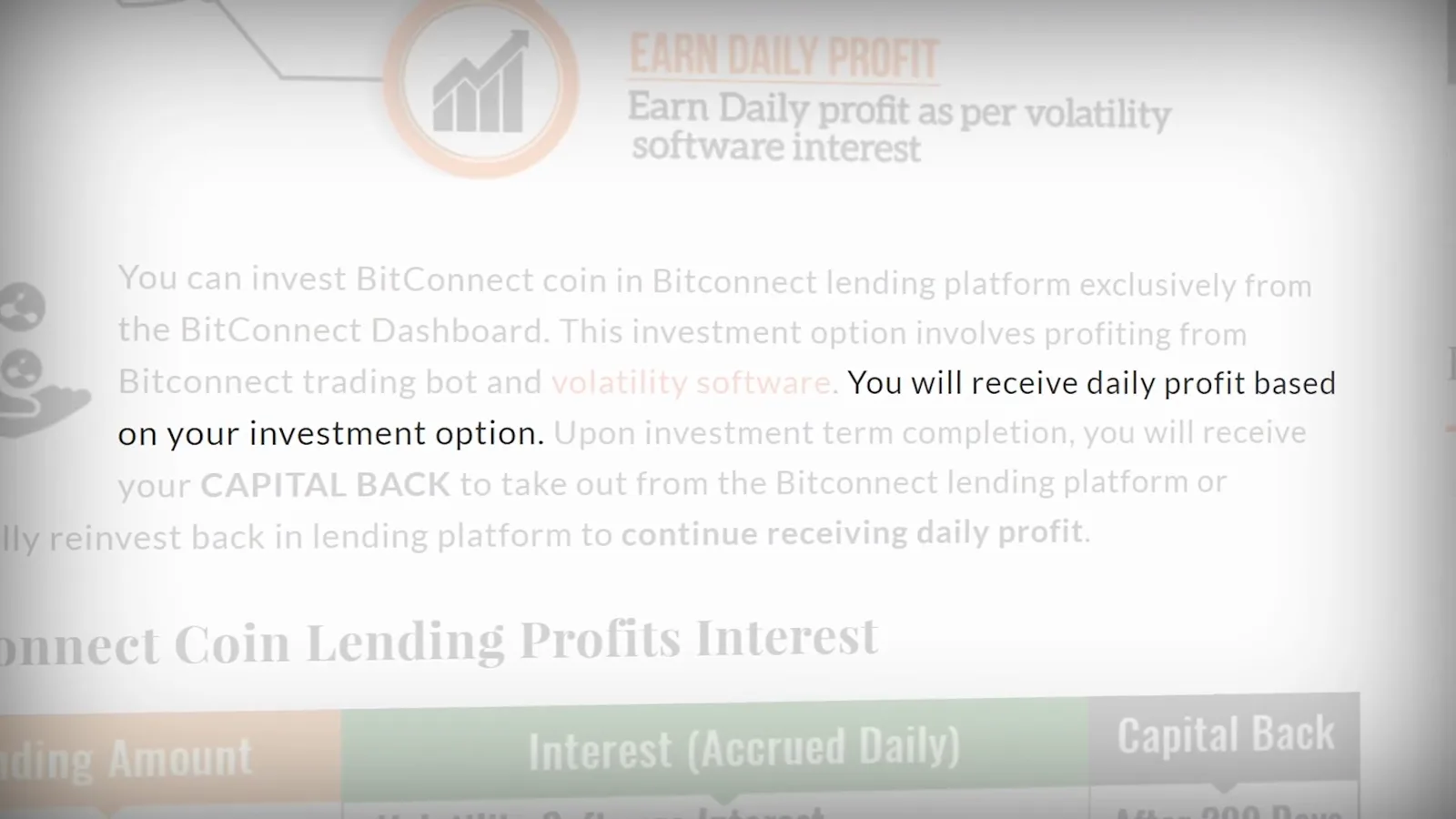
The three-step loop: deposit BTC, buy BCC, lend it back.Watch at 1:05 - 2
The math that should have ended it in 2016
For deposits of $10,000 or more, BitConnect guaranteed 0.25% daily interest — 91.25% a year — with referral bonuses promising up to 480% more. As one contemporary write-up put it, there is no legitimate business on earth that can pay that rate risk-free. Compounding new investors' deposits was the only mechanism that could keep the promises alive.

A "guaranteed" 91.25% a year — the red flag everyone could see.Watch at 3:10 - 3
Referral commissions: the pyramid inside the Ponzi
Recruiters earned seven levels of commissions — 7% on the first tier, stepping down to 0.2% on the seventh — worth more than 12% extra on every deposit and reinvestment. That fusion of a Ponzi payout loop with multi-level recruiting is why regulators and journalists described BitConnect as both a Ponzi and a pyramid scheme.

Seven levels of commissions — every new deposit paid the people above it.Watch at 3:20 - 4
Inside the lending dashboard
The dashboard made the scheme feel like a working fintech product: Bitcoin and BCC wallets, a Lend BitConnect button, a reinvest option, and a live exchange-rate ticker. In late 2017 that ticker showed one BCC at about $340 — a price that existed only because BitConnect itself stood behind it.
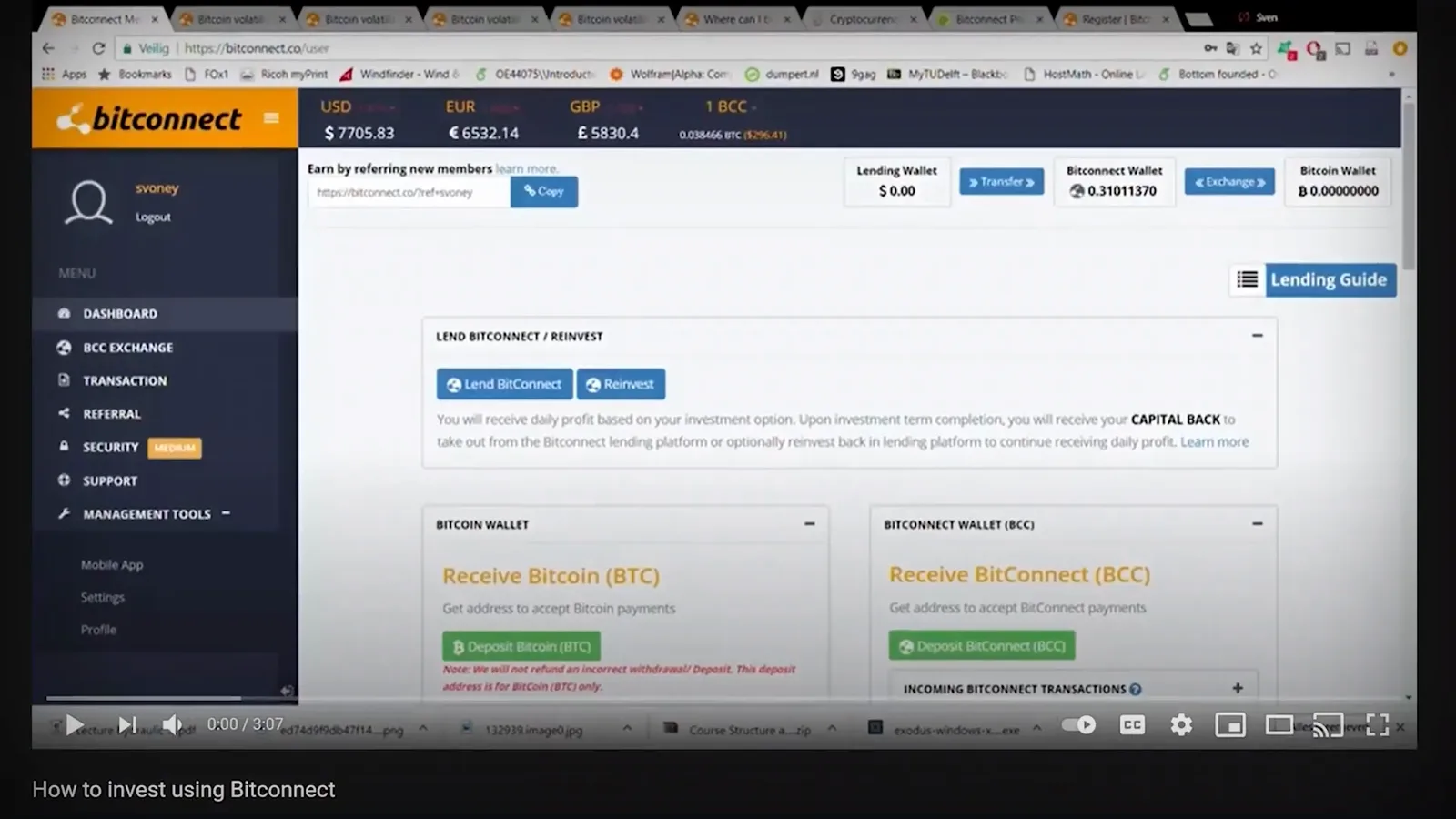
One BCC at $339.97 — a price only BitConnect itself could honor.Watch at 24:30
The Boom: From Obscure ICO to a $1.4 Billion Coin
For most of 2017 the numbers only went up, and the roadmap promised even more.
- 5
The roadmap: four phases of big promises
In December 2016 BitConnect published a four-phase timeline: an ICO with a 4.8 million BCC giveaway, a wallet and desktop client, mining plus a staking pool that supposedly paid 120% a year, and a "smart card" to spend BCC at retailers. Almost none of it materialized — but every announcement gave new deposits a reason to arrive.
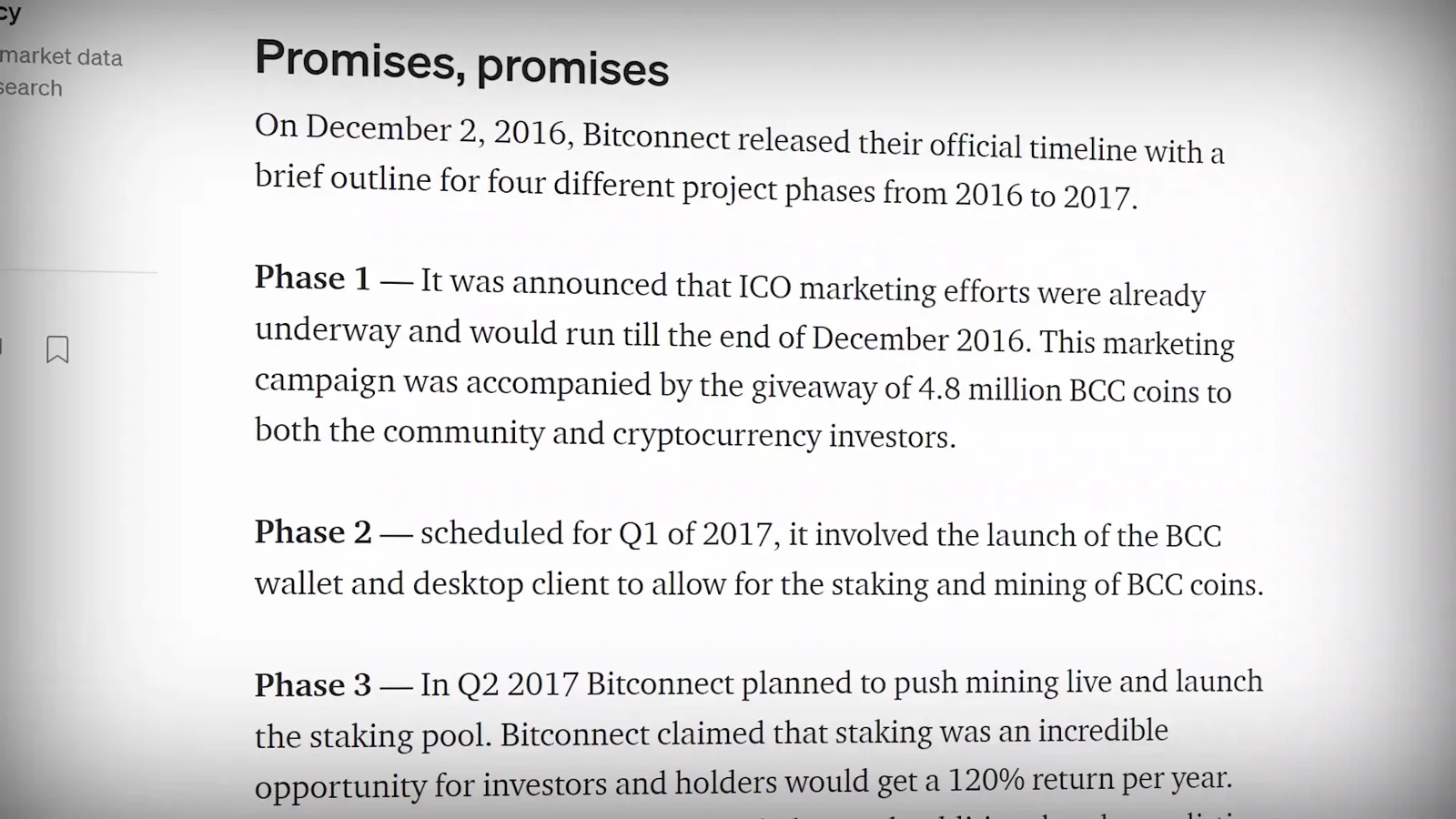
Four phases, one purpose: keep the deposits coming.Watch at 3:50 - 6
2017: a top-20 coin worth $1.43 billion
In May 2017 BCC's market capitalization sat under $90 million at about $15 per token; by late 2017 the coin ranked among the 20 largest cryptocurrencies at $1.43 billion — beside Bitcoin's $304.5 billion. The ranking rested on BitConnect's own exchange pricing and referral-driven demand, but for newcomers the list itself was the proof of legitimacy.
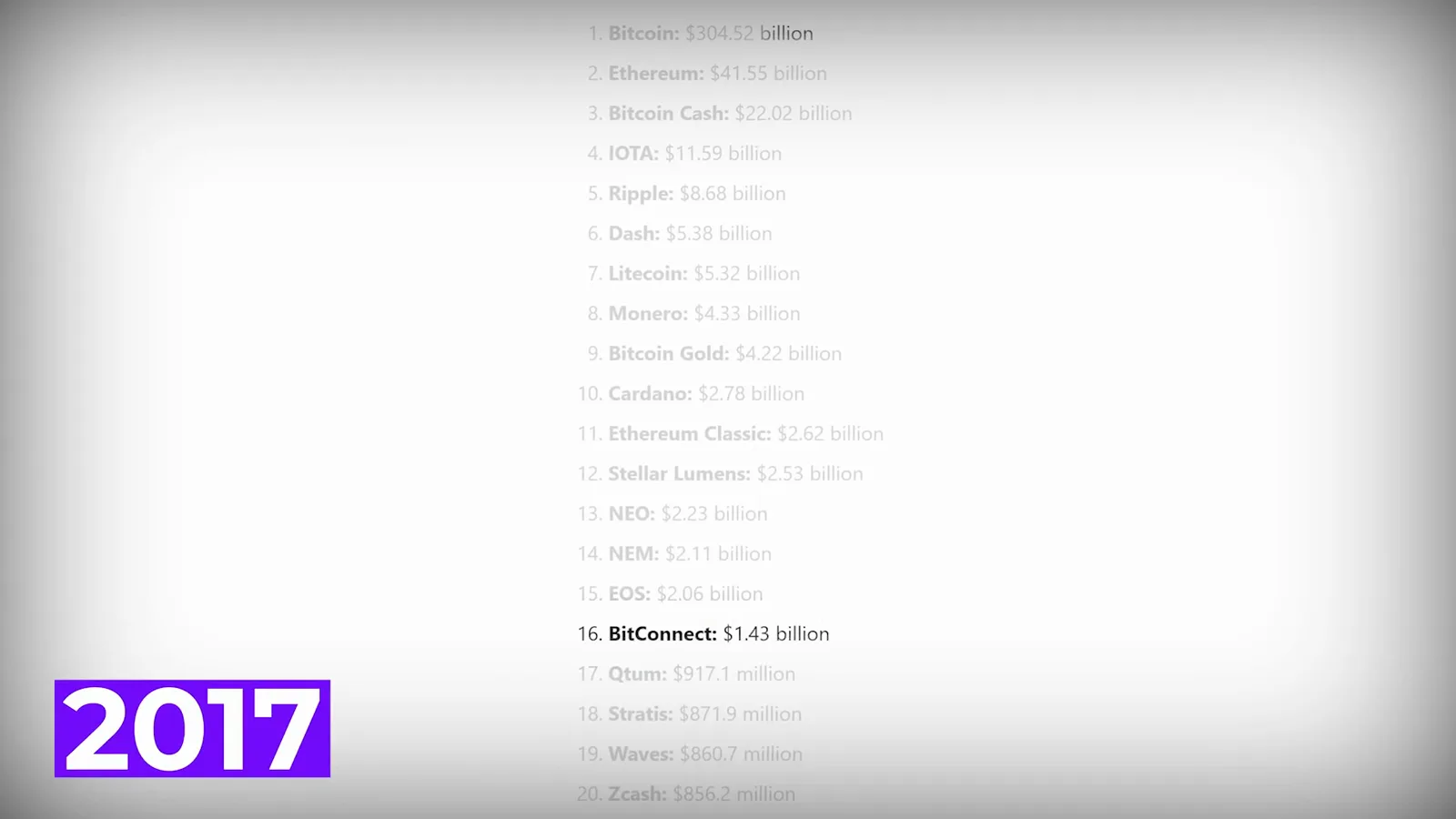
16th place in the market — built mostly on its own deposits.Watch at 5:06 - 7
"I was making $1,500 to $3,000 a day"
Investors posted their daily payouts and chose to compound instead of withdrawing — exactly the behavior a scheme that needs fresh deposits wants to encourage. Australian investor Robert told VICE he poured in his entire pay packet, covered his mortgage from daily interest, and lost everything within days of the shutdown.
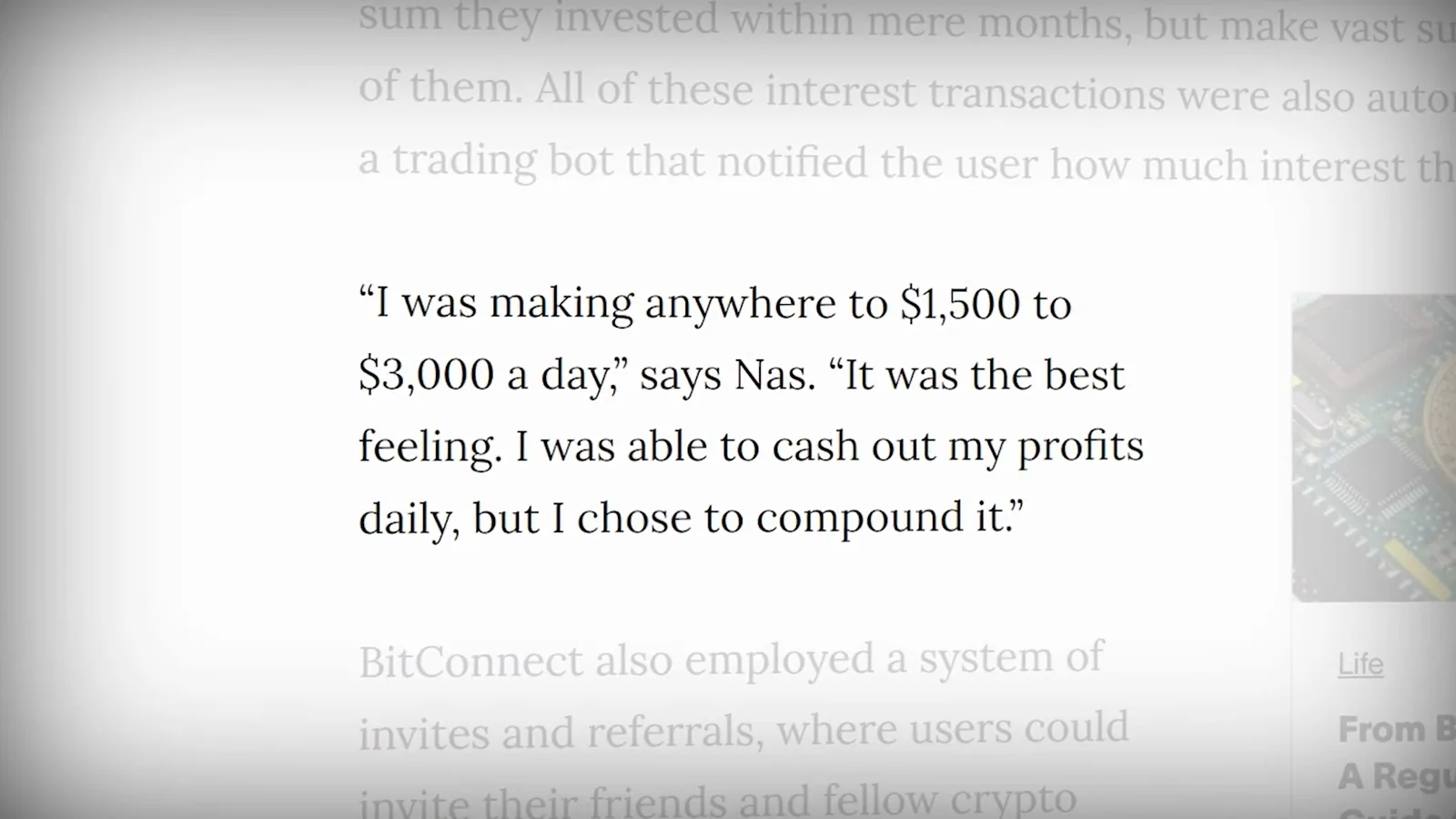
Daily payouts were the bait; compounding was the trap.Watch at 5:28
The Unraveling: Debunks, Warnings and a Cease-and-Desist
While the price climbed, skeptics were dismantling every pillar of the story.
- 8
Ethereum's founder called it early
Vitalik Buterin publicly suggested BitConnect was running a Ponzi scheme, and crypto sleuths picked apart its filings, finding listed stakeholders with inconsistent addresses and birth dates. In November 2017 the UK gave the company notice: two months to prove its legitimacy or be dissolved and have its assets confiscated.
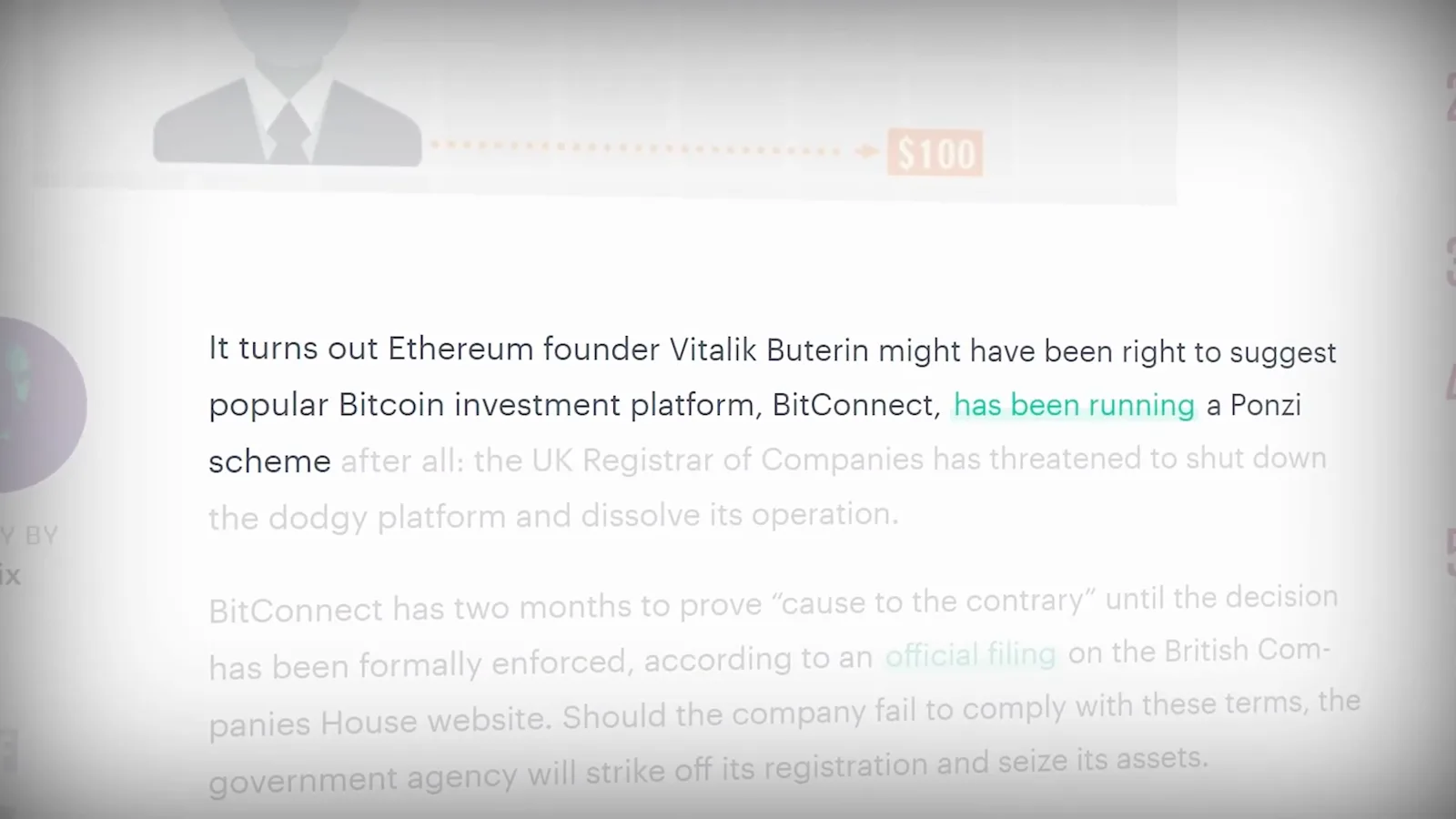
The warnings were public months before the collapse.Watch at 10:20 - 9
The trading bot that (probably) never existed
BitConnect claimed its "volatility software" bot traded Bitcoin's swings for 0.5-1% daily, reporting an average 0.89% return over the previous six months — without ever publishing verifiable trade history. When an anonymous source leaked chats from a private Facebook group of top promoters, US promoter Craig Grant dismissed the bot as "just a story".
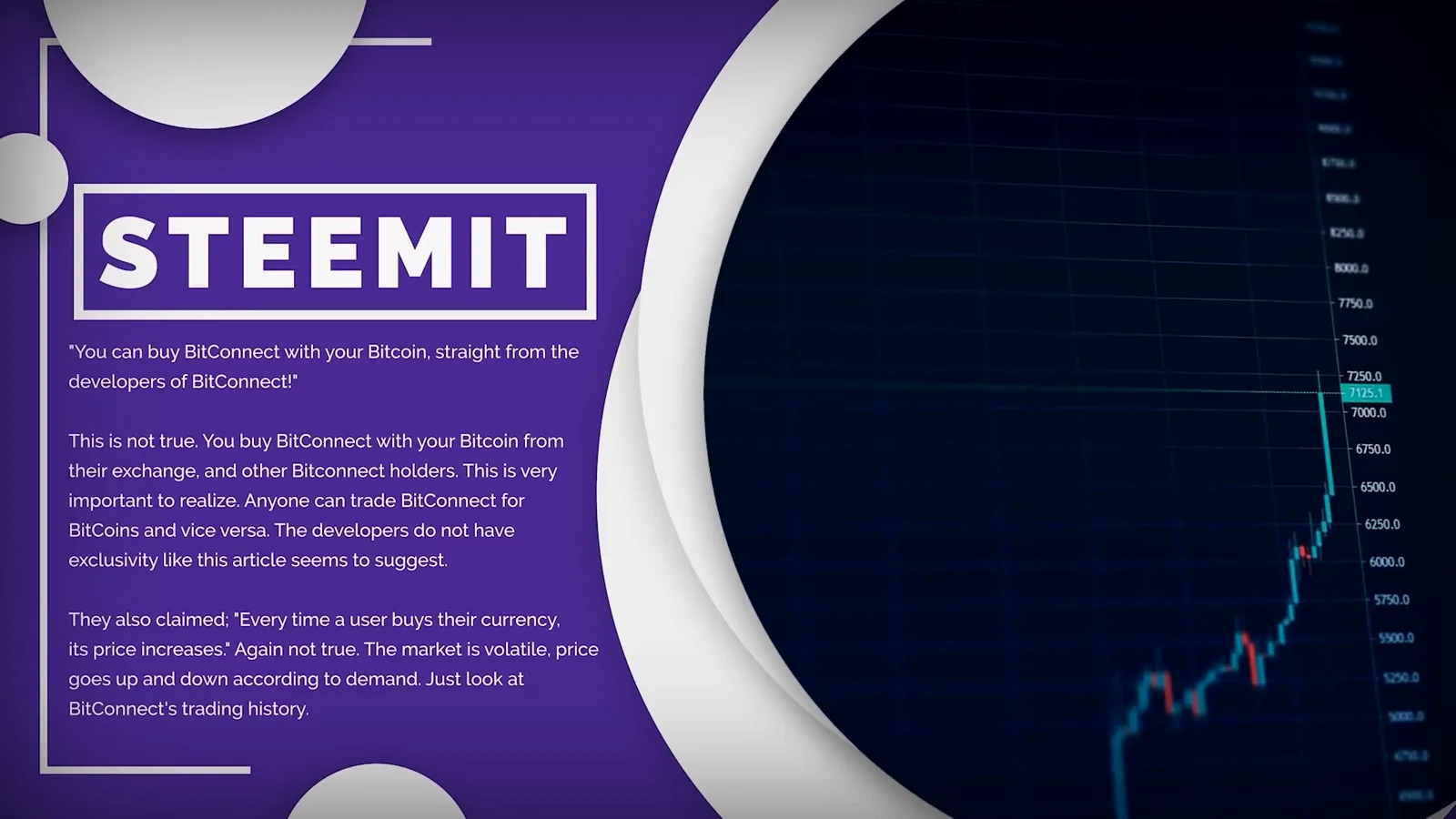
No raw trade history, no bot — just deposits moving between accounts.Watch at 12:22 - 10
Texas pulls the first emergency lever
On January 3-4, 2018 the Texas State Securities Board issued an emergency cease-and-desist: BitConnect would not disclose who ran the company, where it operated, or its finances, while affiliates sold the lending program through referral links. The Houston Chronicle's summary was blunt — investors had no idea who they were dealing with, and if BitConnect shut down, recovering funds would be impossible.
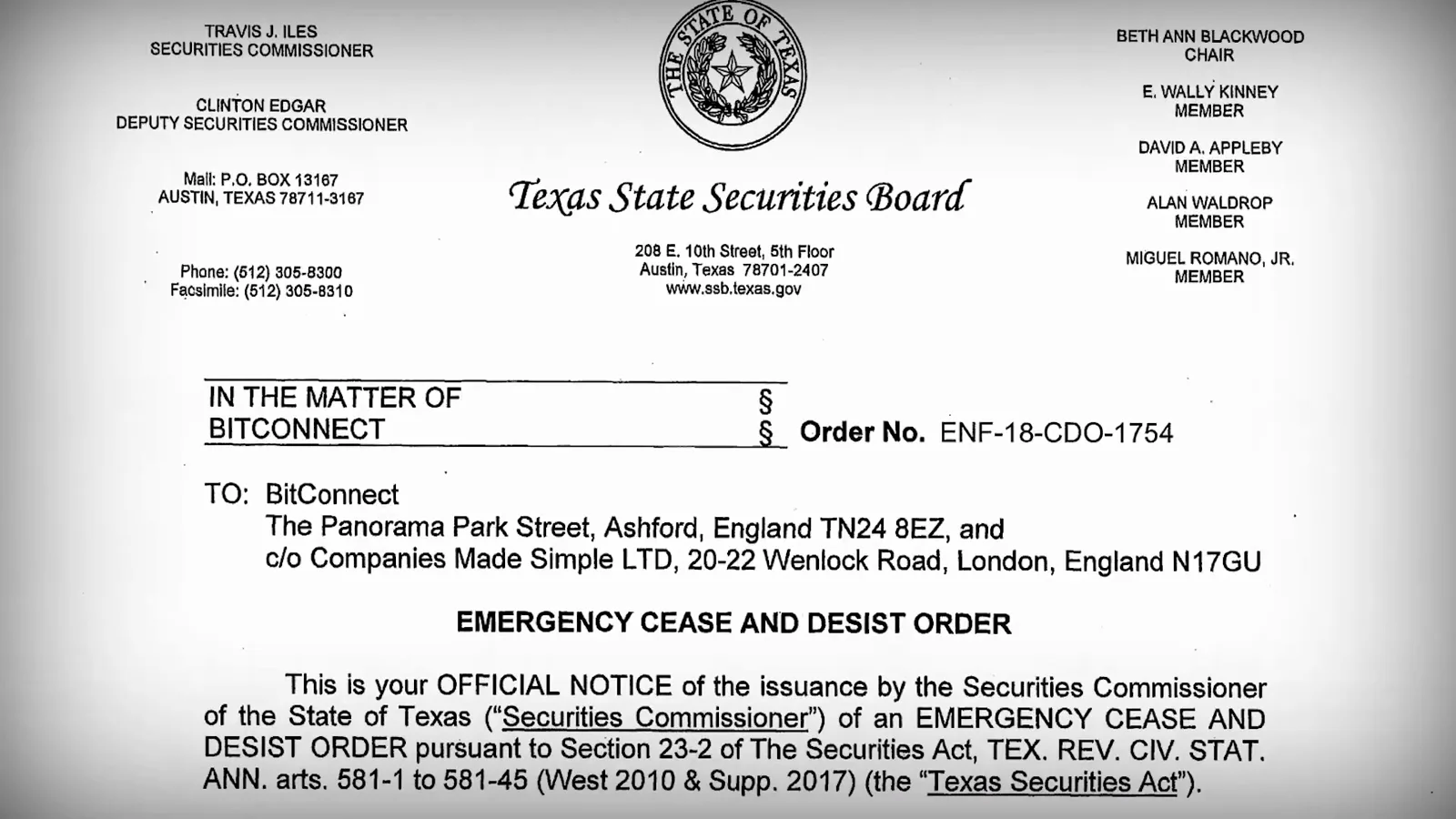
Order No. ENF-18-CDD-1754 — the beginning of the end.Watch at 14:40
January 2018: Fourteen Days to Zero
From the Texas order to a dead coin in under three weeks.
- 11
January 17: the platform simply stops
Rather than prove anything to regulators, BitConnect closed its lending platform and exchange on January 17, 2018. The official statement blamed "continuous bad press", cease-and-desist letters from Texas and North Carolina, and DDoS attacks — while promising to refund outstanding loans at a 15-day average price of $363.62 per BCC.
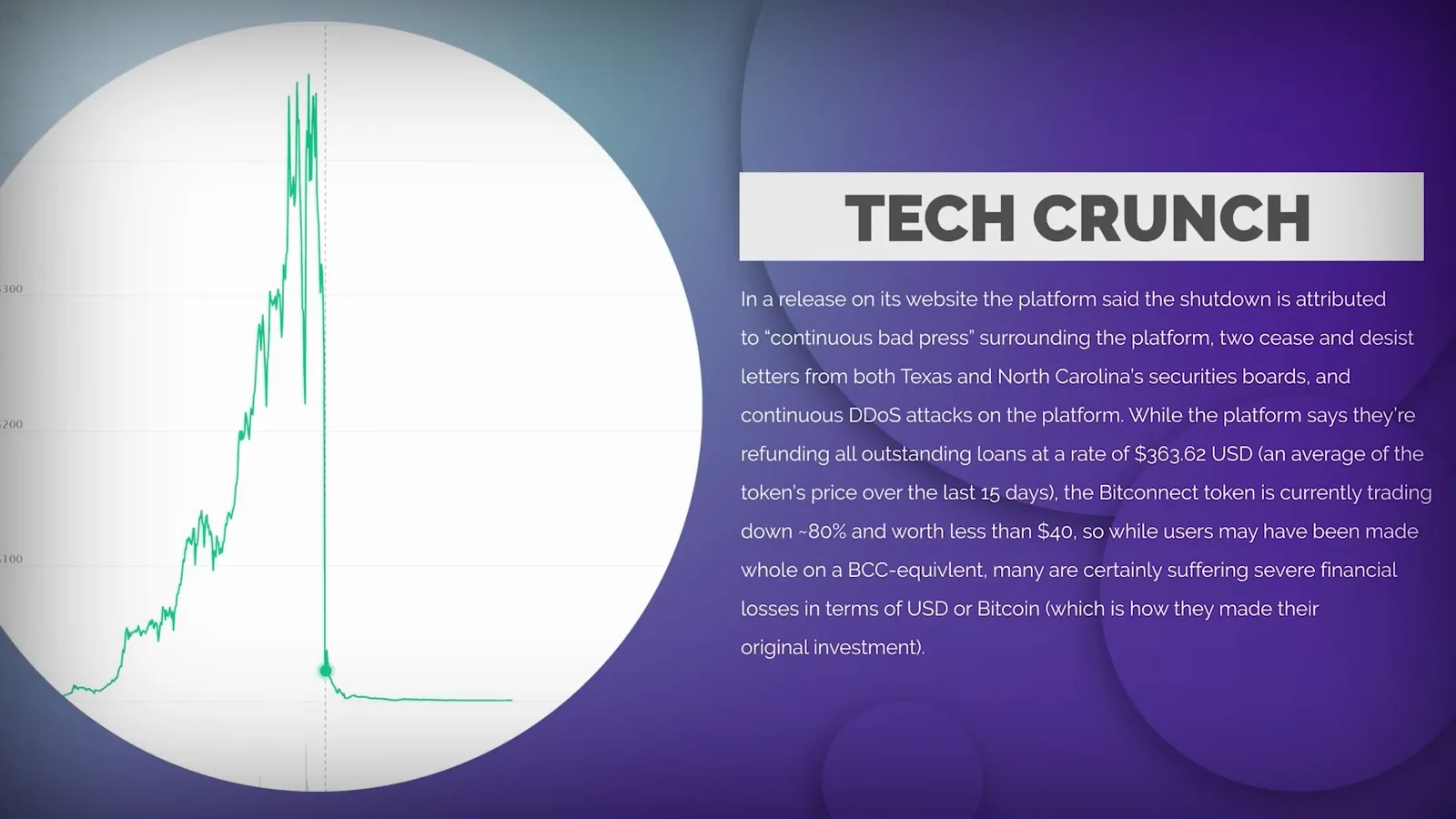
The candle every crypto investor should learn to recognize.Watch at 16:08 - 12
The excuses didn't survive the week
The DDoS excuse fell apart on contact with reality: exchanges weather denial-of-service attacks all the time without erasing 90% of their value. BCC lost more than 80% within a day, sliding under $40 — because the promised $363.62 refund rate depended on a platform that no longer existed.

Blaming hackers for a bankruptcy of trust.Watch at 16:30 - 13
"Four days away from my $50,000"
Investor Nas said he deposited US$100,000, compounded it into US$350,000 on paper, and was four days from a US$50,000 payout when the website closed. From a December peak above $470, BCC fell below one dollar within weeks — wiping out gains denominated in dollars and Bitcoin, not just tokens.
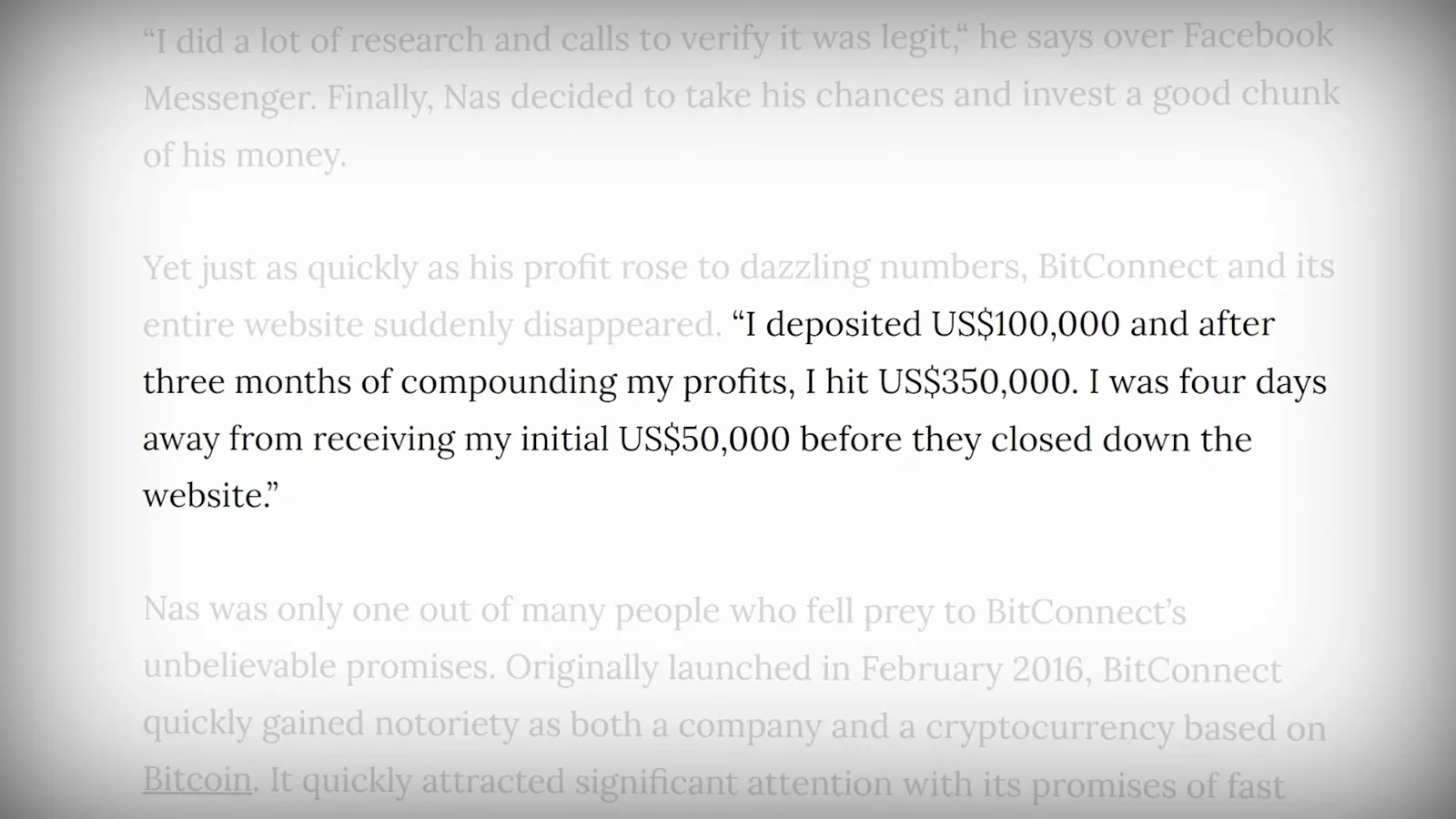
Paper gains never met a withdrawal queue that didn't exist.Watch at 16:58
The Aftermath: Arrests, Abductions and Subpoenas
The collapse rippled from a Houston newsroom to Indian police stations.
- 14
The founders: Kumbhani, Darji and a $12.6 billion claim
BitConnect was founded by Satish Kumbhani and promoted in Asia by Divyesh Darji, both from India. Indian investigators accused Darji, Mahendra Chaudhary and Kumbhani of siphoning $12.6 billion — 880 billion rupees — from Indian investors in the wake of demonetization, and in February 2022 a US federal grand jury indicted Kumbhani over the $2.4 billion global scheme; he remains at large. The strangest subplot: an aggrieved Indian investor hired policemen to abduct BitConnect staff and force out 2,400 BTC.
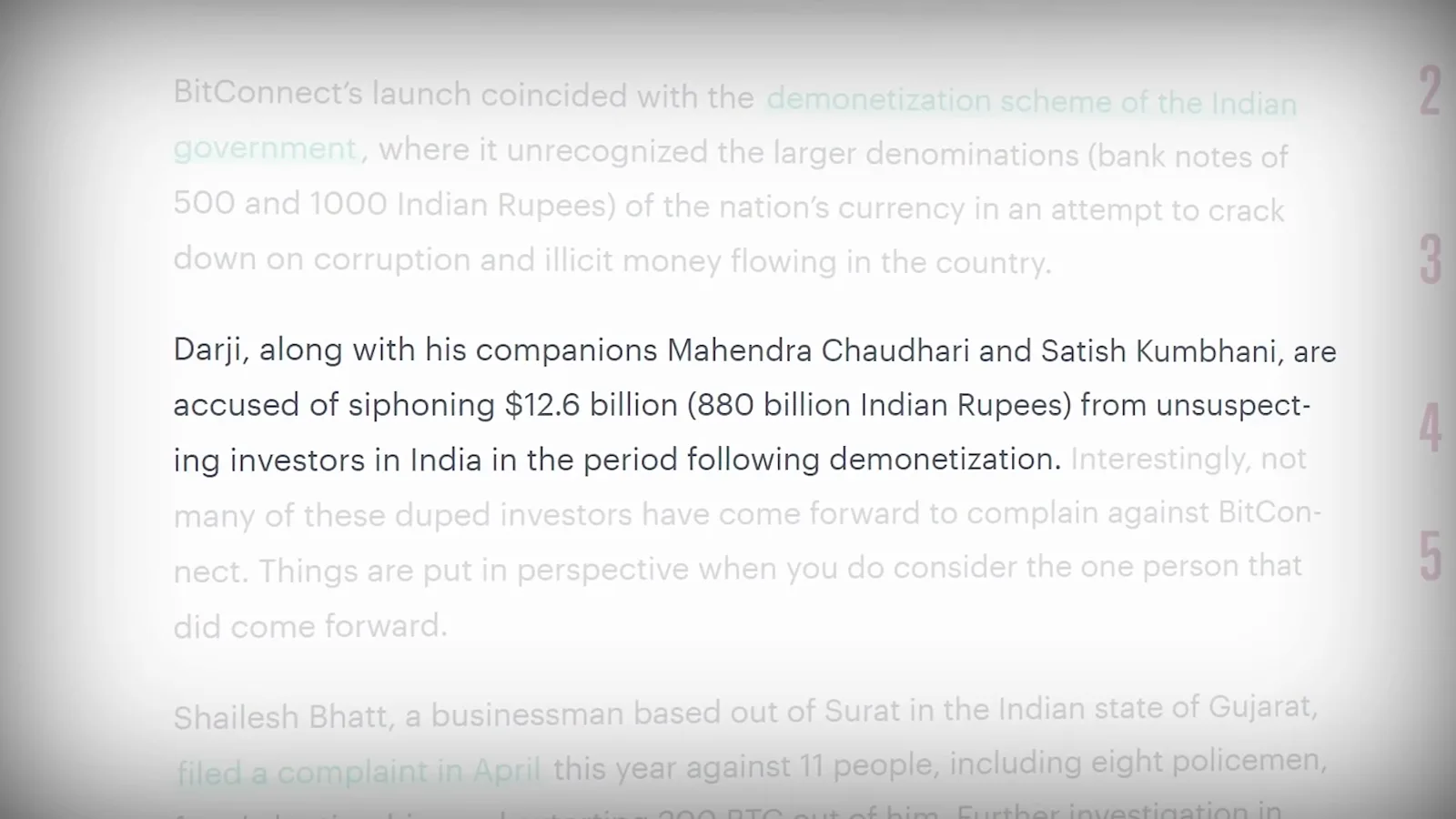
The India file: billions allegedly moved after demonetization.Watch at 22:16 - 15
The India angle: demonetization meets crypto mania
BitConnect's rise coincided with India's 2016 demonetization, which invalidated 500 and 1,000 rupee notes and left cash-heavy savers hunting for an exit. India's criminal investigation department concluded there was a direct connection between that unaccounted cash and BCC, whose local pitch promised 4% a day for recruiting new members — and suspected the token was created to launder black money.

In India, the same coin was pitched at 4% a day.Watch at 23:00 - 16
The promoters: subpoenas, FBI holds and a meme
The YouTube promoters who fueled the boom faced their own reckoning: Trevon James was reportedly subpoenaed to testify before the SEC, fellow promoter Kalyn Powell was detained by the FBI, and YouTube itself was named in the class action. Carlos Matos — whose "hey hey hey" chant became crypto's most famous meme — went quiet about cryptocurrency and resurfaced making weight-loss content.
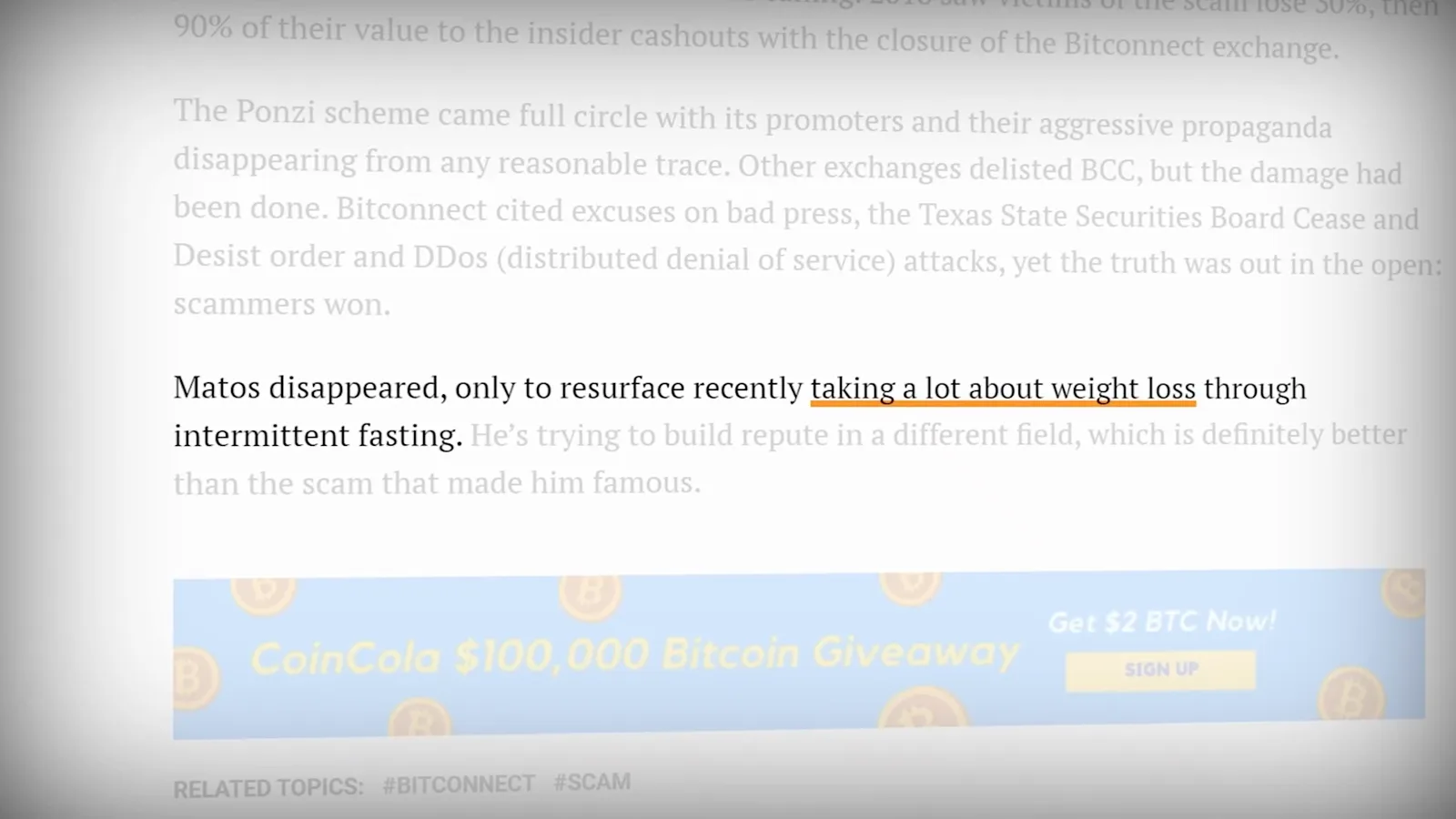
From meme legend to intermittent fasting influencer.Watch at 27:49
Frequently Asked Questions
What was BitConnect?
Was BitConnect a Ponzi scheme?
How much did people lose in the BitConnect collapse?
What happened to Carlos Matos?
Who founded BitConnect and where is he now?
Could BitConnect's returns have been real?
Continue the Story
The DAO Hack, Explained
Crypto's other landmark disaster: how an exploit drained tens of millions of ether and split Ethereum in two.
Mt. Gox Collapse: The Complete Timeline
The first great crypto collapse: 850,000 missing Bitcoin and a decade of repayments.
The ICO Boom
The mania that minted BitConnect — and thousands of tokens like it.
Bitcoin History: The Complete Guide
Put the BitConnect mania back into Bitcoin's full arc, from whitepaper to institutional adoption.
Bitcoin Milestones Timeline
The price and legitimacy inflection points — including the 2017 bubble BitConnect rode.
The Complete Blockchain Timeline
From the genesis block to the ICO era's cautionary tales, in one continuous timeline.